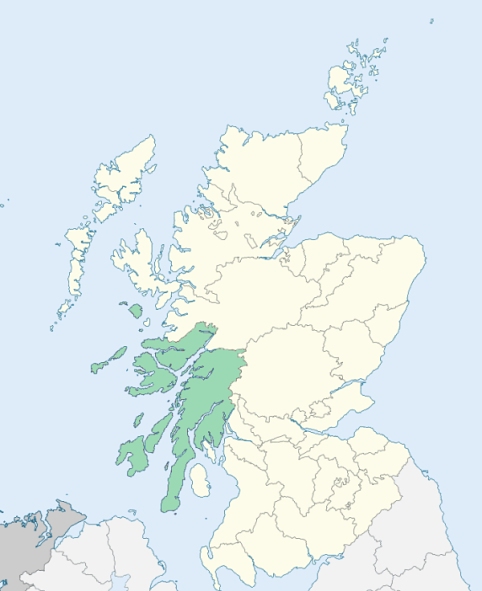
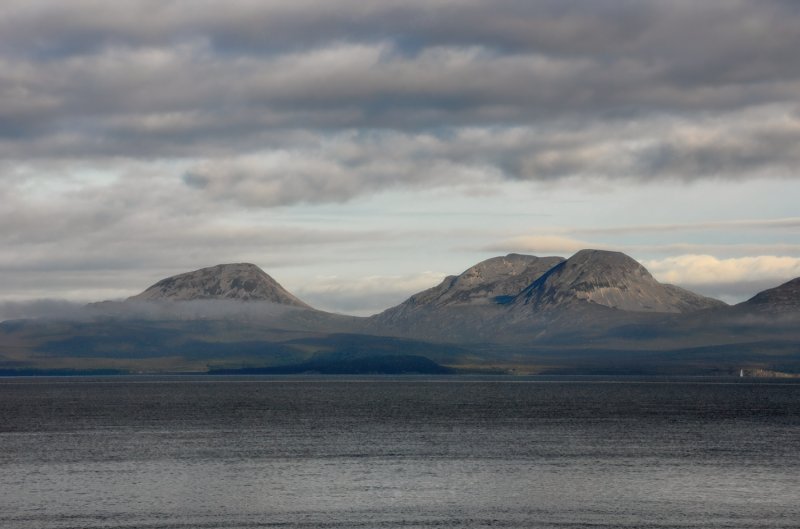
Jura and Colonsay is a parish in the Argyleshire Hebrides. It comprehends the islands of Jura, Colonsay, Oronsay, Scarba, Lunga, Balnahuagh, and Garvelloch. Colonsay is separated from Oronsay only by a narrow sound which is dry at low water, so that the two islands may be considered as one. They extend lengthwise nearly north and south, Colonsay on the north and Oronsay on the south. (1867: The Imperial Gazetteer of Scotland, by John Marius Wilson).
Gruinnard or Gruinart
Ardlussa
PRE-REFORMATION GOVERNANCE:
POST-REFORMATION GOVERNANCE:
Until modern times this parish was of vast extent, including also many islands of which nine were inhabited. Among these, besides Jura and Scarba, were Lunga, the Garvelach Isles, Colonsay, Oronsay, Gigha, and Cara. To get over the difficulty of working so wide a field, the Presbytery of Kintyre, on 27 October 1702, directed that "the minister shall preach six months and a half in Jura, and five and a half months at Colonsay, yearly." The parish of Gigha was taken off in 1726, and that of Colonsay in 1861.
Jura. The church of Jura at Kilearnadail was dedicated to St Kiaran. On Eileach Naomh, one of the Garvelach Isles, a monastery was founded by St Columba. At Kilmorlie, in Scarba, there was a chapel of St Mary. In Lunga were St Columba's Chapel and Holy Well. In Jura itself there were chapels of St Catan and St Mary.
Colonsay. The parish of Colonsay was disjoined quoad omnia from Jura on 27 February 1861. A Priory of St Oran was founded on the island of Colonsay in the time of St Columba. There were also of old in Colonsay, chapels of St Catan, St Kenneth, and St Mary. On the island of Oronsay there remain extensive ruins of the Augustinian Priory of St Columba, founded about 1350 by John, Lord of the Isles.
Includes ministers, licentiates, assistants, readers, and clerks.
Jura (QO)
Colonsay (QO)
(1928: Fasti Ecclesiæ Scoticanæ, by Hew Scott, D. D.)
Parish registers turned over to the Registrar-General, as a result of the Registration of Births, Deaths, and Marriages (Scotland) Act of 1854. The letters B. D. and M. indicate Births (or Baptisms), Deaths (or Burials), and Marriages (or Proclamations of Banns) respectively. Numbers indicate separate volumes or books. Note: These records are by no means complete or without damage; consult the Detailed List of the Old Parochial Registers of Scotland (1872) to learn more about the condition of the records.
| OPR and RD Numbers | |||
|---|---|---|---|
| Date Range | Name | Number | Type |
| 1704-1854 | Jura and Colonsay | 539 | OPR |
| 1855-1969 | Jura | 539-1 | RD |
| 1855-1969 | Colonsay and Oronsay | 539-2 | RD |
| 1970-1971 | Colonsay and Oronsay | 539 | RD |
| 1970-1971 | Jura | 541 | RD |
| 1972-2006 | Jura | 544 | RD |
| 1972-2006 | Colonsay and Oronsay | 545 | RD |
| 2007-2008 | Jura, Argyll and Bute | 544 | RD |
| 2007-2008 | Colonsay and Oronsay, Argyll and Bute | 545 | RD |
| 2009 | Argyll and Bute, Jura | 544 | RD |
| 2009 | Argyll and Bute, Colonsay and Oronsay | 545 | RD |
| 2026 | (Jura) Argyll and Bute Council; Jura Community Council | ||
| 2026 | (Colonsay) Argyll and Bute Council; Colonsay Community Council | ||
| 2026 | (Oronsay) Argyll and Bute Council; Colonsay Community Council | ||
(2009: Parishes and Registration Districts of Scotland - Old and New, National Records of Scotland)
Local community councils (2026) are provided as a potential source of additional information for settlements within the original boundaries of the parish. (Source)
Statistics from informal and official censuses
Jura: Black, Buie, Campbell, Clarke, Darroch, Edgar, Ewing, Keith, Lindsay, Shaw
Colonsay & Oronsay: Black, Buie, Campbell, Griffin, Martin, Morrison, Munn, Reid, Smart, Weir
Note: Names appearing in research materials, other than censuses. Simple names (First name, surname only) have been omitted unless they appear associated with large properties. All women's names, and men's names with occupations, military ranks, or peerage titles are included.
By the Reverend Mr Francis Stewart.
"Jura. To ascertain the present population of this parish, a survey was made in June 1792. On the island of Jura there were 204 families, 929 souls of whom 458 were males, and 471 were females. Emigrations to America have proved, once and again, a drain to this island; but, in the present mode of management, it may be said to be still overstocked with inhabitants. Near half the farms in the island are in pasture, and require very few hands to manage them. Of course, the great body of the people live in the farms, which are in tillage. In some of these there are between 50 and 60 souls. The average number of souls to a farm in Jura is 38.
On the island of Scarba there are 2 farms, 14 families, 50 souls of whom 27 are males and 23 females. On the island of Lunga there is 1 farm, 6 families, 29 souls, of whom 13 are males, and 16 are females. On the island of Balnahuaigh there are 28 families, 132 souls, of whom 64 are males, and 69 females.
Colonsay and Oronsay. The population is 134 families, 718 souls, of whom 352 are males and 366 females. There are above 40 souls, at an average in each of the farms; but some of these being very small, not having above 3 or 4 families, the number of souls in the best inhabited farms is very great. A few emigrated from Colonsay to America summer 1792; but in summer 1791, a considerable proportion of the inhabitants crossed the Atlantic. Those who remain, give out that they are waiting only good accounts from their relations, and a proper opportunity of being transported to the other hemisphere.
Jura and Colonsay. The language universally spoken in the parish is Gaelic. Very few of the old people understand English. The inhabitants do not feel that strong desire of bettering their circumstances, that would stimulate them to exertion and enterprise. Instead of trying the effects of industry at home, they foster the notion of getting at once into a state of ease and opulence, with their relations beyond the Atlantic."
(This section contains excerpts, at times restructured or paraphrased, from an article appearing in Statistical Account of Scotland, Sir John Sinclair, 1791-1799)
Primary Sources:
Statistical Account of Scotland (1791-1799), Volume 12, p. 317
New Statistical Account of Scotland (1834-1845), Volume 7, Section II, p. 534
See Parish Page Sources for all source information and links.