Innis Eoghain (Insh)
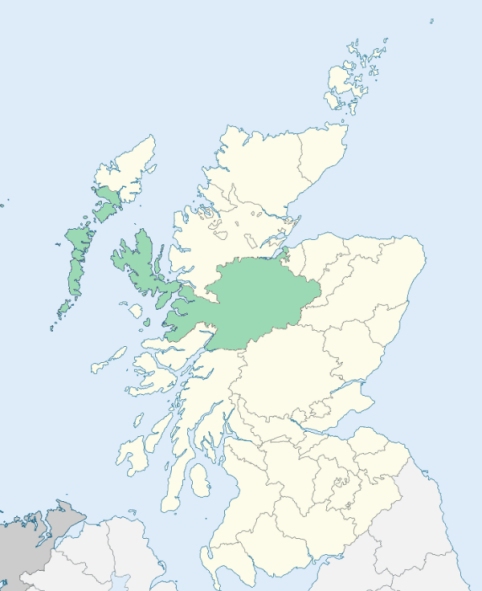
Kingussie is a parish in the district of Badenoch, Inverness-shire. It is bounded on the south by Perthshire, and on other sides by the parishes of Laggan, Moy and Dalarossie, and Alvie. (1867: The Imperial Gazetteer of Scotland, by John Marius Wilson).
Clune, Dalwhinnie, Drumguish, Feshie Bridge, Glenbanchor, Insh, Kingussie, Newtonmore, Ralia, Ruthven, Strone
The parish of Kingussie & Inch had a detached part containing 2,133 acres, and surrounded by the parish of Laggan. This detached part has been transferred to the parish of Laggan. See affected properties and landholders. (1892: Boundary of counties and parishes in Scotland as settled by the Boundary Commissioners under the Local Government Act, 1889, by Hay Shennan)
PRE-REFORMATION GOVERNANCE:
POST-REFORMATION GOVERNANCE:
The parishes of Kingussie and Innis Eoghain were united about 1580.
Kingussie. Kingussie was a prebend of the Cathedral of Elgin. Its church was dedicated to St Columba. From an early time there was at Kingussie a Celtic monastery of St Columba, said to have been founded by the saint himself. In 1490 George, second Earl of Huntly, founded it anew as a medieval priory. There was a chapel of St Bride within the bounds at Benchar, and two others at Invertromie and Nuide. The Feille Challumchille, a great fair of St Columba, was held at Kingussie at Midsummer. There is a mission chapel at Newtonmore in the parish.
Insh, or Innis Eoghain. The church of this parish was dedicated to St Adamnan. In or about 1830 a Parliamentary charge was made at Insh. On 18 January 1869 the parish of Insh was again disjoined quoad sacra from Kingussie.
Includes ministers, licentiates, assistants, readers, and clerks.
Kingussie (QO)
Insh, or Innis Eoghain (QO)
(1928: Fasti Ecclesiæ Scoticanæ, by Hew Scott, D. D.)
Parish registers turned over to the Registrar-General, as a result of the Registration of Births, Deaths, and Marriages (Scotland) Act of 1854. The letters B. D. and M. indicate Births (or Baptisms), Deaths (or Burials), and Marriages (or Proclamations of Banns) respectively. Numbers indicate separate volumes or books. Note: These records are by no means complete or without damage; consult the Detailed List of the Old Parochial Registers of Scotland (1872) to learn more about the condition of the records.
| OPR and RD Numbers | |||
|---|---|---|---|
| Date Range | Name | Number | Type |
| 1724-1854 | Kingussie and Insh | 102 | OPR |
| 1855-1947 | Kingussie and Insh | 102 | RD |
| 1948-1970 | Kingussie and Laggan | 102 | RD |
| 1971-1971 | Kingussie | 102 | RD |
| 1972-2006 | Kingussie | 234 | RD |
| 2009 | Highland, Kingussie | 234 | RD |
| 2026 | (Kingussie) Highland Council; Kingussie and Vicinity Community Council | ||
| 2026 | (Insh) Highland Council; Kincraig and Vicinity Community Council | ||
| 2026 | (Laggan) Highland Council; Laggan Community Council | ||
(2009: Parishes and Registration Districts of Scotland - Old and New, National Records of Scotland)
Local community councils (2026) are provided as a potential source of additional information for settlements within the original boundaries of the parish. (Source)
Statistics from informal and official censuses
Bell, Cameron, Campbell, Cattanach, Fraser, Grant, Kennedy, MacPherson, Ross, Stewart
Note: Names appearing in research materials, other than censuses. Simple names (First name, surname only) have been omitted unless they appear associated with large properties. All women's names, and men's names with occupations, military ranks, or peerage titles are included.
By the Reverend Mr John Anderson.
"The number of inhabitants ascertained by a late survey, amounts to 1803. Of these there are males above ten years of age 645, females 693, – children of both sexes under ten years of age, 645. The inhabitants consist of six heritors, three of whom are resident; several officers retired on half-pay, from the army and navy; and the remainder almost wholly of husbandmen and cottagers; excepting smiths and weavers, there are few mechanics of any kind.
There is no village either in the parish, or in the whole district. This inconvenience is severely felt. Not only the luxuries, but even many of the common necessaries of life, must be sent for to the distance of more than forty miles. Tradesmen have no fixed place of residence where they can be resorted to. There is no centre for the little traffic, or barter, requisite to be carried on in an inland country. The wool that could have been manufactured in the place, must be sent by a long land carriage to buyers invited from another kingdom.
From the foregoing circumstances, the poverty of the inhabitants may be inferred as an unavoidable consequence. An aversion to labour, combining with local disadvantages, and feudal oppression, cannot fail to render a peasantry poor, dispirited, and comfortless. To say the truth, the wretched appearance of numbers of them, is sufficient proof of the hardships they endure.
Like most of the natives of the Highlands, they are brave, hospitable, and polite. Their vices may be said to be grafted on their virtues. They are quarrelsome, addicted to drunkenness, and little to be depended on for the sincerity of their professions. The Gaelic language is most frequently spoken, though the English is tolerably well understood by many of them. They have preserved but few traditions of their civil history; and these are scarcely worth the trouble of recording."
(This section contains excerpts, at times restructured or paraphrased, from an article appearing in Statistical Account of Scotland, Sir John Sinclair, 1791-1799)
Primary Sources:
Statistical Account of Scotland (1791-1799), Volume 3, p. 34
New Statistical Account of Scotland (1834-1845), Volume 14, Section I, p. 63
See Parish Page Sources for all source information and links.