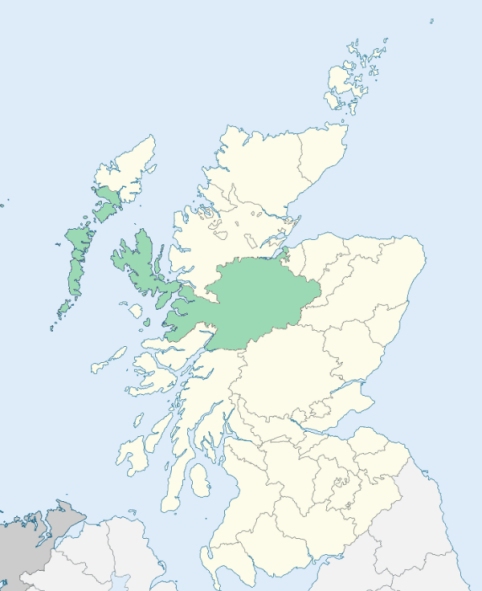
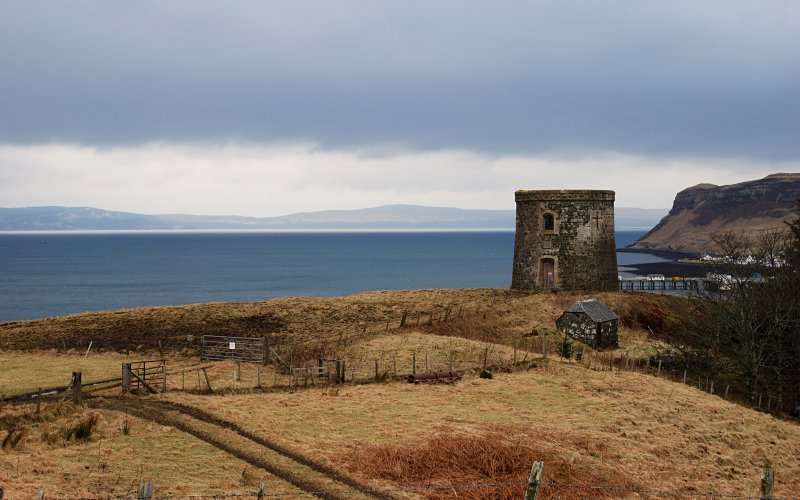
Kilmuir is a parish comprehending the northern extremity of the island of Skye, together with the islets Iaskir, Altavig, Fladda, Fladdachuain, Tulm, and Trodda, in Inverness-shire. It is bounded on the south by Snizort, and on all other sides by the sea. (1867: The Imperial Gazetteer of Scotland, by John Marius Wilson).
Aird, Balgown, Balmacqueen or Balmaqueen, Bornesketaig or Borniskittag, Camismore, Culnaknock, Digg, Duntulm, Elishader, Flodigarry, Garafad, Heribusta, Hungladder, Kilmaluag, Kilmuir, Kilvaxter, Lealt, Linicro, Lonfearn, Marishader, Mugstad or Monkstadt, Staffin or Steinscholl, Totscore, Valtos
PRE-REFORMATION GOVERNANCE:
POST-REFORMATION GOVERNANCE:
The old church of this parish was dedicated to St Luag. In or near 1600 the parish church was taken from Kilmaluaig to Kilmuir, where it replaced an ancient chapel. Within the bounds are the remains of two small monastic houses. One of these was at Monkstad, prevously called Mugstad. The other was St Columba's Monastery of Kilcholmkill. It was built on an island in Loch Cholmkill, a sheet of water now drained away. There were a number of chapels in this parish, including that of St Mary at Kilmuir, one of St Bride, and two dedicated to St Columba, one of them on the island of Troda, and the other standing on the more distant island of Fladda Chuain.
Disjoined Quoad Sacra Parishes:
Stenscholl, previously Kilmartin. The old parish church was dedicated to St Martin. In the sixteenth century the parishes of Stenscholl and Kilmaluag, now called Kilmuir, were united. A parliamentary church was erected here in 1828, and the district comprising the old parish of Kilmartin was constituted a quoad sacra parish by the General Assembly on 25 May 1833. The parish was disjoined from Kilmuir by the Court of Teinds, 14 July 1847.
Includes ministers, licentiates, assistants, readers, and clerks.
Kilmuir (QO)
Stenscholl, or Kilmartin (QO)
(1928: Fasti Ecclesiæ Scoticanæ, by Hew Scott, D. D.)
Parish registers turned over to the Registrar-General, as a result of the Registration of Births, Deaths, and Marriages (Scotland) Act of 1854. The letters B. D. and M. indicate Births (or Baptisms), Deaths (or Burials), and Marriages (or Proclamations of Banns) respectively. Numbers indicate separate volumes or books. Note: These records are by no means complete or without damage; consult the Detailed List of the Old Parochial Registers of Scotland (1872) to learn more about the condition of the records.
| OPR and RD Numbers | |||
|---|---|---|---|
| Date Range | Name | Number | Type |
| 1823-1854 | Kilmuir | 112 | OPR |
| 1855-1970 | Kilmuir | 112-1 | RD |
| 1855-1970 | Stenscholl | 112-2 | RD |
| 2009 | Highland Council | 255 | RD |
| 2026 | (Kilmuir) Highland Council; Kilmuir and Logie Easter Community Council | ||
| 2026 | (Stenscholl) Highland Council; Staffin Community Council | ||
(2009: Parishes and Registration Districts of Scotland - Old and New, National Records of Scotland)
Local community councils (2026) are provided as a potential source of additional information for settlements within the original boundaries of the parish. (Source)
Statistics from informal and official censuses
Campbell, Lamont, MacDonald, Mackenzie, MacLean, MacLeod, Matheson, Nicolson, Ross, Stewart
Note: Names appearing in research materials, other than censuses. Simple names (First name, surname only) have been omitted unless they appear associated with large properties. All women's names, and men's names with occupations, military ranks, or peerage titles are included.
By the Reverend Mr Donald Martin.
"The amount of the population now is 2065. The number of males is 999; of females 1066. All reside in the country. Both men and women frequently live to the age of 80. There are some men above 90; very few reach 100. The people are mostly employed in husbandry. There are also some handicraftsmen; but there is so little work for them, that they live poorly when they happen to have no land.
About 20 years ago, some families emigrated from this parish to America, but none since. The revolution in that country, has sent home to us lately, a few of our friends. The parish affords sufficient employment for all the inhabitants; but many of the young men, notwithstanding, to the great detriment of this part of the country, go to the south of Scotland, to earn higher wages.
The people of this country, and indeed of all the Western Highlands, have signalized themselves, in the last, and in the former wars, by their valour, and their ability in bearing every species of hardship and fatigue. They are possessed of vivacity and penetration in a high degree. Their general size is from 5 feet 8 inches to 6 feet. There are no manufactures, but of such coarse cloths and linens, as the country people wear. The inhabitants are very economical, industrious, and humane. In the seafaring line, they are not particularly active. There is a small boat or two, in every farm on the coast, for the purpose of fishing; but they are seldom launched. Crimes are rarely committed."
(This section contains excerpts, at times restructured or paraphrased, from an article appearing in Statistical Account of Scotland, Sir John Sinclair, 1791-1799)
Primary Sources:
Statistical Account of Scotland (1791-1799), Volume 2, p. 547
New Statistical Account of Scotland (1834-1845), Volume 14, Section I, p. 237
See Parish Page Sources for all source information and links.