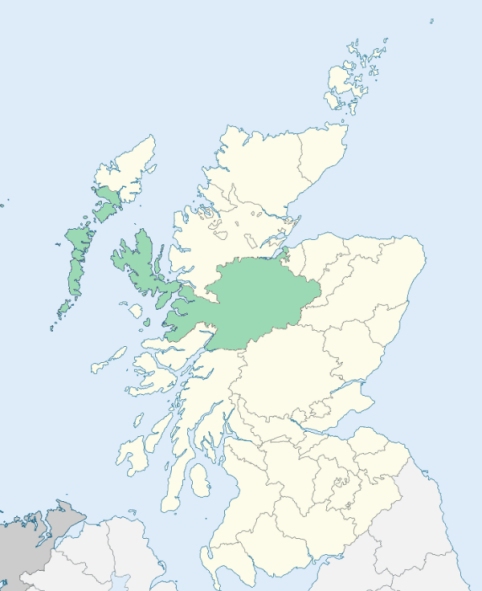
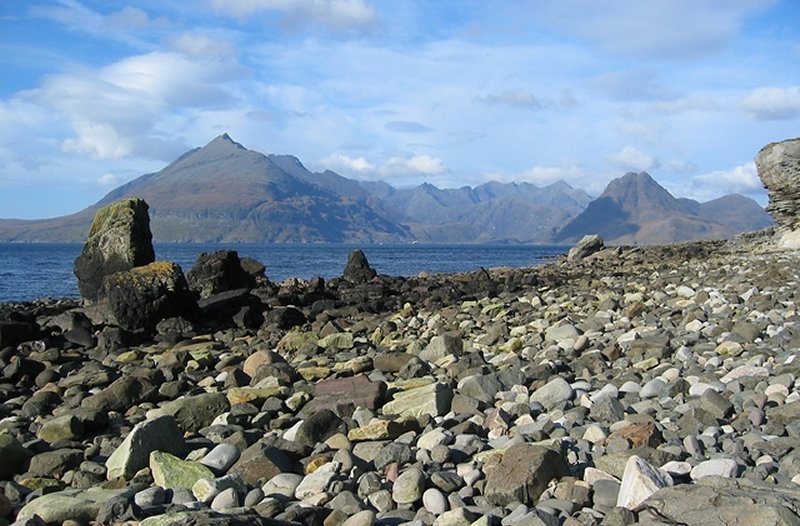
Strath is a parish in the Skye division of Inverness-shire. It comprises the islands of Scalpa, Pabba, and Longa, and part of the south-east district of the island of Skye. It is bounded partly on the west by Bracadale, partly on the east by Sleat, and everywhere else by the sea. (1867: The Imperial Gazetteer of Scotland, by John Marius Wilson).
Boreraig, Breakish, Broadford, Camasunary, Corry, Harrapool, Kilchrist, Kyle-Akin or Kyleakin, Luib, Skulamus, Strathaird, Suisnish, Torrin, Waterloo
The parish of Sleat had a detached part containing 7,186 acres, and situated at Kylerhea. This detached part was separated from the main portion of the parish by part of the parish of Strath. An exchange of territory was effected between the two parishes. The northern portion of the detached part of Sleat was given to Strath, while at the same time a portion of Strath was given to Sleat, so as to connect the remainder of the detached part of Sleat with the main portion of the parish. See affected properties and landholders. (1892: Boundary of counties and parishes in Scotland as settled by the Boundary Commissioners under the Local Government Act, 1889, by Hay Shennan)
PRE-REFORMATION GOVERNANCE:
POST-REFORMATION GOVERNANCE:
In earlier times this parish was called Strathswordale, and often Strath Mhic Fiònghainn ("MacKinnon's Valley"). This latter name it got from the Chief of the Clan Fiongan, to whom most of its area belonged. For the last 150 years it has been usual to style it Strath. The parish church stood of old at Cill Chriosd, and was dedicated to Christ. Within the bounds stood various chapels. These included St Coan's at Boreaig, St Malrubh's near the ferry at Cill Aiseag, St Bride's at Cill Bhride, St Mary's at Cill Mhàiri, St Francis' at Teampul Fhrangaig in the island of Scalpa, and the chapel on the island of Pabbay. There were also three holy Wells, St Coan's at Boreraig, St Clement's at Tobar Chleamain, and St Malrubh's at Cill Aiseag. There are mission chapels at Kyleakin, Breakish, Strathaird, Dunan, and Elgoll.
Includes ministers, licentiates, assistants, readers, and clerks.
(1928: Fasti Ecclesiæ Scoticanæ, by Hew Scott, D. D.)
Parish registers turned over to the Registrar-General, as a result of the Registration of Births, Deaths, and Marriages (Scotland) Act of 1854. The letters B. D. and M. indicate Births (or Baptisms), Deaths (or Burials), and Marriages (or Proclamations of Banns) respectively. Numbers indicate separate volumes or books. Note: These records are by no means complete or without damage; consult the Detailed List of the Old Parochial Registers of Scotland (1872) to learn more about the condition of the records.
| OPR and RD Numbers | |||
|---|---|---|---|
| Date Range | Name | Number | Type |
| 1815-1854 | Strath | 119 | OPR |
| 1855-1970 | Strath | 119 | RD |
| 1971-1971 | Broadford | 119 | RD |
| 1972-2006 | Broadford | 259 | RD |
| 2009 | Highland, Broadford | 259 | RD |
| 2026 | Highland Council; Broadford and Strath Community Council | ||
(2009: Parishes and Registration Districts of Scotland - Old and New, National Records of Scotland)
Local community councils (2026) are provided as a potential source of additional information for settlements within the original boundaries of the parish. (Source)
Statistics from informal and official censuses
Campbell, Finlayson, Fletcher, Grant, MacKinnon, Matheson, Munro, Nicolson, Robertson, Ross
Note: Names appearing in research materials, other than censuses. Simple names (First name, surname only) have been omitted unless they appear associated with large properties. All women's names, and men's names with occupations, military ranks, or peerage titles are included.
By Mr Thomas Fraser, of the Inverness Academy.
"Ten years ago the list of examinable persons contained upwards of 1200; none included under 9 years of age. The present population, according to a list made out in June 1794, is 1579 souls. There are here no extraordinary instances of longevity, but there are a few now living between 80 and 90 years of age. There is no tradesman here that confines himself solely to his trade, but is occasionally a farmer, fisherman, weaver, tailor, shoemaker, or carpenter, &c.
The people in general are of the middle size. In a tolerable degree they enjoy the comforts of life. Their dress, diet, and lodging, however, stand still in need of amendment. It is the general opinion, that their condition would be ameliorated if they had longer leases, and greater encouragement for improvements. They much regret that their proprietors stay too short time among them, to obtain a full and true account of the real state of the people. The inhabitants, for want of a sufficient capital, are unable to prosecute the fishing to any extent. But if the proprietors would take the fish and black cattle in payment of the rents, or even procure good markets for both, it would undoubtedly spur on the tenants to industry. In 1837 about 200 emigrated to Australia."
(This section contains excerpts, at times restructured or paraphrased, from an article appearing in Statistical Account of Scotland, Sir John Sinclair, 1791-1799)
Primary Sources:
Statistical Account of Scotland (1791-1799), Volume 16, p. 222
New Statistical Account of Scotland (1834-1845), Volume 14, Section I, p. 300
See Parish Page Sources for all source information and links.