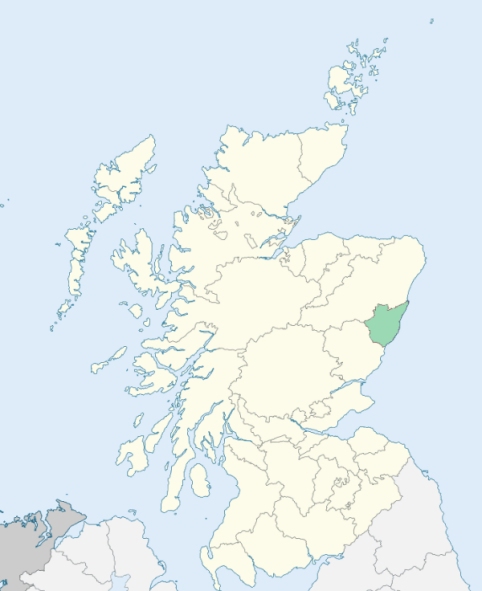
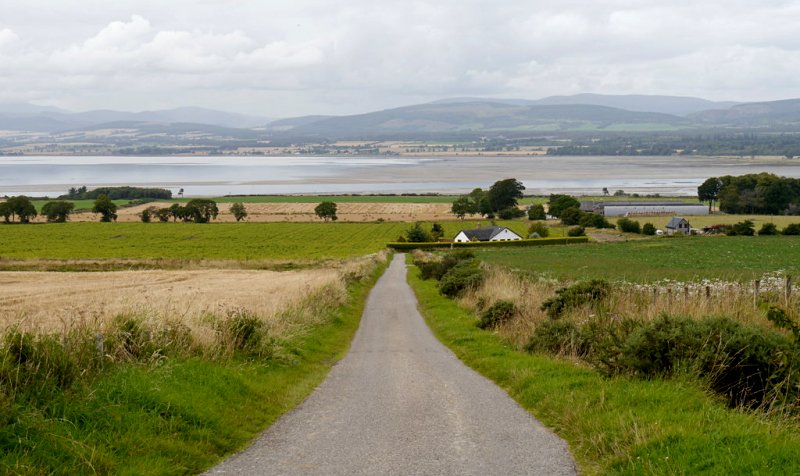
Nigg is a parish in the extreme north-east of Kincardineshire. Its north end is separated only by the River Dee from the city of Aberdeen. It is bounded by the parish of Banchory Devenick, by the county of Aberdeen, and by the German Ocean (North Sea.) (1867: The Imperial Gazetteer of Scotland, by John Marius Wilson).
Altens, Burnbank, Charleston, Cove, Torry
PRE-REFORMATION GOVERNANCE:
POST-REFORMATION GOVERNANCE:
The ancient church of Nigg was dedicated to St Fiachra. It belonged to the Abbey of Arbroath. Near the old church is St Fiachra's Well.
Disjoined Quoad Sacra Parishes:
St Fittick's. In old times travelers leaving Aberdeen for the south crossed the Dee from Futtie to Torry by St Fittick's Ferry. This place gets its name from St Futach, whom the tradition of the country honours as an early Pictish missionary. Toward the end of the nineteenth century Torry became part of the City of Aberdeen, and a mission chapel was planted there. The parish of St Fittick was disjoined from Nigg on 17 December 1915.
Includes ministers, licentiates, assistants, readers, and clerks.
Nigg (QO)
St Fittick's (QS)
(1928: Fasti Ecclesiæ Scoticanæ, by Hew Scott, D. D.)
Parish registers turned over to the Registrar-General, as a result of the Registration of Births, Deaths, and Marriages (Scotland) Act of 1854. The letters B. D. and M. indicate Births (or Baptisms), Deaths (or Burials), and Marriages (or Proclamations of Banns) respectively. Numbers indicate separate volumes or books. Note: These records are by no means complete or without damage; consult the Detailed List of the Old Parochial Registers of Scotland (1872) to learn more about the condition of the records.
| OPR and RD Numbers | |||
|---|---|---|---|
| Date Range | Name | Number | Type |
| 1675-1854 | Nigg | 266 | OPR |
| 1855-1931 | Nigg | 266 | RD |
| 1932-1970 | Nigg and Banchory Devenick | 266 | RD |
| 1971-1975 | Nigg and Banchory Devenick | 341 | RD |
| 2009 | Aberdeen City | 300 | RD |
| 2026 | (Nigg) Aberdeen City Council; Nigg Community Council | ||
| 2026 | (Banchory Devenick) Aberdeenshire Council; Banchory Community Council | ||
(2009: Parishes and Registration Districts of Scotland - Old and New, National Records of Scotland)
Local community councils (2026) are provided as a potential source of additional information for settlements within the original boundaries of the parish. (Source)
Statistics from informal and official censuses
Allan, Craig, Duncan, Forbes, Leiper, Main, Robertson, Walker, Webster, Wood
Note: Names appearing in research materials, other than censuses. Simple names (First name, surname only) have been omitted unless they appear associated with large properties. All women's names, and men's names with occupations, military ranks, or peerage titles are included.
By the Reverend Mr David Cruden.
"In 1791, there were 1090 souls in 265 houses, 497 males and 593 females. There are 47 land families, with 405 children, and 42 fisher families with 314 children. There are 12 cottagers, 9 overseers and cottar servants, 51 male servants, 51 female servants, 23 salmon fishers, 83 sea-fishers, 47 labourers, 17 quarriers, 2 masons, 3 dykers, 3 butchers, 2 or 3 shopkeepers, 3 tailors, 4 blacksmiths, 2 shoe and harness-makers, 3 carpenters, 4 seamen, 2 ferrymen, 2 custom-house officers, 1 cart-wright, 1 house carpenter, and 1 miller.
Among the land people, there has been a great migration, mostly down the country towards the coasts; very little among the fishers. No land man becomes a fisher. From this place, some go to learn handicrafts, to manufactures, and abroad. Since 1778, 70 have been, for a longer or shorter time, sailors; 44 have served in the fleet. Several natives have applied to ship-building and commerce, with spirit and success. None attach themselves to studious engagements.
The people, on the whole, are not defective in understanding, and are very industrious. They are decent, content with their lot, sober, and charitable: It were to be wished that their impressions of religion were deeper. No crime, of a heinous nature, has been committed in the memory of any living. Among the fishers, a strife of words may be at a time, which is soon laid; they are ready to seize any thing in the sea, whose owner is not ascertained, not to plunder the wreck; but of taking a mussel from the sea-bed of another, or keeping back a penny of the common fish, a suspicion was never heard. They are not destitute of the spirit of adventure and sympathy."
(This section contains excerpts, at times restructured or paraphrased, from an article appearing in Statistical Account of Scotland, Sir John Sinclair, 1791-1799)
Primary Sources:
Statistical Account of Scotland (1791-1799), Volume 7, p. 194
New Statistical Account of Scotland (1834-1845), Volume 11, Section II, p. 195
See Parish Page Sources for all source information and links.