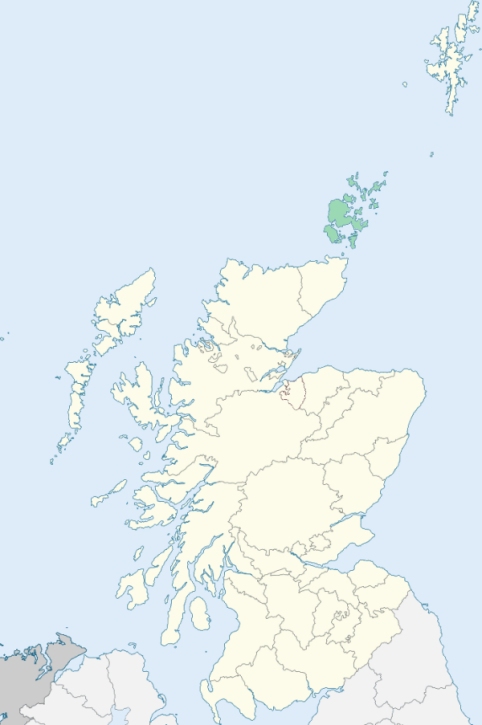
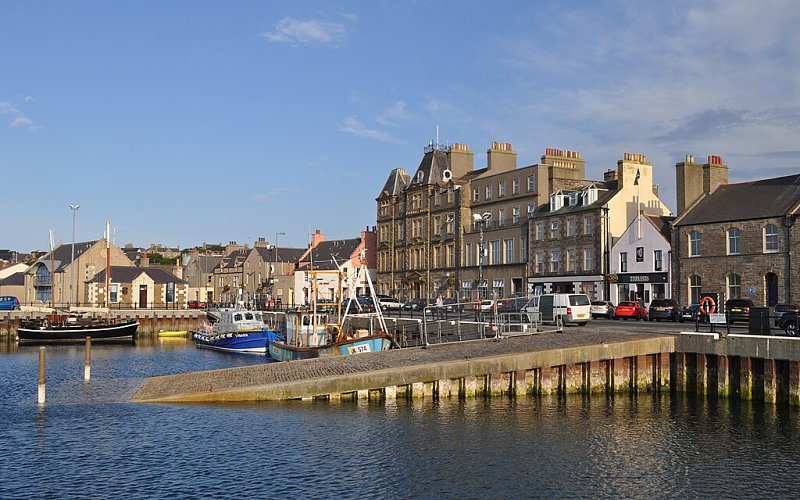
Kirkwall and St Ola is a parish in the mainland of Orkney. It extends across the isthmus of the eastern peninsula of the mainland, so as to be bounded both on the north and on the south by the sea, and it is bounded on the west by the parishes of Firth and Orphir, and on the east by the parishes of St Andrews and Holm. (1867: The Imperial Gazetteer of Scotland, by John Marius Wilson).
Honton, Kirkwall, Pickaquoy
PRE-REFORMATION GOVERNANCE:
POST-REFORMATION GOVERNANCE:
Kirkwall. The great church of St Magnus, now belonging to this parish, was of old the Cathedral of the diocese of Orkney. St Olaf's was then the parish church of Kirkwall. Some years after 1560, a second parish called St Magnus' was set up, having the Cathedral church for its place of worship. The parochial district assigned to it took in nearly all the royal burgh, but included a mere fraction of the large landward area. Kirkwall had thus two parishes, St Magnus' for the town, and St Olaf's to be used by the rural people. Before the end of the sixteenth century the parishes of St Magnus and St Olaf were again joined, with the Cathedral as their parish church. The building of the Cathedral church at Kirkwall was begun in 1137. At Pickaquoy, within the burgh of Kirkwall, there was a chapel of St Duthac. Fairs were held in the town on St Magnus' Day, Palm Sunday, Lammas, and Martinmas.
St Ola. This was the original parish church of Kirkwall. Its church was dedicated to St Olaf the King, Patron Saint of Norway. St Olaf's was a prebend of Kirkwall Cathedral.
Includes ministers, licentiates, assistants, readers, and clerks.
(1928: Fasti Ecclesiæ Scoticanæ, by Hew Scott, D. D.)
Parish registers turned over to the Registrar-General, as a result of the Registration of Births, Deaths, and Marriages (Scotland) Act of 1854. The letters B. D. and M. indicate Births (or Baptisms), Deaths (or Burials), and Marriages (or Proclamations of Banns) respectively. Numbers indicate separate volumes or books. Note: These records are by no means complete or without damage; consult the Detailed List of the Old Parochial Registers of Scotland (1872) to learn more about the condition of the records.
| OPR and RD Numbers | |||
|---|---|---|---|
| Date Range | Name | Number | Type |
| 1657-1854 | Kirkwall and St Ola | 21 | OPR |
| 1855-1856 | Kirkwall and St Ola Burgh | 21-1 | RD |
| 1855-1856 | Kirkwall and St Ola Landward | 21-2 | RD |
| 1857-1971 | Kirkwall and St Ola | 21 | RD |
| 1972-2003 | Kirkwall | 144 | RD |
| 2009 | Orkney Islands, Kirkwall | 144 | RD |
| 2026 | Orkney Islands Council; Kirkwall and St Ola Community Council | ||
(2009: Parishes and Registration Districts of Scotland - Old and New, National Records of Scotland)
Local community councils (2026) are provided as a potential source of additional information for settlements within the original boundaries of the parish. (Source)
Statistics from informal and official censuses
Leslie, Miller, Muir, Scott, Shearer, Sinclair, Slett, Smith, Thomson, Wilson
Note: Names appearing in research materials, other than censuses. Simple names (First name, surname only) have been omitted unless they appear associated with large properties. All women's names, and men's names with occupations, military ranks, or peerage titles are included.
By the Reverend Mr George Barry.
"Though the country parish be small, it contains a considerable number of farmers. This is owing to the narrow limits of their possessions. They amount to 50, exclusive of cottars or cottagers. Their families consist of about 10 persons each, and this number includes their children, who when they are grown up, whether they be male or female, remain with their parents in the capacity of servants.
In the town the tradesmen are pretty numerous. The master weavers are 53, their journeymen 8, and their apprentices 14. The shoemakers amount to masters 16, journeymen 2, and apprentices 17. The tailors are masters 15, no journeymen, apprentices 11. The hammermen, which include several crafts, are master wrights 22, with only 1 journeyman, and 29 apprentices; master masons 7, journeymen 16, and apprentices 6; master slaters 6, no journeymen, and only 2 apprentices; the smiths have 4 masters, 1 journeyman, and 4 apprentices; and there are only 3 coopers, and all of them masters. The number of sailors that live here varies according to circumstances. In time of war there are very few; peace brings home many of them; at present there are about 200, and above 25 boatmen. To the hurt of this country, and perhaps of the kingdom at large, there are here no fishers by profession."
(This section contains excerpts, at times restructured or paraphrased, from an article appearing in Statistical Account of Scotland, Sir John Sinclair, 1791-1799)
Primary Sources:
Statistical Account of Scotland (1791-1799), Volume 7, p. 529
New Statistical Account of Scotland (1834-1845), Volume 15, Section III, p. 1
See Parish Page Sources for all source information and links.