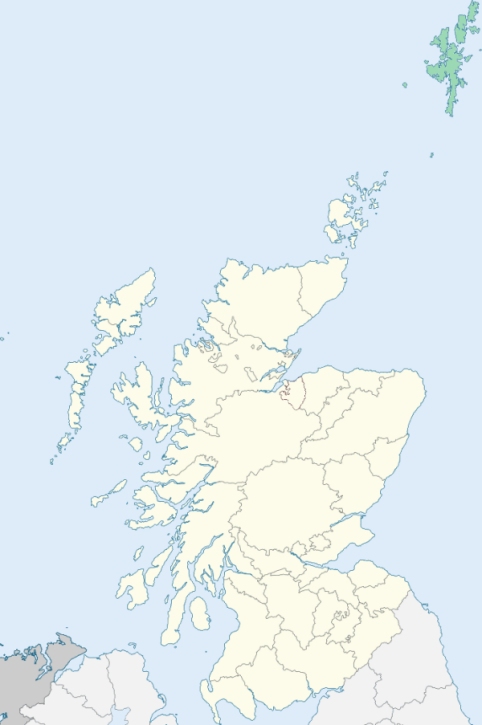
Nesting is a parish nearly in the middle of the eastern district of Shetland. It comprehends the ancient parishes of Nesting, Lunnasting (or Lunasting), and Whalsay, and a district of detached islands. Nesting and Lunnasting extend along the east coast of the mainland from Gletness to Lunnanness. Whalsay consists principally of the island of that name, lying nearly 3 miles east of the nearest part of Lunnasting, and the detached district of islands consists chiefly of the Out-Skerries, 5 miles northeast of Whalsay. (1867: The Imperial Gazetteer of Scotland, by John Marius Wilson).
Gletness, Isbister, Lunna or Lunna Nesting, Lunnanness, Symbister
PRE-REFORMATION GOVERNANCE:
POST-REFORMATION GOVERNANCE:
In the 16th century the parishes of Nesting, Lunnasting, and Whalsay were all united.
Nesting. The church was dedicated to St Ola. The present church was built in 1794.
Lunnasting. The church was dedicated to St Margaret. There is now a mission chapel at Lunna.
Whalsay and Skerries. The church of Whalsay was dedicated to the Holy Rood. On 15 July 1868 Whalsay was disjoined quoad sacra from Nesting and Lunnasting. There was within the bounds a chapel of St Nicholas at the Housay Skerries. There are now mission chapels at Isbister and the Whalsay Skerries.
Includes ministers, licentiates, assistants, readers, and clerks.
Nesting and Lunnasting (QO)
Whalsay and Skerries (QO)
(1928: Fasti Ecclesiæ Scoticanæ, by Hew Scott, D. D.)
Parish registers turned over to the Registrar-General, as a result of the Registration of Births, Deaths, and Marriages (Scotland) Act of 1854. The letters B. D. and M. indicate Births (or Baptisms), Deaths (or Burials), and Marriages (or Proclamations of Banns) respectively. Numbers indicate separate volumes or books. Note: These records are by no means complete or without damage; consult the Detailed List of the Old Parochial Registers of Scotland (1872) to learn more about the condition of the records.
| OPR and RD Numbers | |||
|---|---|---|---|
| Date Range | Name | Number | Type |
| 1783-1854 | Nesting and Lunnasting | 7 | OPR |
| 1787-1854 | Whalsay and Skerries | 7 | OPR |
| 1855-1971 | Nesting | 7-1 | RD |
| 1855-1971 | Lunnasting | 7-2 | RD |
| 1855-1892 | Whalsay and Skerries | 7-3 | RD |
| 1893-1971 | Whalsay | 7-3 | RD |
| 1972-2006 | Nesting | 107 | RD |
| 1972-2006 | Lunnasting | 106 | RD |
| 1972-2006 | Whalsay Skerries | 108 | RD |
| 1972-2006 | Whalsay | 109 | RD |
| 2009 | (Nesting) Shetland Islands, Nesting | 107 | RD |
| 2009 | (Lunnasting) Shetland Islands, Lunnasting | 106 | RD |
| 2009 | (Whalsay Skerries) Shetland Islands, Whalsay Skerries | 108 | RD |
| 2009 | (Whalsay) Shetland Islands, Whalsay | 109 | RD |
| 2026 | (Nesting and Lunnasting) Shetland Islands Council; Nesting and Lunnasting Community Council | ||
| 2026 | (Whalsay Skerries) Shetland Islands Council; Skerries Community Council | ||
| 2026 | (Whalsay) Shetland Islands Council; Whalsay Community Council | ||
(2009: Parishes and Registration Districts of Scotland - Old and New, National Records of Scotland)
Local community councils (2026) are provided as a potential source of additional information for settlements within the original boundaries of the parish. (Source)
Statistics from informal and official censuses
Anderson, Arthur, Hughson, Hunter, Irvine, Jameson, Leask, Robertson, Sutherland, Williamson
Note: Names appearing in research materials, other than censuses. Simple names (First name, surname only) have been omitted unless they appear associated with large properties. All women's names, and men's names with occupations, military ranks, or peerage titles are included.
By A Friend to Statistical Inquiries .
"This ministry contains a greater number of inhabitants, in proportion to the rental land, than any other in Shetland, owing to the exertions of the two principal heritors, Mr Bruce Steuart of Symbister, and Mr Hunter of Lunna, in making new settlements on grounds formerly uncultivated. These improvements have been attempted with the view of increasing the number of fishermen on their respective estates; but when the fishing fails, as it often does, these settlers on new grounds become burdens on the proprietor; and, without the assistance of their landmaster, must starve, when the small fishing fails for their support; for none of them have a possession of land, that, with the best cultivation, and in the most favourable years, can supply their families in meal, or any kind of grain, for nearly one half of the year."
(This section contains excerpts, at times restructured or paraphrased, from an article appearing in Statistical Account of Scotland, Sir John Sinclair, 1791-1799)
Primary Sources:
Statistical Account of Scotland (1791-1799), Volume 17, p. 498
New Statistical Account of Scotland (1834-1845), Volume 15, Section IV, p. 53
See Parish Page Sources for all source information and links.