Kemnay and Craigern
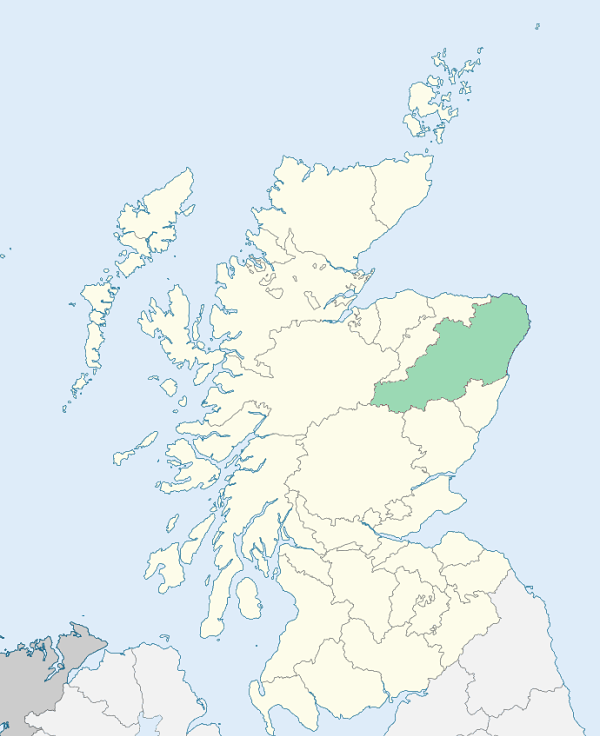
Kemnay is a parish in the Garioch district of Aberdeenshire. It is bounded by the parishes of Inverurie, Kintore, Skene, Cluny, Monymusk, and Chapel of Garioch. (1867: The Imperial Gazetteer of Scotland, by John Marius Wilson).
Kemnay
PRE-REFORMATION GOVERNANCE:
POST-REFORMATION GOVERNANCE:
The parishes of Kemnay and Craigern were united about 1500.
Kemnay. The church of Kemnay was dedicated to St Anne. Kemnay was a vicarage belonging to the adjoining parsonage of Kinkell. The present church was built in 1844.
Craigern. The church of Craigern was dedicated to St Bride.
Includes ministers, licentiates, assistants, readers, and clerks.
(1928: Fasti Ecclesiæ Scoticanæ, by Hew Scott, D. D.)
Parish registers turned over to the Registrar-General, as a result of the Registration of Births, Deaths, and Marriages (Scotland) Act of 1854. The letters B. D. and M. indicate Births (or Baptisms), Deaths (or Burials), and Marriages (or Proclamations of Banns) respectively. Numbers indicate separate volumes or books. Note: These records are by no means complete or without damage; consult the Detailed List of the Old Parochial Registers of Scotland (1872) to learn more about the condition of the records.
| OPR and RD Numbers | |||
|---|---|---|---|
| Date Range | Name | Number | Type |
| 1660-1854 | Kemnay | 207 | OPR |
| 1855-1967 | Kemnay | 207 | RD |
| 2009 | Aberdeenshire, Inverurie | 319 | RD |
| 2026 | Aberdeenshire Council; Kemnay Community Council | ||
(2009: Parishes and Registration Districts of Scotland - Old and New, National Records of Scotland)
Local community councils (2026) are provided as a potential source of additional information for settlements within the original boundaries of the parish. (Source)
Statistics from informal and official censuses
Clark, Davidson, Duncan, Emslie, Milne, Reid, Robertson, Smith, Walker, Webster
Note: Names appearing in research materials, other than censuses. Simple names (First name, surname only) have been omitted unless they appear associated with large properties. All women's names, and men's names with occupations, military ranks, or peerage titles are included.
By the Reverend Mr John Menzies.
"At the present time the whole number of inhabitants is 611, of whom there are 150 under 10 years of age, 104 from 10 to 20, 3 from 80 to 90, and 2 above 90. There are few widowers; but there is a considerable number of widows; only one old bachelor, who is a housekeeper, but a good many unmarried women, who are pretty far advanced in life. The number of females exceeds that of the males by 92.
There are 4 weavers, 3 tailors, 1 blacksmith, 3 shoemakers, 2 joiners, and 1 cart-wright. None of these manufacture articles for sale, but work for the inhabitants of the parish and neighbourhood. There are also 2 grocers, one of whom is a distiller. All the rest, except the principal landholder, his family and domestics, are farmers, cottagers, and farm servants.
The women never work in the fields but in harvest. They are constantly employed in household affairs, and in knitting coarse worsted stockings for exportation, which is the only manufacture which has been introduced into the district. The Aberdeen hosiers take in the manufactured stockings, and give out wool once a month. A woman who is considered as a good knitter, will finish 2 pairs in a week, if the worsted is spun to her. Several of the men, when they become old, and unfit for working in the fields, employ themselves in spinning and knitting. Some of the boys likewise are so employed in winter."
(This section contains excerpts, at times restructured or paraphrased, from an article appearing in Statistical Account of Scotland, Sir John Sinclair, 1791-1799)
Primary Sources:
Statistical Account of Scotland (1791-1799), Volume 12, p. 199
New Statistical Account of Scotland (1834-1845), Volume 12, p. 817
See Parish Page Sources for all source information and links.