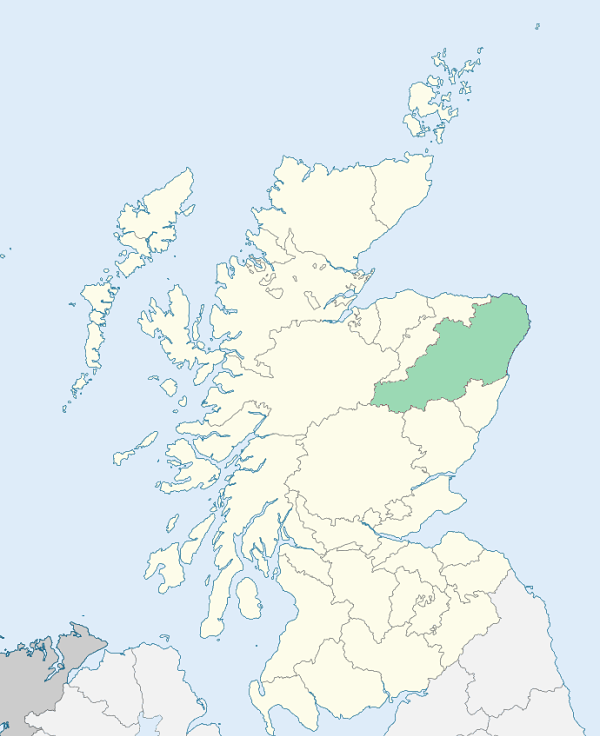
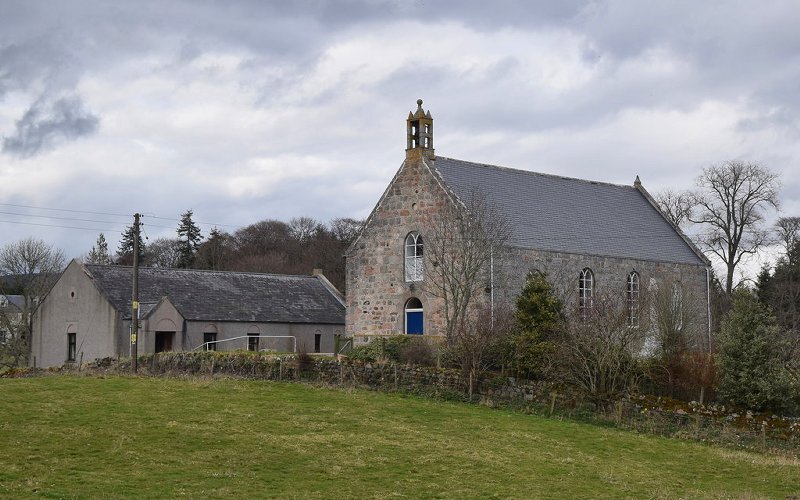
Cluny is a parish in the district of Kincardine-O'Neil, Aberdeenshire. It is bounded by Monymusk, Kemnay, Skene, Echt, Midmar, Kincardine-O'Neil, and Tough. (1867: The Imperial Gazetteer of Scotland, by John Marius Wilson).
Cluny, Sauchen
Cairndaie, Littleton, Lyne, Corsindae, Kebbary, Shiels, Arnhill, Baudyground, Corrennie, Corsindae, Greencrook, Kinnernie, Leggerdale, Ordhill, Rowanbush
The parish of Cluny had a detached part separated from the remainder of the parish by an intervening portion of the parish of Midmar. An exchange of territory was effected between these parishes, with the result of connecting the detached part of Cluny with the main portion of the parish, and of transferring to Midmar an intrusive peninsula of the parish of Cluny. In order to equalise the exchange, Cluny received an additional portion of Midmar, taken from the north-east corner of the latter parish. See affected properties and landholders. (1892: Boundary of counties and parishes in Scotland as settled by the Boundary Commissioners under the Local Government Act, 1889, by Hay Shennan)
PRE-REFORMATION GOVERNANCE:
POST-REFORMATION GOVERNANCE:
The church of Cluny was dedicated to St Machar. Part of the parish of Kinairney was annexed to Cluny on 6 February 1740, and part to Midmar.
Includes ministers, licentiates, assistants, readers, and clerks.
(1928: Fasti Ecclesiæ Scoticanæ, by Hew Scott, D. D.)
Parish registers turned over to the Registrar-General, as a result of the Registration of Births, Deaths, and Marriages (Scotland) Act of 1854. The letters B. D. and M. indicate Births (or Baptisms), Deaths (or Burials), and Marriages (or Proclamations of Banns) respectively. Numbers indicate separate volumes or books. Note: These records are by no means complete or without damage; consult the Detailed List of the Old Parochial Registers of Scotland (1872) to learn more about the condition of the records.
| OPR and RD Numbers | |||
|---|---|---|---|
| Date Range | Name | Number | Type |
| 1751-1854 | Cluny | 181 | OPR |
| 1855-1967 | Cluny | 181 | RD |
| 2009 | Aberdeenshire, Alford | 326 | RD |
| 2026 | Aberdeenshire Council; Cluny, Midmar, and Monymusk Community Council | ||
(2009: Parishes and Registration Districts of Scotland - Old and New, National Records of Scotland)
Local community councils (2026) are provided as a potential source of additional information for settlements within the original boundaries of the parish. (Source)
Statistics from informal and official censuses
Brown, Donald, Duncan, Forbes, Gibb, Lawson, Milne, Reid, Robertson, Smith
Note: Names appearing in research materials, other than censuses. Simple names (First name, surname only) have been omitted unless they appear associated with large properties. All women's names, and men's names with occupations, military ranks, or peerage titles are included.
By the Reverend Mr Robert Michie.
"The population in this year 1793 stands thus: 885 souls of whom 433 are males, and 452 females. There are 4 blacksmiths, 4 house carpenters 2 millwrights, 3 cart-wrights, 3 coopers, 5 tailors, 8 shoemakers with 1 apprentice, 8 weavers with 3 apprentices, 4 millers, 2 gardeners with 3 apprentices, 3 shopkeepers, 1 dyer, and 1 butcher. There are 204 families, 137 married couples, 48 men servants, and 35 women servants.
The only manufacture carried on in this district is the knitting of stockings, in which all the women, and some old men and boys are employed the whole year round, excepting in harvest.
The language of the generality of the people here is the Aberdeenshire dialect, intermixed with several old French words and phrases, from the ancient intercourse betwixt France and Scotland. No Gaelic is spoken within twenty miles, but most of the names of places are Celtic.
There are two licensed houses for the sale of ale and spirits principally for the sake of travelers, for drinking is much less the custom here than formerly, the people being sober, decent, and industrious. Several live to the age of between 80 and 90."
(This section contains excerpts, at times restructured or paraphrased, from an article appearing in Statistical Account of Scotland, Sir John Sinclair, 1791-1799)
Primary Sources:
Statistical Account of Scotland (1791-1799), Volume 10, p. 235
New Statistical Account of Scotland (1834-1845), Volume 12, p. 1018
See Parish Page Sources for all source information and links.