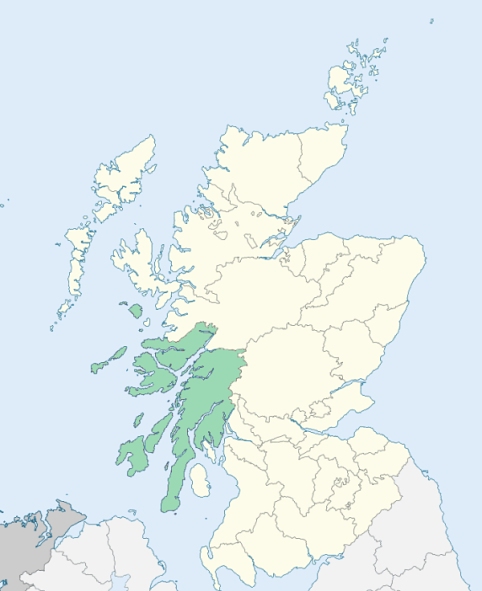
Glassary, or Kilmichael-Glassary, is a parish in the district of Argyll-proper, Argyllshire. It is bounded by Loch Fyne on the south and south-east; by Loch Awe and part of the parish of Kilmartin on the northwest and north; by the parishes of Inverary and Dalavich on the east and north-east; and by those of Kilmartin, North Knapdale, and South Knapdale on the west and south-west. (1867: The Imperial Gazetteer of Scotland, by John Marius Wilson)
Ford or Ford Lochawe, Glassary or Kilmichael-Glassary, Lochgair
Kilmory
PRE-REFORMATION GOVERNANCE:
POST-REFORMATION GOVERNANCE:
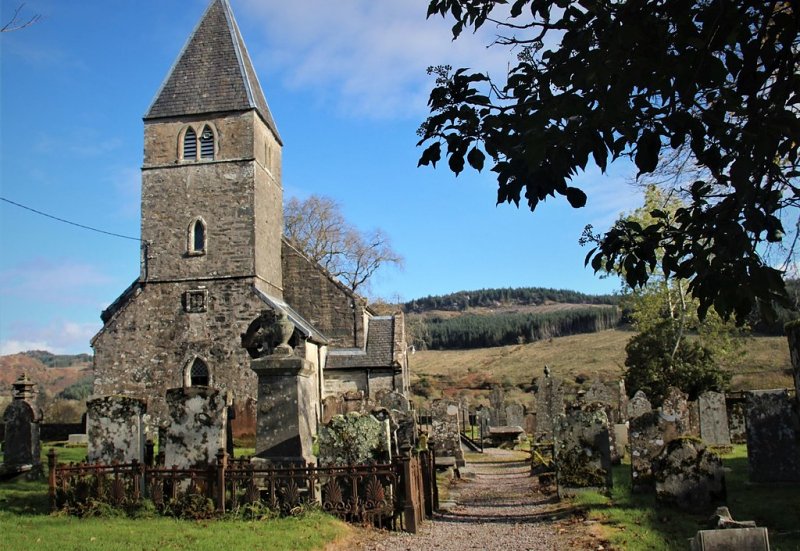
The church of Glassary was dedicated to St Michael. Beside it a Michaelmas fair used to be held. There were three chapels in the parish. One of them was on the west side at Kilbride. It bore the name of St Bride. Another stood at Killevin, near Crarae, on Lochfyne. It was dedicated to St Stebhan, Abbot of Iona. At Cill an Iubhair, which was once a village of some size, there was held a yearly tryst called Am Margadh Dubh (the Black Fair).
Includes ministers, licentiates, assistants, readers, and clerks.
(1928: Fasti Ecclesiæ Scoticanæ, by Hew Scott, D. D.)
Parish registers turned over to the Registrar-General, as a result of the Registration of Births, Deaths, and Marriages (Scotland) Act of 1854. The letters B. D. and M. indicate Births (or Baptisms), Deaths (or Burials), and Marriages (or Proclamations of Banns) respectively. Numbers indicate separate volumes or books. Note: These records are by no means complete or without damage; consult the Detailed List of the Old Parochial Registers of Scotland (1872) to learn more about the condition of the records.
| OPR and RD Numbers | |||
|---|---|---|---|
| Date Range | Name | Number | Type |
| 1750-1854 | Glassary | 511 | OPR |
| 1855-1969 | Glassary | 511 | RD |
| 2009 | Argyll and Bute, Oban | 526 | RD |
| 2026 | Argyll and Bute Council; Dunadd Community Council | ||
(2009: Parishes and Registration Districts of Scotland - Old and New, National Records of Scotland)
Local community councils (2026) are provided as a potential source of additional information for settlements within the original boundaries of the parish. (Source)
Statistics from informal and official censuses
Cameron, Campbell, Crawford, Ferguson, Gillies, Livingstone, Munro, Sinclair, Smith, Turner
Note: Names appearing in research materials, other than censuses. Simple names (First name, surname only) have been omitted unless they appear associated with large properties. All women's names, and men's names with occupations, military ranks, or peerage titles are included.
By the Reverend Mr Dugald Campbell.
"The number of souls in the parish (December 1792), stood as follows: There were 2568 total, of whom 665 were under 10 years of age. There are 5 blacksmiths, 32 weavers, 6 shoemakers constantly employed within the parish, besides a number of inferior shoemakers, who, during the winter months, and half of the spring are employed by the small tenants, and afterward earn their subsistence at road-making, fence-building, ditching, or herring-fishing. There are 30 boats; each boat requires 4 hands. About 40 more of the young men go to the north herring-fishing. There are 2 masons, 6 millers, 6 tailors, 3 boat carpenters, 3 joiners, 2 wheel-wrights, 2 tide-waiters, and 2 surgeons, and the rest are employed in farming and herding.
The people are generally active, humane, and hospitable, middle-sized, and capable of bearing cold, wet, and hunger to a great degree; they are not given to drinking, though, from their social disposition, when a number of them occasionally meet, they are apt to take a sitting together. The language mostly spoken is the Gaelic; though, from the frequent intercourse of the people with the low country, and the advantage of a more general education, which has been the case for the last 20 years, the greatest number of them speak and understand a little English."
(This section contains excerpts, at times restructured or paraphrased, from an article appearing in Statistical Account of Scotland, Sir John Sinclair, 1791-1799)
Primary Sources:
Statistical Account of Scotland (1791-1799), Volume 13, p. 653
New Statistical Account of Scotland (1834-1845), Volume 7, Section II, p. 675
See Parish Page Sources for all source information and links.