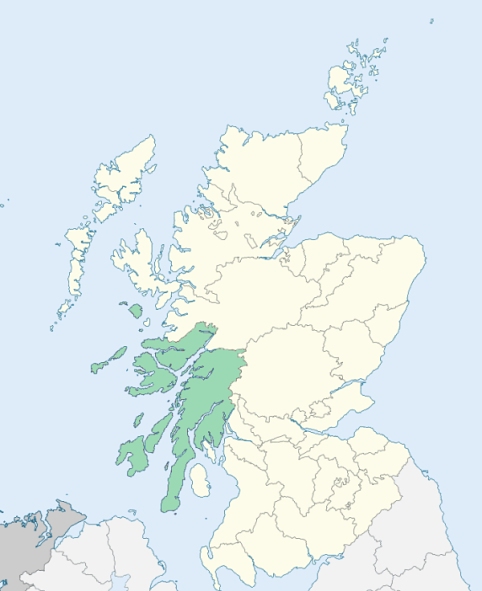
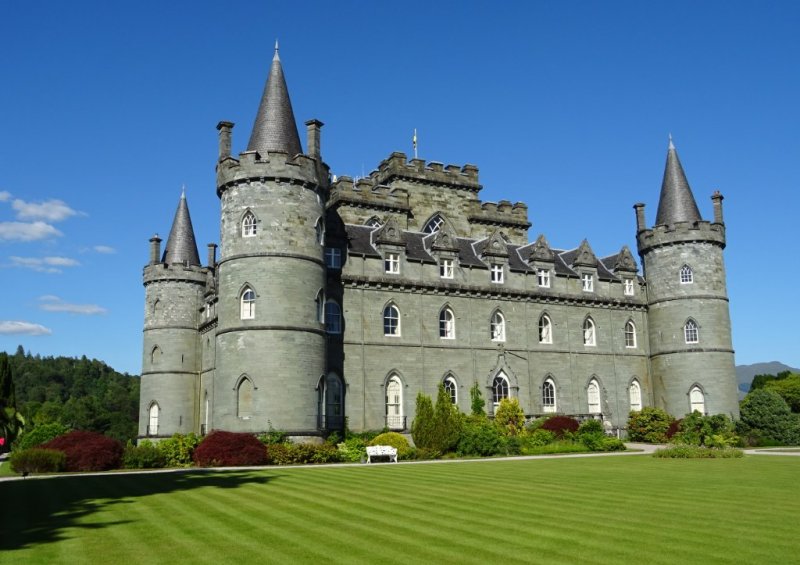
Inveraray - Inveraray is a parish in the Argyle district of Argyleshire. It is bounded on the north and north-east by the parish of Innishail, on the east by Dumbartonshire and Loch Fyne, on the south by Loch Fyne, on the south-west, by Kilmichael-Glassary, and on the west and north-west by Dalavich and Kilchrenan. (1867: The Imperial Gazetteer of Scotland, by John Marius Wilson)
Glenaray - The glen of the rivulet Aray in Argyleshire. Comprehends the entire northeast portion of the parish of Inverary, and even seems at one time to have designated the whole of that parish. (1867: The Imperial Gazetteer of Scotland, by John Marius Wilson)
Achandraine or Auchindrain, Achnagol, Claonary, Furnace, Inveraray
PRE-REFORMATION GOVERNANCE:
POST-REFORMATION GOVERNANCE:
These two parishes were united on 27 March 1745. About that time the church of Glenaray was rebuilt at Inveraray. Each parish has still its own minister and its own church, both churches being at Inveraray.
Glenaray. The old church of Glenaray was at Kilmalew. It was dedicated to St Malew (Maldhuibh). Within the bounds there were six chapels: St Fintan's at Kilmun, St Blaan's at Kilblaan, St Bride's at Kilbride, St John's at Killiain, and the chapels of Glen Shira and Achantiobaiot. On Loch Gair there is now a mission chapel.
Inveraray. The parish of Inveraray was disjoined from Glenaray on 26 December 1651, but was again united to it in 1745. At Inveraray there was of old a chapel of St Beaandan.
Includes ministers, licentiates, assistants, readers, and clerks.
Glenaray (QO)
Inveraray (QO)
(1928: Fasti Ecclesiæ Scoticanæ, by Hew Scott, D. D.)
Parish registers turned over to the Registrar-General, as a result of the Registration of Births, Deaths, and Marriages (Scotland) Act of 1854. The letters B. D. and M. indicate Births (or Baptisms), Deaths (or Burials), and Marriages (or Proclamations of Banns) respectively. Numbers indicate separate volumes or books. Note: These records are by no means complete or without damage; consult the Detailed List of the Old Parochial Registers of Scotland (1872) to learn more about the condition of the records.
| OPR and RD Numbers | |||
|---|---|---|---|
| Date Range | Name | Number | Type |
| 1651-1854 | Inveraray and Glenaray | 513 | OPR |
| 1855-1856 | Inveraray Burgh | 513-1 | RD |
| 1855-1856 | Inveraray Landward | 513-2 | RD |
| 1857-1971 | Inveraray | 513 | RD |
| 1972-2006 | Inveraray | 528 | RD |
| 2007 | Inveraray, Argyll and Bute | 528 | RD |
| 2009 | Argyll and Bute, Inveraray | 528 | RD |
| 2026 | Argyll and Bute Council; Inveraray Community Council | ||
(2009: Parishes and Registration Districts of Scotland - Old and New, National Records of Scotland)
Local community councils (2026) are provided as a potential source of additional information for settlements within the original boundaries of the parish. (Source)
Statistics from informal and official censuses
Inveraray: Bell, Cameron, Campbell, MacArthur, Maitland, Munro, Robertson, Sinclair, Smith, Stewart
Glenaray: Bain, Bell, Cameron, Campbell, Clark, Crawford, Ferguson, Gardner, Munro, Sinclair
Note: Names appearing in research materials, other than censuses. Simple names (First name, surname only) have been omitted unless they appear associated with large properties. All women's names, and men's names with occupations, military ranks, or peerage titles are included.
By the Reverend Mr Paul Fraser.
"The population in 1792 was 1832; there were 1063 inhabitants in the town, and 769 in the country. Of these there were 930 males, and 902 females, of whom 480 were under 10 years of age. There were 6 merchants, 1 surgeon, 6 writers, 5 shopkeepers, 1 innkeeper, 8 smiths, 5 masons, 15 carpenters, 7 weavers, 20 shoemakers, 15 tailors, 2 butchers, 2 millers, 2 bakers, 7 gardeners, 8 fishermen, 2 ferrymen, 1 watchmaker, 2 coopers, 1 wheelwright, 1 saddler, 3 barbers, 3 carters, 4 messengers, 4 sheriff-officers, 10 slaters, and 2 milliners.
The English is the prevailing language in the town, and the Gaelic in the country part of the parish. At Inveraray there is one principal inn, and several public houses of inferior accommodation.
The Scotch Highlanders, in general, as well as the natives of this county and prish, in particular, are a high spirited, generous, and brave race of people. From the nature of their country and climate, as well as their early habits, they are inured to bear wet and cold, fatigue and hunger; and consequently are well qualified to sustain the hardships of the field, and have ever been distinguished for their activity and valour, in every quarter of the globe. They seem not averse to a military life, and have proved an excellent nursery to the British army.
All the people of this parish are of the Established Church. They are, in general, humane and peaceable, orderly and decent in their behaviour. A regard to the rules of temperance, may be justly said to prevail, particularly among the people of condition. Too lavish a use of spirits, has been often complained of, amongst the inferior ranks. Dram-drinking, however, though still too much practised, particularly by females of the lowest class, is happily less prevalent than at former periods."
(This section contains excerpts, at times restructured or paraphrased, from an article appearing in Statistical Account of Scotland, Sir John Sinclair, 1791-1799)
Primary Sources:
Statistical Account of Scotland (1791-1799), Volume 5, p. 287
New Statistical Account of Scotland (1834-1845), Volume 7, Section II, p. 1
See Parish Page Sources for all source information and links.