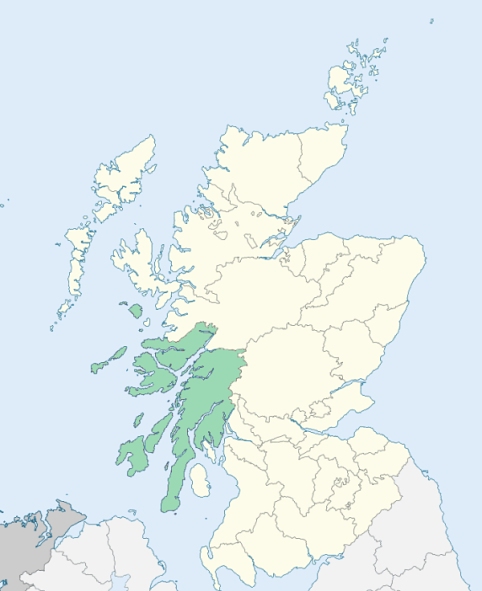
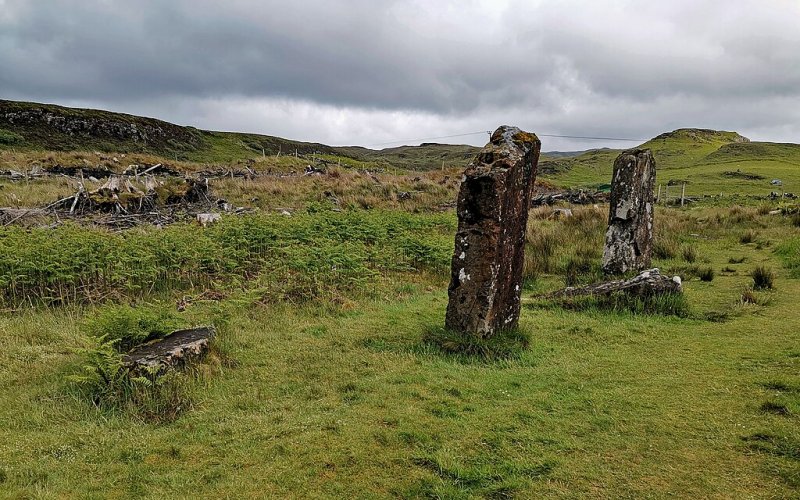
Kilmore and Kilbride is a united parish in Lorn, Argyleshire. It is bounded on three sides seaward by Loch Feachan, the Sound of Mull, and Loch Etive, and elsewhere by the parishes of Muckairn, Kilchrenan and Kilninver. Kilbride comprises the island of Kerrera, the burgh of Oban, and a part of the mainland south-east and south of these. (1867: The Imperial Gazetteer of Scotland, by John Marius Wilson).
Ardchonailmulin, Ardintallin, Balimore, Baranchalltin, Baranruch, Barnabuck, Colgin, Craigintaggart, Dunach, Gallanach, Kilbride, Kilmore, Lerags, Lugh, Molighe, Oban, Slatrach, Torinturik
Dunach, Dunolly, Glenfeochan
PRE-REFORMATION GOVERNANCE:
POST-REFORMATION GOVERNANCE:
The parishes of Kilmore and Kilbride were united before 1636. Each of them has still its own separate church.
Kilmore. This parish was a rectory of old. The ecclesiastical court of the district, when first set up in 1638, was named the Presbytery of Kilmore, and for a long time its ordinary place of meeting was in this parish.
Kilbride. The church of this parish was dedicated to St Bride. It belonged to the Abbey of Kilwinning. It was a mensal church of the Bishop of Argyll.
Disjoined Quoad Sacra Parishes:
Connel. This parish gets its name from an ancient chapel of St Conal which stood at the landing-place where Conal Ferry crosses Loch Etive. On 18 March 1910, the parish of Connel was disjoined from St Columba's, Oban, Muckairn, and Kilbride. The modern parish church is styled St Oran's.
Oban. Services were begun here in 1803. A church was built in 1821. On 5 June 1867, the parish of Oban was disjoined from Kilbride.
St Columba's, Oban. The foundation of a mission church here was laid 8 January 1874, and the church opened 25 July 1875. The parish was disjoined from Oban and Kilbride on 19 July 1880.
Includes ministers, licentiates, assistants, readers, and clerks.
Kilmore and Kilbride (QO)
Kilbride (QO)
Connel (QS)
Oban (QS)
St Columba's, Oban (QS)
(1928: Fasti Ecclesiæ Scoticanæ, by Hew Scott, D. D.)
Parish registers turned over to the Registrar-General, as a result of the Registration of Births, Deaths, and Marriages (Scotland) Act of 1854. The letters B. D. and M. indicate Births (or Baptisms), Deaths (or Burials), and Marriages (or Proclamations of Banns) respectively. Numbers indicate separate volumes or books. Note: These records are by no means complete or without damage; consult the Detailed List of the Old Parochial Registers of Scotland (1872) to learn more about the condition of the records.
| OPR and RD Numbers | |||
|---|---|---|---|
| Date Range | Name | Number | Type |
| 1782-1854 | Kilmore and Kilbride | 523 | OPR |
| 1855-1859 | Kilmore and Kilbride, Burgh of Oban | 523-1 | RD |
| 1855-1859 | Kilmore and Kilbride, Landward | 523-2 | RD |
| 1860-1969 | Kilmore and Kilbride | 523 | RD |
| 1970-1971 | Oban | 529 | RD |
| 1972-2006 | Oban | 526 | RD |
| 2007-2008 | Oban, Argyll and Bute | 526 | RD |
| 2009 | Argyll and Bute, Oban | 526 | RD |
| 2026 | (Kilmore and Kilbride) Argyll and Bute Council; Kilmore and Kilbride Community Council | ||
| 2026 | (Oban) Argyll and Bute Council;Oban Community Council | ||
(2009: Parishes and Registration Districts of Scotland - Old and New, National Records of Scotland)
Local community councils (2026) are provided as a potential source of additional information for settlements within the original boundaries of the parish. (Source)
Statistics from informal and official censuses
Black, Brown, Buchanan, Cameron, Campbell, Carmichael, Livingston, Munro, Sinclair, Stewart
Note: Names appearing in research materials, other than censuses. Simple names (First name, surname only) have been omitted unless they appear associated with large properties. All women's names, and men's names with occupations, military ranks, or peerage titles are included.
By the Reverend Mr Patrick M'Donald, Minister.
"It is difficult to ascertain the exact number of the inhabitants, as they are in a very fluctuating state, by many annually going to the Low Country, and from one part of this country to another; but from the two last years lists, there appeared to be, at an average, of inhabitants, of all ages in 1791 in Kilmore, about 700 souls; in 1791 in Kilbride, about 600 souls; and in 1792 in Oban, about 586 souls.
In Oban there are 7 clerks, 5 slaters, 24 labourers, 7 sawyers, 3 coopers, 17 weavers, 1 painters, 9 tailors, 12 carpenters, 3 masons, 1 barber, 1 baker, 1 currier, 4 tanners, 19 sailors, 17 joiners, 12 smiths, 25 shoemakers, and 5 merchants. Besides these, these are a good many other tradesmen scattered over the parish.
The change in the circumstances, the appearance, and the morals of the people of the lower class, in this parish, has been considerable, since the present incumbent's admission. As to their appearance, if we were to judge form the change in their dress and manner of living, (particularly of the workmen and servants), more especially of the younger sort, many of them have arrived at such a pitch of gaiety in the one, and of expence in the other, that their circumstances would appear to be much improved: But there is reason to believe, the change is more to be ascribed to their advance in luxury, than in opulence. It deserves, however, to be remarked, that the old tenants have hardly made any alteration in their manner of living. The inhabitants, in general, are rational in their religion; sober, with a very few exceptions; laborious and industrious: The gentlemen are well-bred, polite, discreet and hospitable."
(This section contains excerpts, at times restructured or paraphrased, from an article appearing in Statistical Account of Scotland, Sir John Sinclair, 1791-1799)
Primary Sources:
Statistical Account of Scotland (1791-1799), Volume 11, p. 121
New Statistical Account of Scotland (1834-1845), Volume 7, Section II, p. 522
See Parish Page Sources for all source information and links.