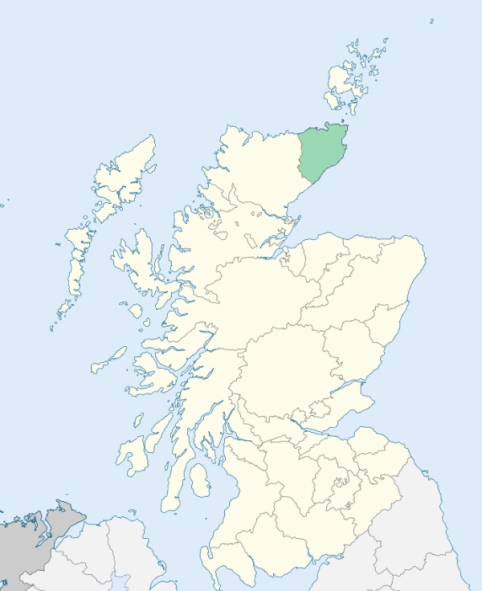
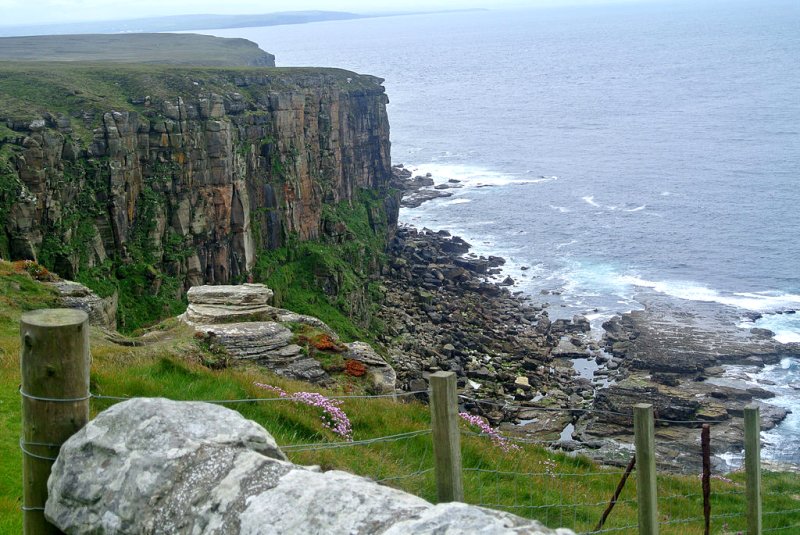
Dunnet is a parish on the north coast of Caithness-shire. It is bounded by the Pentland Firth, and by the parishes of Canisbay, Bower, and Olrig. (1867: The Imperial Gazetteer of Scotland, by John Marius Wilson).
Brough, Dunnet, Greenland, Ham, Ratter, Reaster, Scarfskerry or Scarfs Kerry
PRE-REFORMATION GOVERNANCE:
POST-REFORMATION GOVERNANCE:
Dunnet was a prebend of the Cathedral of Dornoch. Its parish church was dedicated to St Faelchu. There were chapels at St John's Loch, Reaster, Ham, Scarfs Kerry, and Dwarick Head. A fair of St Fumach was held at Dunnet, and also a fair of St Luke in October. At Reaster there was a tryst on Lady Day in Harvest.
Includes ministers, licentiates, assistants, readers, and clerks.
(1928: Fasti Ecclesiæ Scoticanæ, by Hew Scott, D. D.)
Parish registers turned over to the Registrar-General, as a result of the Registration of Births, Deaths, and Marriages (Scotland) Act of 1854. The letters B. D. and M. indicate Births (or Baptisms), Deaths (or Burials), and Marriages (or Proclamations of Banns) respectively. Numbers indicate separate volumes or books. Note: These records are by no means complete or without damage; consult the Detailed List of the Old Parochial Registers of Scotland (1872) to learn more about the condition of the records.
| OPR and RD Numbers | |||
|---|---|---|---|
| Date Range | Name | Number | Type |
| 1751-1854 | Dunnet | 36 | OPR |
| 1855-1967 | Dunnet | 36 | RD |
| 2009 | Highland | 160 | RD |
| 2026 | Highland Council; Dunnet and Canisbay Community Council | ||
(2009: Parishes and Registration Districts of Scotland - Old and New, National Records of Scotland)
Local community councils (2026) are provided as a potential source of additional information for settlements within the original boundaries of the parish. (Source)
Statistics from informal and official censuses
Banks, Budge, Calder, Gunn, Manson, Simpson, Sinclair, Sutherland, Swanson, Wallace
Note: Names appearing in research materials, other than censuses. Simple names (First name, surname only) have been omitted unless they appear associated with large properties. All women's names, and men's names with occupations, military ranks, or peerage titles are included.
By the Reverend Mr Thomas Jolly, Minister.
"In the inland parts, the people depend chiefly on their farms for subsistence: But along the coast, their chief support is from the sea. And there are scarcely any handicraftsmen in the parish, who do not occasionally follow the profession of farmers or fishermen. The women are generally employed in spinning linen yarn, which they make of a good quality, though they cannot do a great quantity in a day. Some of them have of late begun to spin on two-handed wheels, and are making astonishing progress with them. The inhabitants are, in general, a sagacious people; and excepting in so far as they are prevented by their vicinity to the sea, appear to want nothing but a sufficient spur to make them industrious."
(This section contains excerpts, at times restructured or paraphrased, from an article appearing in Statistical Account of Scotland, Sir John Sinclair, 1791-1799)
Primary Sources:
Statistical Account of Scotland (1791-1799), Volume 11, p. 243
New Statistical Account of Scotland (1834-1845), Volume 15, Section II, p. 34
See Parish Page Sources for all source information and links.