St Michael's
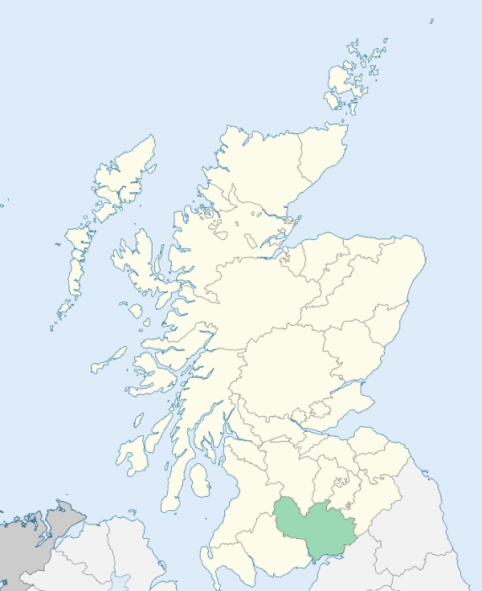
Dumfries is a parish on the south-west border of Dumfriesshire. It is bounded on the west by Kirkcudbrightshire, and on the other sides by the parishes of Holywood, Kirkmahoe, Tinwald, Torthorwald, and Caerlaverock. (1867: The Imperial Gazetteer of Scotland, by John Marius Wilson).
Dumfries, Gaston or Gasstown, Georgeton or Georgetown, Greenbrae, Kelton, Locharbriggs, Lochthorn, Nobelhill, Pleasance, Stoop
PRE-REFORMATION GOVERNANCE:
POST-REFORMATION GOVERNANCE:
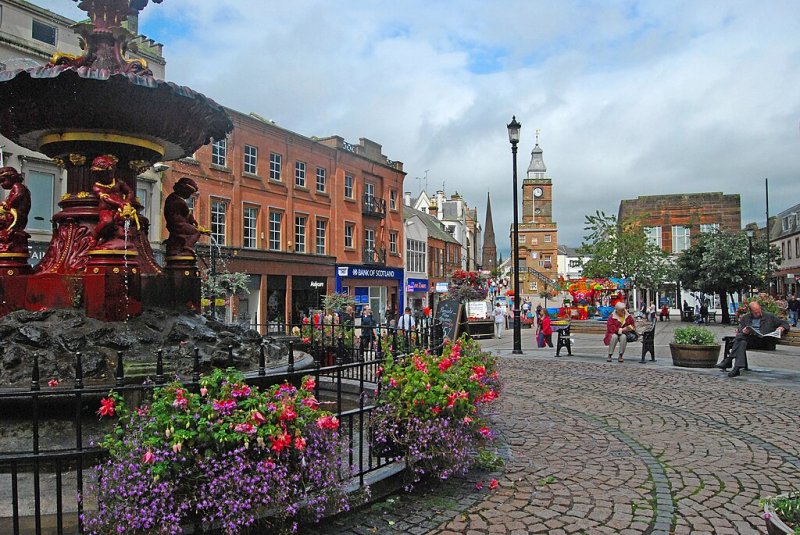
Previous to the Reformation the churches in Dumfries were St Michael's, which belonged to the Abbey of Kelso, the chapel of St Bride in the Castle, the chapel of St Thomas, which was gifted to the Abbey of Kelso by William the Lion, the chapel of the Holy Cross, and the church of the Franciscan Monastery. Of these, St Michael's alone has had an uninterrupted ministerial succession. The present church was built on the original site in 1745. At Over-Kelwood, in the south of the parish, there was a chapel of St Laurence, with a hermitage attached to it.
Greyfriars', previously New Church. On the site of the medieval castle of Dumfries, in which there was a chapel, a church known as the New Church was built in the years 1724-27. A church was built on the old site, 1866-68. The name of Greyfriars was given it, in memory of the Franciscan convent which in old times stood a short way from the site.
Disjoined Quoad Sacra Parishes:
St Mary's. The foundation of this church was laid 24 May 1837, and it was opened for worship 17 November 1839. The parish was disjoined from St Michael's and erected in 1854.
Includes ministers, licentiates, assistants, readers, and clerks.
Dumfries, or St Michael's (QO)
Greyfriars', or New Church (QO)
St Mary's (QS)
(1928: Fasti Ecclesiæ Scoticanæ, by Hew Scott, D. D.)
Parish registers turned over to the Registrar-General, as a result of the Registration of Births, Deaths, and Marriages (Scotland) Act of 1854. The letters B. D. and M. indicate Births (or Baptisms), Deaths (or Burials), and Marriages (or Proclamations of Banns) respectively. Numbers indicate separate volumes or books. Note: These records are by no means complete or without damage; consult the Detailed List of the Old Parochial Registers of Scotland (1872) to learn more about the condition of the records.
| OPR and RD Numbers | |||
|---|---|---|---|
| Date Range | Name | Number | Type |
| 1604-1854 | Dumfries | 821 | OPR |
| 1855-1857 | Dumfries Burgh | 821-1 | RD |
| 1855-1857 | Dumfries Landward | 821-2 | RD |
| 1858-1971 | Dumfries | 821 | RD |
| 1972-2004 | Dumfries | 834 | RD |
| 2005-2009 | Dumfries and Galloway, Dumfries | 834 | RD |
| 2026 | Dumfries & Galloway Council; Corberry and Laurieknowe Community Council Georgetown Community Council Heathhall Community Council Lincluden Community Council Lochside and Woodlands Community Council Loreburn Community Council St Michaels Community Council Summerville and Stakeford Community Council | ||
(2009: Parishes and Registration Districts of Scotland - Old and New, National Records of Scotland)
Local community councils (2026) are provided as a potential source of additional information for settlements within the original boundaries of the parish. (Source)
Statistics from informal and official censuses
Bell, Brown, Dickson, Kerr, Kirkpatrick, Paterson, Richardson, Smith, Thomson, Wilson
Note: Names appearing in research materials, other than censuses. Simple names (First name, surname only) have been omitted unless they appear associated with large properties. All women's names, and men's names with occupations, military ranks, or peerage titles are included.
By the Reverend Mr William Burnside.
"The present population of the town, as appears from an enumeration lately taken, may be fairly estimated at 5600 souls. The inhabitants of the country part of the parish are 1400; total 7000 souls. The number of separate families in the town, is from 1400 to 1500. The families in the country are somewhat above 300. There are 150 of the Episcopal communion, 270 Antiburgher Seceders, 200 of the Relief communion, and 38 Roman Catholics. There are 40 persons above 15 years of age, born in England and Ireland.
The numbers of the different incorporated trades in the town are respectively as follows: 70 hammermen, 220 squaremen, 85 tailors, 59 weavers, 236 shoemakers, 23 skinners and glovers, 33 fleshers; 100 tanners, nailers, plasterers, brass-founders, silversmiths, watchmakers, dyers and others; 26 bakers, 50 gardeners, 30 stocking-makers, 15 hat-makers, 10 or 11 seamen and fishermen, 30 writers, 1 physician, 3 surgeons, and 4 apothecaries.
Dumfries is a Royal Burgh. The mechanics are divided into 7 different incorporations. A deacon from each of these corporations, with 12 merchant councillors, a treasurer, a dean of guild, 3 baillies, and a provost, making altogether 25 members, compose the town-council.
Almost every branch of mechanical or commercial industry is practised. Leather is made in 2 or 3 tan-works. Some stockings and hats too, and some small quantities of linen, and coarse woollen cloths have been manufactured here. Quantities of flour, meal, and barley are made in mills belonging to the town. About 8 or 10 coasting vessels belong to this town, besides two or three which are employed in the Baltic, and in the wine trade. Forty years ago a considerable tobacco trade was carried on from Dumfries. Dumfries has 2 principal inns, a coffeehouse, and several taverns. A printing-house is established here, and a newspaper published weekly. As the capital of the county, Dumfries is the seat of the Sheriff and of the Commissary Courts.
The character of the inhabitants, is allowed to be, in general, very respectable. They are charitable and benevolent, hospitable to strangers, and mix frequently amongst themselves in domestic intercourse. In their disposition and manners they are social and polite; and the town, together with the neighbourhood a few miles around it, furnishes a society, amongst whom a person of a moderate fortune may spend his days, with as much satisfaction and enjoyment, as, perhaps, in any part of these kingdoms."
(This section contains excerpts, at times restructured or paraphrased, from an article appearing in Statistical Account of Scotland, Sir John Sinclair, 1791-1799)
Primary Sources:
Statistical Account of Scotland (1791-1799), Volume 5, p. 119
New Statistical Account of Scotland (1834-1845), Volume 4, Section I, p. 1
See Parish Page Sources for all source information and links.