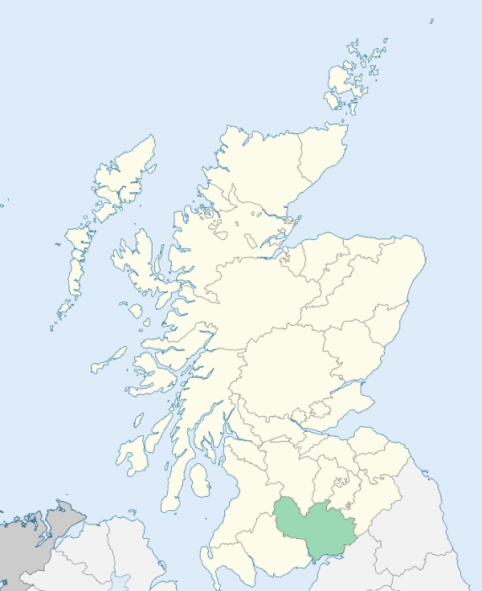
Ewes is a parish at the north-east extremity of Dumfriesshire. It is bounded on the north and east by Roxburghshire, on the south by Canonbie and Langholm, and on the west by Westerkirk. (1867: The Imperial Gazetteer of Scotland, by John Marius Wilson).
Arkleton, Ewes, Kirkstyle, Kirkton
PRE-REFORMATION GOVERNANCE:
POST-REFORMATION GOVERNANCE:
Ewes, Ewesdale, or Nether Ewes. The church was dedicated to St Cuthbert. There were chapels at Unthank and Mosspaul.
Ewes-Duris, or Overkirk of Ewes. The church was dedicated to St Mark.
Includes ministers, licentiates, assistants, readers, and clerks.
(1928: Fasti Ecclesiæ Scoticanæ, by Hew Scott, D. D.)
Parish registers turned over to the Registrar-General, as a result of the Registration of Births, Deaths, and Marriages (Scotland) Act of 1854. The letters B. D. and M. indicate Births (or Baptisms), Deaths (or Burials), and Marriages (or Proclamations of Banns) respectively. Numbers indicate separate volumes or books. Note: These records are by no means complete or without damage; consult the Detailed List of the Old Parochial Registers of Scotland (1872) to learn more about the condition of the records.
| OPR and RD Numbers | |||
|---|---|---|---|
| Date Range | Name | Number | Type |
| 1700-1854 | Ewes | 825 | OPR |
| 1855-1969 | Ewes | 825 | RD |
| 2009 | Dumfries and Galloway, Langholm | 838 | RD |
| 2026 | Dumfries & Galloway Council; Langholm, Ewes and Westerkirk Community Council | ||
(2009: Parishes and Registration Districts of Scotland - Old and New, National Records of Scotland)
Local community councils (2026) are provided as a potential source of additional information for settlements within the original boundaries of the parish. (Source)
Statistics from informal and official censuses
Anderson, Beattie, Elliot, Ewart, Graham, Irving, Jackson, Little, Robson, Telfer
Note: Names appearing in research materials, other than censuses. Simple names (First name, surname only) have been omitted unless they appear associated with large properties. All women's names, and men's names with occupations, military ranks, or peerage titles are included.
By the Reverend Mr John Laurie.
"The inhabitants of this parish have, for some time past, been diminishing. I find, in the account given to Dr Webster in 1755, the population stated at 392. At this period, it does not exceed 320. This decrease is owing, in some measure, to the difficulty the poor find in procuring fuel; but mostly to the situation of the farms, which are generally, and at a less expense, managed by servants residing in the tenants houses, than by herds having houses and families of their own.
The only tradesmen are 7 weavers, some of whom are employed in weaving coarse woollen stuffs, from yarn which they purchase from Galloway, and that neighourhood, and sell at Carlisle; and the rest either in weaving linen checks, for a manufactory at the same place, or in country work. One smith, employed by the farmers, and 2 tailors."
(This section contains excerpts, at times restructured or paraphrased, from an article appearing in Statistical Account of Scotland, Sir John Sinclair, 1791-1799)
Primary Sources:
Statistical Account of Scotland (1791-1799), Volume 14, p. 465
New Statistical Account of Scotland (1834-1845), Volume 4, Section I, p. 437
See Parish Page Sources for all source information and links.