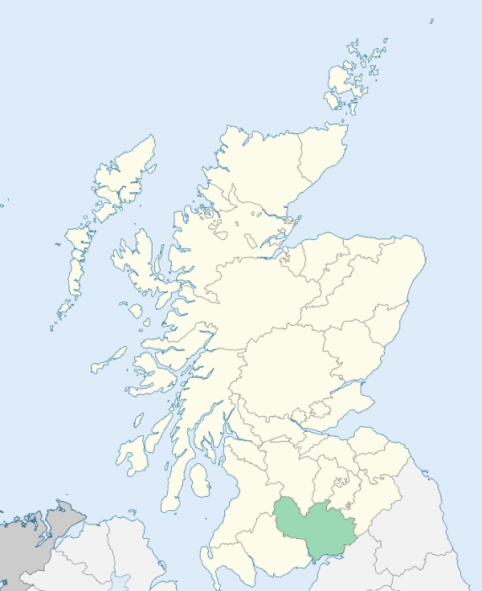
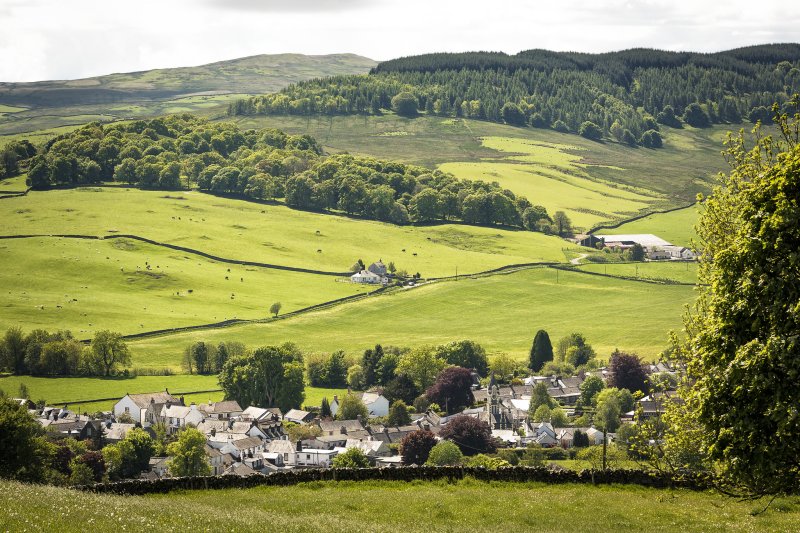
Glencairn is a parish on the western border of Dumfriesshire. It is bounded by Kirkcudbrightshire, and by the parishes of Tynron, Keir, and Dunscore. (1867: The Imperial Gazetteer of Scotland, by John Marius Wilson).
Dunreggan, East Skelston, Glencairn, Kirkland, Moniaive or Minnyhive, Wallaceton
Craigdarroch, Crawfordton, Maxwelton
PRE-REFORMATION GOVERNANCE:
POST-REFORMATION GOVERNANCE:
The church was dedicated to St Cuthbert. It belonged to the Dean of Glasgow. At Moniaive there is a mission chapel of St Ninian.
Includes ministers, licentiates, assistants, readers, and clerks.
(1928: Fasti Ecclesiæ Scoticanæ, by Hew Scott, D. D.)
Parish registers turned over to the Registrar-General, as a result of the Registration of Births, Deaths, and Marriages (Scotland) Act of 1854. The letters B. D. and M. indicate Births (or Baptisms), Deaths (or Burials), and Marriages (or Proclamations of Banns) respectively. Numbers indicate separate volumes or books. Note: These records are by no means complete or without damage; consult the Detailed List of the Old Parochial Registers of Scotland (1872) to learn more about the condition of the records.
| OPR and RD Numbers | |||
|---|---|---|---|
| Date Range | Name | Number | Type |
| 1693-1854 | Glencairn | 826 | OPR |
| 1855-1968 | Glencairn | 826 | RD |
| 2009 | Dumfries and Galloway, Dumfries | 834 | RD |
| 2026 | Dumfries & Galloway Council; Glencairn Community Council | ||
(2009: Parishes and Registration Districts of Scotland - Old and New, National Records of Scotland)
Local community councils (2026) are provided as a potential source of additional information for settlements within the original boundaries of the parish. (Source)
Statistics from informal and official censuses
Black, Brown, Hastings, Henderson, Martin, Reid, Smith, Todd, Wallace, Wilson
Note: Names appearing in research materials, other than censuses. Simple names (First name, surname only) have been omitted unless they appear associated with large properties. All women's names, and men's names with occupations, military ranks, or peerage titles are included.
By the Reverend Mr William Grierson.
"The return to Dr Webster, in 1755, was 1794 souls. There are now about 1400 persons above 7 or 8 years of age, and consequently about 1700 in all. In the two villages of Minniehive (Moniaive) and Dunreggan, there are 98 families. There is an Antiburgher meeting-house near Minniehive; but that sect seems rather on the decline. There are likewise a few Cameronians in the parish; but neither of these, nor indeed both together, bear any proportion to those who attend the Established Church.
There are no manufactures carried on in this parish, the greater part of the inhabitants being employed in farming, droving, handicrafts, and common labour. The people are, in general, healthy; and several now alive, as well as others lately dead, have arrived at 80 years of age, and upwards. Their houses and dress, of late, have been much improved; and, in the latter of these respects, people of every class seem to be running into an extreme. The manner of the people, in general, are very agreeable, mild, courteous, and obliging; and they are distinguished for hospitality, and natural civility to strangers."
(This section contains excerpts, at times restructured or paraphrased, from an article appearing in Statistical Account of Scotland, Sir John Sinclair, 1791-1799)
Primary Sources:
Statistical Account of Scotland (1791-1799), Volume 2, p. 339
New Statistical Account of Scotland (1834-1845), Volume 4, Section I, p. 330
See Parish Page Sources for all source information and links.