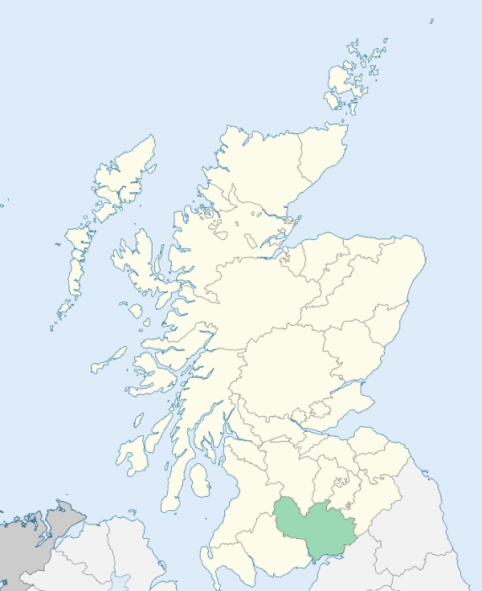
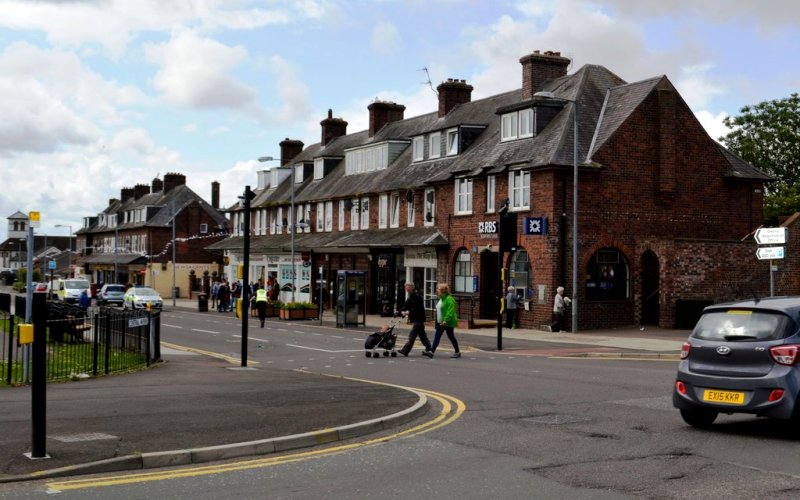
Gretna is a parish on the south-east verge of Dumfriesshire. It is bounded on the north by Half-Morton, on the east by the River Sark which divides it from England, on the south-east and south by the Solway Firth, on the west by Dornock, and on the north-west by Kirkpatrick-Fleming. (1867: The Imperial Gazetteer of Scotland, by John Marius Wilson).
Brewhouses or Browhouses, Gretna or Graitney, Gretna Green, Old Gretna, Rigg, Springfield
PRE-REFORMATION GOVERNANCE:
POST-REFORMATION GOVERNANCE:
The parishes of Gretna and Rinpatrick were united in 1609.
Gretna, or Gretanhow. A fair was formerly held here on St Laurence Day, 10 August.
Rinpatrick, or Redkirk. The church of Rinpatrick was dedicated to St Patrick. Along with the churchyard, it has been swept away by the tide of the Solway Firth.
Includes ministers, licentiates, assistants, readers, and clerks.
(1928: Fasti Ecclesiæ Scoticanæ, by Hew Scott, D. D.)
Parish registers turned over to the Registrar-General, as a result of the Registration of Births, Deaths, and Marriages (Scotland) Act of 1854. The letters B. D. and M. indicate Births (or Baptisms), Deaths (or Burials), and Marriages (or Proclamations of Banns) respectively. Numbers indicate separate volumes or books. Note: These records are by no means complete or without damage; consult the Detailed List of the Old Parochial Registers of Scotland (1872) to learn more about the condition of the records.
| OPR and RD Numbers | |||
|---|---|---|---|
| Date Range | Name | Number | Type |
| 1730-1854 | Gretna | 827 | OPR |
| 1855-1971 | Gretna | 827 | RD |
| 1972-2004 | Gretna | 840 | RD |
| 2005-2009 | Dumfries and Galloway, Gretna | 840 | RD |
| 2026 | Dumfries & Galloway Council; Gretna and Rigg Community Council Springfield and Gretna Green Community Council | ||
(2009: Parishes and Registration Districts of Scotland - Old and New, National Records of Scotland)
Local community councils (2026) are provided as a potential source of additional information for settlements within the original boundaries of the parish. (Source)
Statistics from informal and official censuses
Armstrong, Beattie, Bell, Clark, Graham, Harkness, Irving, Johnston, Johnstone, Nicholson
Note: Names appearing in research materials, other than censuses. Simple names (First name, surname only) have been omitted unless they appear associated with large properties. All women's names, and men's names with occupations, military ranks, or peerage titles are included.
By the Reverend Mr John Morgan.
"There are now 1810 persons in this parish, of whom 805 are males, 1005 are females, and 490 are under 10 years of age. There are 323 families. They are all of the Established Church, except 1 Cameronian, 2 or 3 Burgher Seceders, and a few Episcopalians.
There are 2 surgeons, 4 schoolmasters, 15 shopkeepers, 4 innkeepers, 54 farmers, 7 blacksmiths, 9 joiners, 52 weavers, 8 shoemakers, 9 tailors, 2 butchers, 2 millers, 3 bakers, 3 gardeners, 1 midwife, 1 tallow-chandler, 1 traveling peddler, 75 men who gain a livelihood partly by fishing and partly by some other employment, 1 land surveyor, 31 apprentices, 50 male labouring servants, 52 female labouring servants, and 12 female domestic servants.
In the year 1791, a new village was begun on the farm of Springfield, where upwards of 40 houses have been already built, or are now building. Several weavers are now settling in this village, and as the proprietor is exerting himself for the establishment of manufactures of different kinds, there seems to be little doubt of this village becoming a very considerable place in a short time."
(This section contains excerpts, at times restructured or paraphrased, from an article appearing in Statistical Account of Scotland, Sir John Sinclair, 1791-1799)
Primary Sources:
Statistical Account of Scotland (1791-1799), Volume 9, p. 518
New Statistical Account of Scotland (1834-1845), Volume 4, Section I, p. 262
See Parish Page Sources for all source information and links.