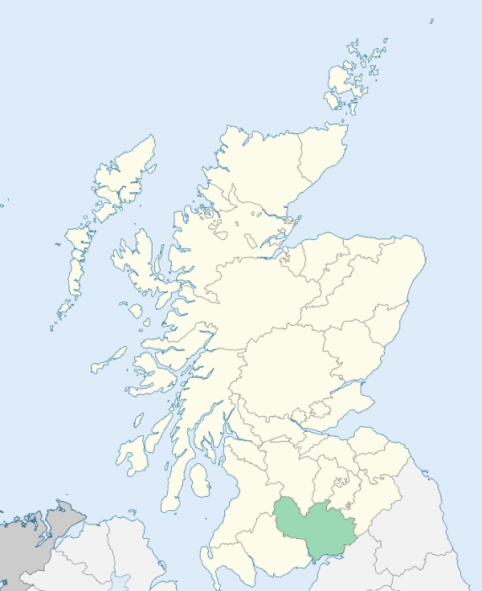
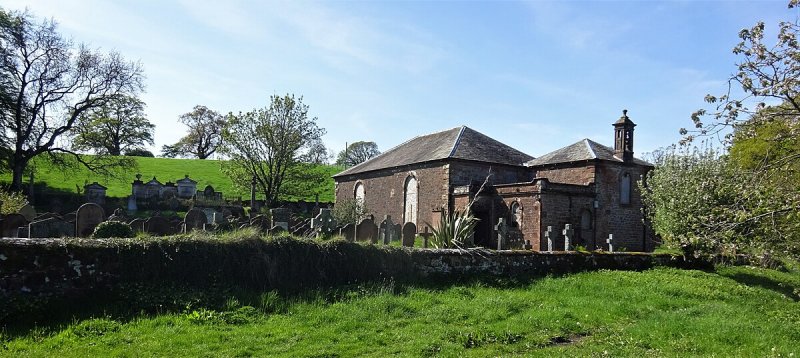
Johnstone is a parish in Annandale, Dumfriesshire. It is bounded by Kirkpatrick-Juxta, Wamphray, Applegarth, Lochmaben, and Kirkmichael. (1867: The Imperial Gazetteer of Scotland, by John Marius Wilson).
Johnstone, Johnstonebridge, Raehills, Springwells, St Ann's
Raehills
PRE-REFORMATION GOVERNANCE:
POST-REFORMATION GOVERNANCE:
In 1674 part of Garrel was annexed to Johnstone. Part of Dungree also was added in the seventeenth century.
Includes ministers, licentiates, assistants, readers, and clerks.
(1928: Fasti Ecclesiæ Scoticanæ, by Hew Scott, D. D.)
Parish registers turned over to the Registrar-General, as a result of the Registration of Births, Deaths, and Marriages (Scotland) Act of 1854. The letters B. D. and M. indicate Births (or Baptisms), Deaths (or Burials), and Marriages (or Proclamations of Banns) respectively. Numbers indicate separate volumes or books. Note: These records are by no means complete or without damage; consult the Detailed List of the Old Parochial Registers of Scotland (1872) to learn more about the condition of the records.
| OPR and RD Numbers | |||
|---|---|---|---|
| Date Range | Name | Number | Type |
| 1734-1854 | Johnstone | 832 | OPR |
| 1855-1968 | Johnstone | 832 | RD |
| 2009 | Dumfries and Galloway, Moffat | 836 | RD |
| 2026 | Dumfries & Galloway Council; Johnstone Community Council | ||
(2009: Parishes and Registration Districts of Scotland - Old and New, National Records of Scotland)
Local community councils (2026) are provided as a potential source of additional information for settlements within the original boundaries of the parish. (Source)
Statistics from informal and official censuses
Brown, Burgess, Dickson, Halliday, Jardine, Johnstone, Proudfoot, Renwick, Rogerson, Smith
Note: Names appearing in research materials, other than censuses. Simple names (First name, surname only) have been omitted unless they appear associated with large properties. All women's names, and men's names with occupations, military ranks, or peerage titles are included.
By the Reverend Mr William Sibbald.
"The number of inhabitants at present is 565; of whom 293 are males, 272 are females, and 140 are under 10 years of age. The inhabitants are all of the Established Church, except 1 Cameronian, 10 Antburghers, and 12 Relief Seceders. There is only one foreigner, a native of Jamaica. There are 122 inhabited houses; no houses are uninhabited.
There are 38 farmers, 5 weavers, 2 shoemakers, 2 blacksmiths, 4 tailors, 3 wrights, 1 miller, 5 masons, 7 apprentices, and 5 female household servants. The farmers, at an average, have a male and female servant each, besides a boy or a girl for taking care of their cattle.
The inhabitants are rather above the middle size; but I never heard of any of them exceeding six feet two inches. Their dress, diet, and lodging, are much amended within these twenty, or even ten years. They seldom live beyond their income. Sympathy is a striking feature in their character. Before the Union, and for some time after it, the inhabitants of Annandale, like other Borderers, were riotous and quarrelsome. Now they are a sober, harmless people, and by the encouragement given them, have of late become industrious. Emigration was frequent till within these 9 years; but there is now employment found both for the parishioners and for strangers. Only 2 have enlisted in the army since 1785. None have entered into the navy, nor gone to sea."
(This section contains excerpts, at times restructured or paraphrased, from an article appearing in Statistical Account of Scotland, Sir John Sinclair, 1791-1799)
Primary Sources:
Statistical Account of Scotland (1791-1799), Volume 4, p. 216
New Statistical Account of Scotland (1834-1845), Volume 4, Section I, p. 151
See Parish Page Sources for all source information and links.