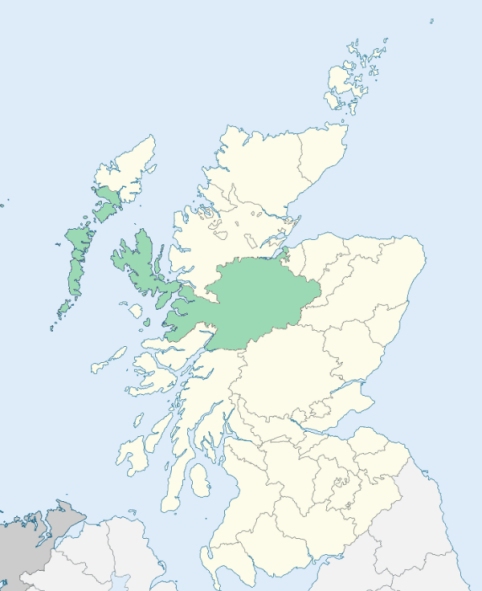
Harris. Harris is a parish in the Outer Hebrides of Inverness-shire. It comprehends the southern part of Lewis, and the small adjacent islands. It is bounded on the north, by the parishes of Lochs and Uig in Lewis, on the east by the Minch and the Little Minch, on the south by the sound of Harris, which divides it from North Uist, and on the west by the Atlantic Ocean. The other isles and islets belonging to it are very numerous, and some of them very small, but the inhabited ones are only eight - Scalpay, Taransay, Scarp, Pabbay, Ensay, Killigray, Bernera, and Anabich. (1867: The Imperial Gazetteer of Scotland, by John Marius Wilson).
St Kilda. St Kilda is an island belonging to the parish of Harris in Inverness-shire. It is situated nearly due west of North Uist, and 37 miles south-west of the Flannan Isles. Though classed with the Hebrides it lies far distant from even their outer main group, and is the most westerly piece of Scottish ground. The language spoken is Gaelic. (1867: The Imperial Gazetteer of Scotland, by John Marius Wilson).
Aline, Ardhasaig, Ardvourlie, Borrisdale, Borsham, Borve, Bowglass, Bunaveneadar, Carnach, Carrigrich, Cliasamol, Diraclett, Flodabay, Govig, Grosebay, Hushinish, Kendibig, Kenngarry, Kennavay, Leverburgh, Maaruig, Meavaig or Miavaig, Northton, Outend, Rhenigidale, Rodel, St Kilda, Scadabay, Scalpay, Scarista, Seilebost, Tarbert, Urgha, West Tarbert
PRE-REFORMATION GOVERNANCE:
POST-REFORMATION GOVERNANCE:
The parishes of Harris and St Kilda were unitee not later than the sixteenth century, but mostly likely before that.
Harris. The church of this parish was dedicated to St Bride, and of old was known as Kilbride. At Rodel there was an Augustinian Priory, dependent on the Abbey of Holyrood. Its church, dedicated to St Clement still remains entire. There are still in the parish traces of the old chapels of St Luag, on the shore of Loch Seaforth, of St Taran and St Keith on the island of Taransay, and of St Luag and St Mary in the island of Pabbay.
St Kilda, or Hirt. The island of Hirt lies fully sixty miles west of any part of the coast of Harris. Its parish church, which exists no longer, was dedicated to Christ, and was known as Cill Chriosd of Hirta. In Hirt there were of old chapels of St Columba and St Breandan. In 1710 a mission chapel was built on the island. It was formerly a part of the parish of Harris. It belonged to the parish of North Uist, and was one of the charges originally constituting the Presbytery of The Long Island erected in 1724. The name of St Kilda is of eighteenth century origin and is not that of any saint, and its meaning is quite uncertain.
Disjoined Quoad Sacra Parishes:
Bernera. The island of Bernera, formerly a part of the parish of Harris, was erected into a parliamentary charge in 1827, declared to be a quoad sacra parish by the Act of Assembly, 25 May 1833, and erected by the Court of Teinds 11 June 1845. On the island of Bernera there were of old chapels of St Columba and St Asaph.
Includes ministers, licentiates, assistants, readers, and clerks.
Harris (QO)
St Kilda (QO)
Bernera (QS)
(1928: Fasti Ecclesiæ Scoticanæ, by Hew Scott, D. D.)
Parish registers turned over to the Registrar-General, as a result of the Registration of Births, Deaths, and Marriages (Scotland) Act of 1854. The letters B. D. and M. indicate Births (or Baptisms), Deaths (or Burials), and Marriages (or Proclamations of Banns) respectively. Numbers indicate separate volumes or books. Note: These records are by no means complete or without damage; consult the Detailed List of the Old Parochial Registers of Scotland (1872) to learn more about the condition of the records.
| OPR and RD Numbers | |||
|---|---|---|---|
| Date Range | Name | Number | Type |
| 1823-1854 | Harris and St Kilda | 111 | OPR |
| 1855-1855 | Harris | 111 | RD |
| 1856-1877 | Harris | 111-1 | RD |
| 1856-1877 | Bernera | 111-2 | RD |
| 1856-1877 | St Kilda | 111-3 | RD |
| 1878-1970 | Harris North | 111-1 | RD |
| 1878-1970 | Harris South | 111-2 | RD |
| 1878-1930 | Bernera | 111-3 | RD |
| 1878-1930 | St Kilda | 111-4 | RD |
| 1971-1971 | Harris | 111 | RD |
| 1972-2006 | Harris | 250 | RD |
| 2009 | Comhairle Nan Eilean Siar, Harris | 250 | RD |
| 2026 | (Harris) Comhairle nan Eilean Siar Council; North Harris Community Council South Harris Community Council | ||
| 2026 | (Bernera) Comhairle nan Eilean Siar Council; Bernera Community Council | ||
(2009: Parishes and Registration Districts of Scotland - Old and New, National Records of Scotland)
Local community councils (2026) are provided as a potential source of additional information for settlements within the original boundaries of the parish. (Source)
Statistics from informal and official censuses
Campbell, Ferguson, MacDonald, MacKay, MacKinnon, MacLennan, MacLeod, Martin, Morrison, Shaw
Note: Names appearing in research materials, other than censuses. Simple names (First name, surname only) have been omitted unless they appear associated with large properties. All women's names, and men's names with occupations, military ranks, or peerage titles are included.
By the Reverend Mr John MacLeod.
"The present incumbent, soon after his admission, made out a roll of catechisable persons, reckoning every soul above seven years old examinable. The number was 1805. Since this period the population has been fast increasing; and the following circumstances regarding its present state, carefully investigated, 1792, for the purposes of this statistical survey, may be depended upon as authentic. Number of souls, 2536; 1136 males, 1400 females.
The great increase of population, since 1779, is owing to a variety of causes. There has been no emigration, neither has there been any drain of young men for the use of the army or navy since that period. They have generally married very early in life. The advanced price of kelp gave some spur to industry in that line of manufacture.
Gaelic is universally spoken here; and excepting the number already specified, who have been taught to read and write English (108), few can speak any other language. It is almost obvious to common reflection, that the inhabitants of these islands, formerly cut off, both by their local and political situation, from all connection with the Scottish, Pictish and Saxon nations, and having as yet but little intercourse with strangers, must have retained this dialect of the ancient Celtic in its greatest purity.
(The people) are sober, docile, sagacious, and capable of industry, were a channel opened to them in which industry might be profitably exerted. They are kind and courteous to strangers, hospitable and charitable even to excess. They have the strongest attachment to their native country, and entertain the most ardent gratitude to benefactors."
(This section contains excerpts, at times restructured or paraphrased, from an article appearing in Statistical Account of Scotland, Sir John Sinclair, 1791-1799)
Primary Sources:
Statistical Account of Scotland (1791-1799), Volume 10, p. 342
New Statistical Account of Scotland (1834-1845), Volume 14, Section I, p. 155
See Parish Page Sources for all source information and links.