Eigg and Canna
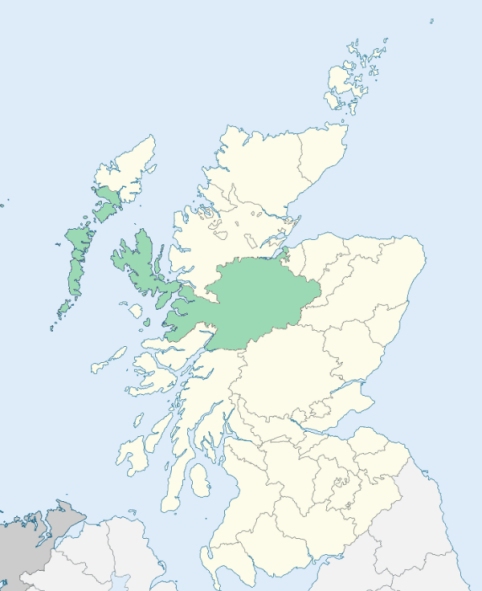
Small Isles is a Hebridean parish consisting of the inhabited islands of Eigg, Rum, Canna, and Muck, and of two or three uninhabited islets. Eigg is in Inverness-shire, and the other islands are in Argyleshire. (1867: The Imperial Gazetteer of Scotland, by John Marius Wilson).
Canna is one of the four islands of the Hebrides which form the parish of Small Isles. It is 3 miles north-west of Rum, and 12 south-west from the nearest point of Skye.(1867: The Imperial Gazetteer of Scotland, by John Marius Wilson).
Eigg, or Egg is an island in the parish of Small Isles and county of Inverness. It is about 8 miles west of Arasaig, the nearest part of the mainland. On the south coast of Eigg, there is a small island, called Eilean-Chastel, or Castle Island, on which a few persons, tending cattle, live during part of the summer months. (1867: The Imperial Gazetteer of Scotland, by John Marius Wilson).
Muck is an island in the parish of Small Isles. It lies 4½ miles north-west of the nearest part of the Argyleshire mainland, and 3¼ south-south-west of the island of Eigg. (1867: The Imperial Gazetteer of Scotland, by John Marius Wilson).
Rum is an island belonging to the parish of Small Isles. (1867: The Imperial Gazetteer of Scotland, by John Marius Wilson).
Canna: Achill
Eigg: Cleadale, Galmisdale, Laig, Lower Grulin, Upper Grulin
Muck: Port Mor
Rum: Dibidil, Guirdil, Harris, Kildonnan, Kilmory, Kinloch, Papadil, Portnacaranean or Port-na-Caranean
The parish of Small Isles was formerly divided between the counties of Argyll and Inverness. According to the Ordnance Survey returns, the parish consists of nine islands, viz., in the county of Argyll, Canna 2,908 acres; Sanday 577 acres; Rum 26,785 acres; Muck 1,585 acres; Oigh-sgeir 76 acres; Eilean nan Each 97 acres; and a small island 8 acres; and in the county of Inverness, Eigg 7,803 acres, and Eilean Chasgaidh 102 acres. The parish was placed wholly in the county of Inverness. See affected properties and landholders. (1892: Boundary of counties and parishes in Scotland as settled by the Boundary Commissioners under the Local Government Act, 1889, by Hay Shennan)
PRE-REFORMATION GOVERNANCE:
POST-REFORMATION GOVERNANCE:
In the sixteenth century the three parishes of Strathswordale, Eigg, and Canna were united. On 16 February 1720 the Court of Teinds severed from the two other the parish of Strathswordale, called also Strath. There are still parish churches in both Eigg and Canna.
Eigg. In early times the island of Eigg became the seat of St Donan's teaching. There he and his missionary comrades were murdered about the year 617. To St Donan the later church of Eigg was dedicated. The island of Muc (or Muck) forms part of this parish. In Eigg there are Wells of St Donan, St Columba, and St Katherine.
Canna. The church of Canna was dedicated to St Columba. Having fallen into ruin, it lay waste for generations, but of late years it has been beautifully restored by Mr Alan G. Thom of Canna. The islands of Canna and Rum together make up this parish.
Includes ministers, licentiates, assistants, readers, and clerks.
(1928: Fasti Ecclesiæ Scoticanæ, by Hew Scott, D. D.)
Parish registers turned over to the Registrar-General, as a result of the Registration of Births, Deaths, and Marriages (Scotland) Act of 1854. The letters B. D. and M. indicate Births (or Baptisms), Deaths (or Burials), and Marriages (or Proclamations of Banns) respectively. Numbers indicate separate volumes or books. Note: These records are by no means complete or without damage; consult the Detailed List of the Old Parochial Registers of Scotland (1872) to learn more about the condition of the records.
| OPR and RD Numbers | |||
|---|---|---|---|
| Date Range | Name | Number | Type |
| 1820-1854 | Eigg and Canna | 116 | RD |
| 1855-1971 | Small Isles | 116 | RD |
| 2009 | Highland, Small Isles | RD | 260 |
| 2026 | Highland Council; Small Isles Community Council | ||
(2009: Parishes and Registration Districts of Scotland - Old and New, National Records of Scotland)
Local community councils (2026) are provided as a potential source of additional information for settlements within the original boundaries of the parish. (Source)
Statistics from informal and official censuses
Beattie, Campbell, Chisholm, Kirk, Livingstone, Matheson, Nicolson, Robertson, Scott, Stewart
Note: Names appearing in research materials, other than censuses. Simple names (First name, surname only) have been omitted unless they appear associated with large properties. All women's names, and men's names with occupations, military ranks, or peerage titles are included.
By the Reverend Mr Donald M'Lean, Minister.
"By a list, lately taken, it appears, that the number of inhabitants in this parish is as follows: In Eigg, 399, in Rum 443, in Canna 304, in Muck 193. Of these there are 648 males, 691 females; 799 Protestants, 540 Roman Catholics.
There are 8 male and 6 female weavers, 1 house-carpenter, and 5 boat-carpenters, 5 tailors, and 2 smiths. Most of these, besides their respective trades, spend a considerable part of their time in fishing, labouring, and other necessary occupations. There are few or no seamen, except those who follow the fishing during a part of the year. There are two merchants, who bring their goods from the Glasgow market.
In the years 1788 and 1790, 183 souls emigrated from this parish to America, and 55 to the mainland of Scotland and to neighbouring islands; of these 176 left Eigg. A principal cause of this emigration was, that the country was overstocked with people, arising from frequent early marriages; of course, the lands were able to supply them but scantily with the necessaries of life. The people appear neither expensive nor luxurious. They live chiefly upon potatoes and herrings; and among the more opulent tacksmen, a dish of tea and a dram of whisky are their greatest luxuries."
(This section contains excerpts, at times restructured or paraphrased, from an article appearing in Statistical Account of Scotland, Sir John Sinclair, 1791-1799)
Primary Sources:
Statistical Account of Scotland (1791-1799), Volume 17, p. 272
New Statistical Account of Scotland (1834-1845), Volume 14, Section I, p. 145
See Parish Page Sources for all source information and links.