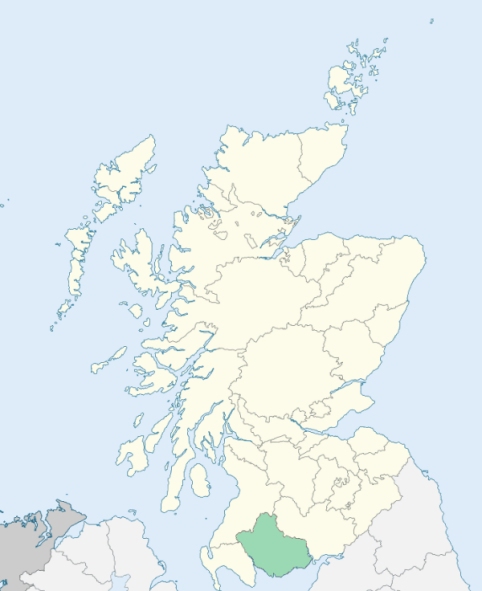
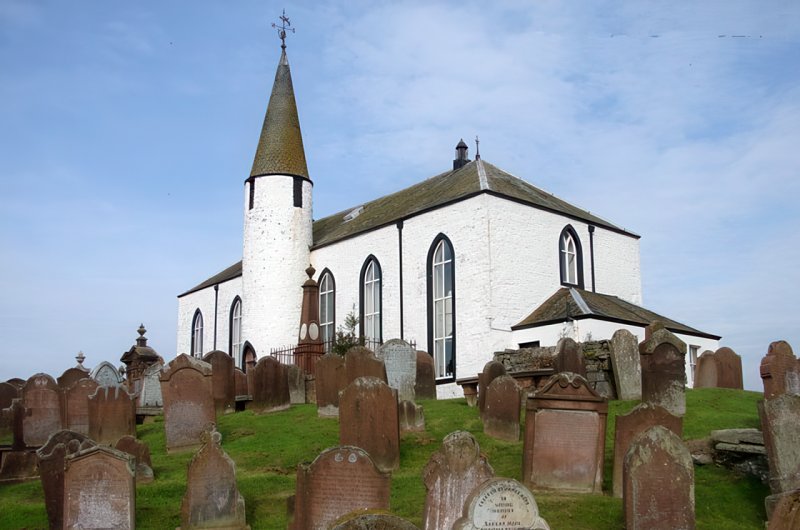
Crossmichael is a parish near the centre of Kirkcudbrightshire. It is bounded on the east by the Urr Water, which divides it from the parishes of Kirkpatrick-Durham and Urr, and on the west by the River Dee, which divides it from Balmaghie, on the north-west it has Parton parish, and on the south-east Buittle and Kelton. (1867: The Imperial Gazetteer of Scotland, by John Marius Wilson).
Clarebrand, Crossmichael
Auchendolly, Greenlaw, Mollance
PRE-REFORMATION GOVERNANCE:
POST-REFORMATION GOVERNANCE:
The church of this parish was dedicated to St Michael. It belonged to the Abbey of Sweetheart. The church was rebuilt in 1751. Beside the church stood of old St Michael's Cross, at which every year was held the Michaelmas Fair of Crossmichael. The fair has lasted on into modern times, but the cross is long since gone.
Disjoined Quoad Sacra Parishes:
Castle Douglas. In 1866 a mission station was begun in the Town Hall, Castle Douglas, for the town people, owing to the distance of the parish church at Kelton. A site for a church was given by Sir George Abercromby of Birkenbog and Forglen, Bart., and a church was opened in 1869. The parish of Castle Douglas was disjoined quoad sacra from Kelton and Crossmichael, and erected by the Court of Teinds, 1 December 1873.
Includes ministers, licentiates, assistants, readers, and clerks.
Crossmichael (QO)
Castle Douglas (QS)
(1928: Fasti Ecclesiæ Scoticanæ, by Hew Scott, D. D.)
Parish registers turned over to the Registrar-General, as a result of the Registration of Births, Deaths, and Marriages (Scotland) Act of 1854. The letters B. D. and M. indicate Births (or Baptisms), Deaths (or Burials), and Marriages (or Proclamations of Banns) respectively. Numbers indicate separate volumes or books. Note: These records are by no means complete or without damage; consult the Detailed List of the Old Parochial Registers of Scotland (1872) to learn more about the condition of the records.
| OPR and RD Numbers | |||
|---|---|---|---|
| Date Range | Name | Number | Type |
| 1751-1854 | Crossmichael | 863 | OPR |
| 1855-1968 | Crossmichael | 863 | RD |
| 2009 | Dumfries and Galloway, Castle Douglas | 852 | RD |
| 2026 | Dumfries and Galloway Council; Crossmichael and District Community Council | ||
(2009: Parishes and Registration Districts of Scotland - Old and New, National Records of Scotland)
Local community councils (2026) are provided as a potential source of additional information for settlements within the original boundaries of the parish. (Source)
Statistics from informal and official censuses
Clark, Johnstone, Kirkpatrick, Millar, Murray, Purdie, Rae, Stewart, Thomson, Wilson
Note: Names appearing in research materials, other than censuses. Simple names (First name, surname only) have been omitted unless they appear associated with large properties. All women's names, and men's names with occupations, military ranks, or peerage titles are included.
By the Reverend Mr John Johnstone.
"By an actual enumeration, the parish was found, on the 1st January 1791, to contain 772 inhabitants. At present there are 380 males, 392 females, of whom 200 are under 10 years of age. They occupy 163 houses, 14 of which have only one inhabitant each. In one village there are 70, and in another 36 souls. All the rest live in the country. There are 4 natives of England, 10 of Ireland, 5 of the Isle of Man, 1 of the Highlands, 3 of Edinburgh, and 749 of Galloway and Dumfries. There are 14 Cameronians with 12 children, 15 Antiburghers with 9 children, 2 Episcopalians, 1 Roman Catholic, and 719 of the Established Church.
There are 68 farmers, 5 weavers, 4 shoemakers, 7 tailors with 3 apprentices, 3 blacksmiths with 1 apprentice, 10 masons with 5 apprentices, 6 joiners with 1 apprentice, 2 dyers with 1 apprentice, 3 shopkeepers, 2 small innkeepers, 51 male servants, 54 female servants, 1 miller, 55 labouring cottagers, and 7 paupers.
The morals of the people in this country have, from three causes, sustained material injury. Its vicinity to Ireland has rendered it the receptacle of some of the least respectable of the inhabitants of that kingdom. The cattle trade is less favourable than agriculture to sobriety and honesty. But, above all, smuggling, for which our local situation is but too favourable, tends to relax every moral obligation. But, while these general remarks are made, it is by no means admitted that the conduct of the inhabitants of this parish furnishes any extraordinary evidence of their truth. None have occasion to beg without the bounds of the parish. Vagrants never repeat without effect a real or a fictitious tale of woe; and when extraordinary collections are made for any charitable purpose, this parish yields not to any of its neighbours in point of liberality. The style of manners are such as made be expected to characterise a people in a state between rudeness and refinement, possessed of a competent portion of the comforts of life, without having obtained the means of luxury."
(This section contains excerpts, at times restructured or paraphrased, from an article appearing in Statistical Account of Scotland, Sir John Sinclair, 1791-1799)
Primary Sources:
Statistical Account of Scotland (1791-1799), Volume 1, p. 167
New Statistical Account of Scotland (1834-1845), Volume 4, Section II, p. 190
See Parish Page Sources for all source information and links.