Crawford Lindsay, Crawford Douglas, Craufurd
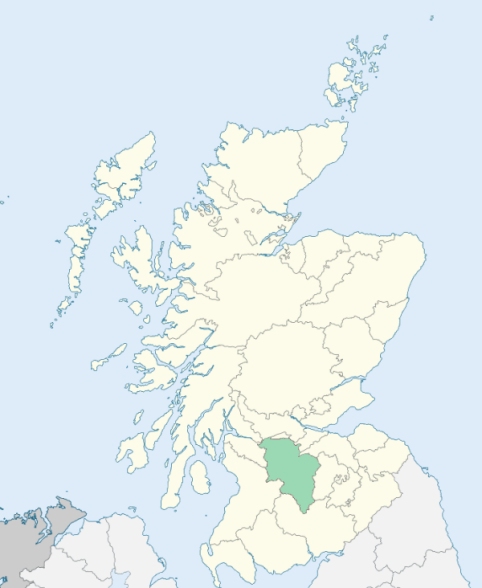
Crawford is a parish in the southern extremity of Lanarkshire. It forms a south-easterly projection from the rest of the county, and is bounded on two sides by Dumfriesshire, on a third by Peeblesshire, and on the fourth by the parishes of Culter, Lamington, and Crawfordjohn. (1867: The Imperial Gazetteer of Scotland, by John Marius Wilson).
Crawford, Leadhills
PRE-REFORMATION GOVERNANCE:
POST-REFORMATION GOVERNANCE:
The church of Crawford belonged to the Abbey of Holyrood. It was dedicated to St Constantine the Martyr. Beside Crawford Castle there was a chapel of St Thomas the Martyr. A fair was held at Crawford on St Barnabas' Day, the 11th of June. Crawford Church now stands at the village of Crawford, where it was rebuilt in 1875. There is a mission chapel in the parish at Elvanfoot.
Disjoined Quoad Sacra Parishes:
Leadhills. In 1656 occasional services were begun at Leadhills. On 15 October 1699 the Presbytery began a long-continued series of appeals to the Earl of Hopetoun, with the view of providing a suitable stipend, and the matter was discussed in the Scottish Parliament. On 19 May 1738 regular services were begun, the cost of maintaining them being borne by Charles, Earl of Hopetoun. On 17 July 1867, the parish of Leadhills was disjoined from Crawford.
Includes ministers, licentiates, assistants, readers, and clerks.
Crawford (QO)
Leadhills (QS)
(1928: Fasti Ecclesiæ Scoticanæ, by Hew Scott, D. D.)
Parish registers turned over to the Registrar-General, as a result of the Registration of Births, Deaths, and Marriages (Scotland) Act of 1854. The letters B. D. and M. indicate Births (or Baptisms), Deaths (or Burials), and Marriages (or Proclamations of Banns) respectively. Numbers indicate separate volumes or books. Note: These records are by no means complete or without damage; consult the Detailed List of the Old Parochial Registers of Scotland (1872) to learn more about the condition of the records.
| OPR and RD Numbers | |||
|---|---|---|---|
| Date Range | Name | Number | Type |
| 1698-1854 | Crawford | 635 | OPR |
| 1855-1857 | Crawford | 635 | RD |
| 1857-1969 | Crawford | 635-1 | RD |
| 1857-1969 | Leadhills | 635-2 | RD |
| 1969-1971 | Crawford | 635 | RD |
| 1969-1971 | Leadhills | 650 | RD |
| 1972-2004 | Crawford | 588 | RD |
| 1972-2004 | Leadhills | 589 | RD |
| 2009 | (Crawford) South Lanarkshire, Crawford | 588 | RD |
| 2009 | (Leadhills) South Lanarkshire, Leadhills | 589 | RD |
| 2026 | (Crawford) South Lanarkshire Council; Crawford and Elvanfoot Community Council | ||
| 2026 | (Leadhills) South Lanarkshire Council; Leadhills Community Council | ||
(2009: Parishes and Registration Districts of Scotland - Old and New, National Records of Scotland)
Local community councils (2026) are provided as a potential source of additional information for settlements within the original boundaries of the parish. (Source)
Statistics from informal and official censuses
Blackwood, Brown, Hope, Menzies, Moffat, Murray, Paterson, Stewart, Weir, Wilson
Note: Names appearing in research materials, other than censuses. Simple names (First name, surname only) have been omitted unless they appear associated with large properties. All women's names, and men's names with occupations, military ranks, or peerage titles are included.
By the Reverend Mr James Maconochie.
"The population of Crawford amounts at present to about 520 persons, exclusive of Leadhills, where the numbers amount at present to 970; in all, 1490. The bulk of the people belong to the Established Church; about 6 Seceders, and 20 Cameronians.
Leadhills contains the most famous and ancient lead mines in Scotland. There are two companies there; the most considerable is that known by the name of the Scotch Mining Company where nearly 200 men are employed. These are subdivided into pickmen, smelters, washers, and labourers, besides carpenters and smiths.
With respect to the common people in this parish, and indeed, in all the parishes round me, I observe a sobriety or regard to moral conduct, which, I hope, proceeds from religious principle. The herds and their wives, who live at too great a distance from the public school to send their children thither, are careful to teach them not only to read the Bible, but to get psalms by heart, &c. There may be instances of petty thefts, but great or daring ones are very rare. The greatest nuisances to which we are exposed, are strolling beggars, who go about the country, more especially at the time of shearing the sheep, and men in trousers who pretend to be sailors in distress."
(This section contains excerpts, at times restructured or paraphrased, from an article appearing in Statistical Account of Scotland, Sir John Sinclair, 1791-1799)
Primary Sources:
Statistical Account of Scotland (1791-1799), Volume 5, p. 505
New Statistical Account of Scotland (1834-1845), Volume 6, p. 327
See Parish Page Sources for all source information and links.