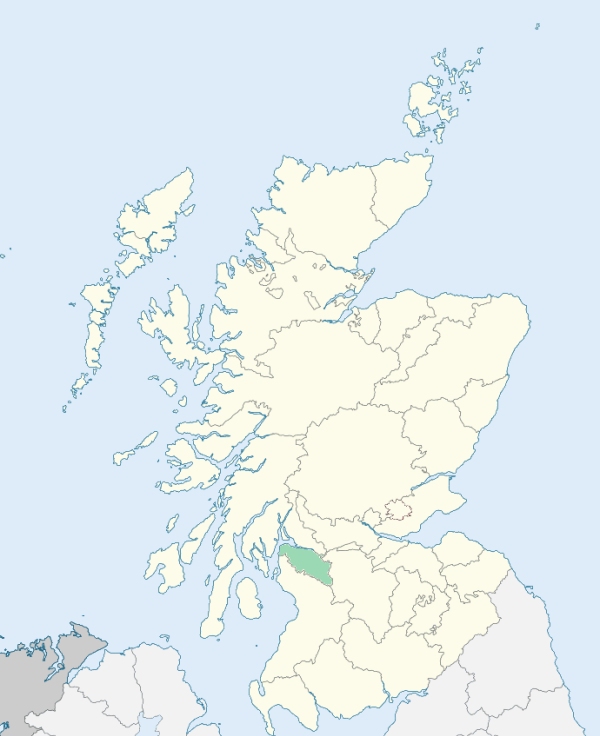
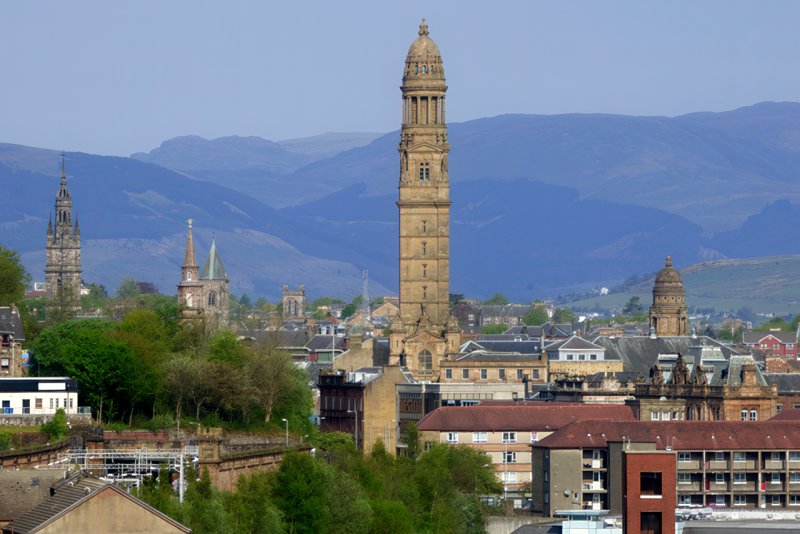
Greenock is a parish, containing a large town of its own name, in the north-west of Renfrewshire. It is bounded on the north by the Firth of Clyde, and on other sides by the parishes of Inverkip, Kilmacolm, and Port Glasgow. (1867: The Imperial Gazetteer of Scotland, by John Marius Wilson).
Cartsdyke or Crawfurdsdike, Greenock
PRE-REFORMATION GOVERNANCE:
POST-REFORMATION GOVERNANCE:
Greenock or West Parish. On 18 November 1589, at Holyrood House, King James VI granted John Shaw of Greenock authority to erect a church for this rising town and its neighbourhood. The church was then built and opened 5 October 1591. On 8 June 1594 this parish was disjoined by Parliament from Inverkip and erected as the Parish of Greenock, a name which it continued to bear till the erection of the East parish in 1809. In 1636 the Lord Commissioners for the Plantation of Kirks enlarged the parish of Greenock by adding to it various lands taken from the parishes of Inverkip and Houston. There were two chapels within the bounds assigned to the parish of Greenock, besides the chapel of St Laurence in what is now the East Parish. One of these chapels stood at Chapelton and the other was the chapel of St Blaan at Kilblaan. There were two yearly fairs held in Greenock - St Helen's Fair, and the Fair of St Laurence. The West Parish Church was rebuilt on a new site in 1840, and a tower added to it in 1854.
East Parish. A church was built for this district in 1774. On 8 March 1809 the East parish was disjoined from the West Parish of Greenock. Near the site of the East Church there was of old a chapel of St Laurence. From this chapel the inlet adjoining got the name of St Laurence Bay, and beside the chapel St Laurence Fair was held annually. The East Church of Greenock was rebuilt in 1853.
Middle Parish, previously New Parish. The Middle Parish was disjoined from the West Parish of Greenock on 15 July 1741. At first this was known as the New Parish. In 1761 the Middle Church was rebuilt. Its tower was added in 1787.
Gaelic Parish, formerly South Church. The church was built in 1791, and opened as a chapel-of-ease, 8 April 1792. The parish was erected by the Court of Teinds, 5 July 1855.
Disjoined Quoad Sacra Parishes:
Augustine. Services were begun here in 1878. A church was built in 1884. The parish was disjoined from Cartsburn, 19 March 1897.
Cartsburn. In 1839 the General Assembly granted a constitution to a chapel for the district of Cartsdyke. The parish was erected 19 February 1866.
Gourock. A chapel was built here in 1776. It was rebuilt and opened on 27 May 1832. On 31 May 1834 it was given a chapel constitution. The parish was disjoined from Inverkip and Greenock West, 8 July 1857.
Ladyburn. A church was opened here on 26 December 1875. Disjoined from the East Parish of Greenock, and erected by the Court of Teinds, 5 June 1882.
North Parish. A church was built for this district in 1823, was known as Blackhall Street Chapel. On 31 May 1834 the General Assembly erected this as a separate charge, and on 30 May 1836 it was granted a constitution as a chapel, and had a definite district assigned to it. In 1840 the old West Church, built for the town and parish of Greenock in 1592, was restored and made a chapel for this north district. The North Parish was disjoined from the West Parish of Greenock, 18 March 1872.
St Paul's. An iron chapel was opened here 21 July 1878, and a stone church 5 March 1893. The parish was disjoined from the West Parish of Greenock, 29 November 1901.
South Parish. The parish was disjoined from the West Parish, 19 July 1875.
Wellpark. On the east side of the Molendinar Burn there was of old a spring much visited by pilgrims, called Our Lady's Well. Ladywell Street still keeps the name. Here, in 1839, a chapel was built. Its work prospered, and, greatly through the aid of James Baird of Cambusdoon, a parish called Wellpark was erected on 5 March 1877.
Includes ministers, licentiates, assistants, readers, and clerks.
Greenock, or West Parish (QO)
East Parish (QO)
Middle Parish, or New Parish (QO)
Gaelic Parish, or South Church (QO)
Augustine (QS)
Cartsburn (QS)
Gourock (QS)
Ladyburn (QS)
North Parish (QS)
St Paul's (QS)
South Parish (QS)
Wellpark (QS)
(1928: Fasti Ecclesiæ Scoticanæ, by Hew Scott, D. D.)
Parish registers turned over to the Registrar-General, as a result of the Registration of Births, Deaths, and Marriages (Scotland) Act of 1854. The letters B. D. and M. indicate Births (or Baptisms), Deaths (or Burials), and Marriages (or Proclamations of Banns) respectively. Numbers indicate separate volumes or books. Note: These records are by no means complete or without damage; consult the Detailed List of the Old Parochial Registers of Scotland (1872) to learn more about the condition of the records.
| OPR and RD Numbers | |||
|---|---|---|---|
| Date Range | Name | Number | Type |
| 1698-1854 | Greenock, Old or West | 564-3 | OPR |
| 1741-1854 | Greenock, New or Middle | 564-1 | OPR |
| 1809-1854 | Greenock, East | 564-2 | OPR |
| 1855-1890 | Greenock, New or Middle | 564-1 | RD |
| 1855-1890 | Greenock, East | 564-2 | RD |
| 1855-1890 | Greenock, Old or West | 564-3 | RD |
| 1891-1948 | Greenock East | 564-1 | RD |
| 1891-1948 | Greenock West | 564-2 | RD |
| 1949-1971 | Greenock | 564 | RD |
| 1972-2001 | Greenock | 640 | RD |
| 2009 | Inverclyde, Greenock | 640 | RD |
| 2026 | Inverclyde Council; Greenock Central Community Council Greenock West and Cardwell Bay Community Council Greenock East Community Council Greenock Southwest Community Council Larkfield, Braeside and Branchton Community Council Holefarm and Cowdenknowes Community Council | ||
(2009: Parishes and Registration Districts of Scotland - Old and New, National Records of Scotland)
Local community councils (2026) are provided as a potential source of additional information for settlements within the original boundaries of the parish. (Source)
Statistics from informal and official censuses
East Greenock: Anderson, Brown, Cameron, Campbell, Crawford, Kerr, Smith, Stewart, Thomson, Wilson
New, or Middle, Greenock: Boyle, Brown, Campbell, Charnley, Cumming, Docherty, Gallacher, Pedersen, Stewart
Old, or West, Greenock: Brown, Cameron, Campbell, Ferguson, Robertson, Scott, Smith, Stewart, Thomson, Wilson
Note: Names appearing in research materials, other than censuses. Simple names (First name, surname only) have been omitted unless they appear associated with large properties. All women's names, and men's names with occupations, military ranks, or peerage titles are included.
By the Reverend Mr Archibald Reid, late Minister of the Parish, now Minister of Mauchline.
"From an accurate account of the inhabitants, taken in January last (1792,) it appears that there are in the parish 3387 families, of whom 6766 were males, and 7533 were females.
From the West Indies the Greenock merchants import rum, sugar, cotton, mahogany, &c. From America, rice, naval stores, potash, oil, timber, &c. and from France, Spain, Portugal, and the Mediterranean, wines, fruit &c. From Greenock are exported herring, coal, and all sorts of British manufactures.
As to manufactures, it is to be observed, that seaport towns are by no means favourable to them. The boys generally prefer, (which, indeed is fortunate,) a seafaring to a sedentary way of life. There are several ropework and duck manufactures, where large quantities of cordage and sailcloth are made, for home consumption and for exportation. There are three soap and candle works, one saddle and shoe manufactory, and two sugar-houses, all carried on for exportation to a great extent.
The town of Greenock, considering the great number of its inhabitants, and of strangers, chiefly seafaring people, in succession from different parts of the world, has been spoken of as remarkably quiet and regular. Very seldom, even in the night-time, is there any disturbance or rioting in the streets; and excepting by a few, a decent respect is paid to the Sabbath."
(This section contains excerpts, at times restructured or paraphrased, from an article appearing in Statistical Account of Scotland, Sir John Sinclair, 1791-1799)
Primary Sources:
Statistical Account of Scotland (1791-1799), Volume 5, p. 569
New Statistical Account of Scotland (1834-1845), Volume 7, Section I, p. 405
See Parish Page Sources for all source information and links.