Abercrossan, Comaraich
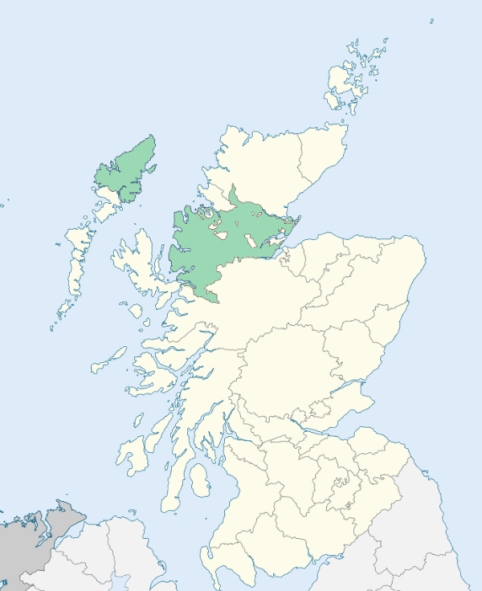
Applecross is an extensive parish on the west coast of Ross-shire. It comprises all the country between Loch Carron and Loch Torriden. (1867: The Imperial Gazetteer of Scotland, by John Marius Wilson).
Applecross, Dibaig, Lochcarron, Shieldaig, Torridon
The parish of Lochcarron had four detached parts, all surrounded by the parish of Applecross. Lochcarron detached No. 1, containing 141 acres, was situated above a mile to the south of the southern end of Loch Damh. The other three detached parts, containing 89, 46, and 491 acres respectively, were situated at the head of Loch Kishorn and on the left bank of the River Kishorn.
(a) That part of Applecross which lies east of the River Kishorn and south of the north march of Kishorn estate was transferred to Lochcarron. In this way detached parts Nos. 2, 3, and 4 of Lochcarron are united to the main portion of the parish.
(b) Lochcarron detached No. 1 and a portion of the main portion of Lochcarron lying to the east of this detached part were transferred to Applecross. See affected properties and landholders. (1892: Boundary of counties and parishes in Scotland as settled by the Boundary Commissioners under the Local Government Act, 1889, by Hay Shennan)
PRE-REFORMATION GOVERNANCE:
POST-REFORMATION GOVERNANCE:
The church of Applecross was dedicated to St Malrubh. It was a commune kirk of the Cathedral of Ross. The great monastery of Applecross was founded in 673 by St Malrubh, who remained its first abbot until his death in 722. Applecross was long a great resort of pilgrims. On 30 December 1726, the lands of Torridon and Kishorn were taken from the parish of Lochcarron and added to Applecross.
Disjoined Quoad Sacra Parishes:
Shieldaig. The first of the parliamentary churches, was declared a quoad sacra parish by the General Assembly, 25 May 1833, and was disjoined from Applecross and Lochcarron by the Court of Teinds, 19 Feb 1897.
Includes ministers, licentiates, assistants, readers, and clerks.
Applecross (QO)
Shieldaig (QS)
(1928: Fasti Ecclesiæ Scoticanæ, by Hew Scott, D. D.)
Parish registers turned over to the Registrar-General, as a result of the Registration of Births, Deaths, and Marriages (Scotland) Act of 1854. The letters B. D. and M. indicate Births (or Baptisms), Deaths (or Burials), and Marriages (or Proclamations of Banns) respectively. Numbers indicate separate volumes or books. Note: These records are by no means complete or without damage; consult the Detailed List of the Old Parochial Registers of Scotland (1872) to learn more about the condition of the records.
| OPR and RD Numbers | |||
|---|---|---|---|
| Date Range | Name | Number | Type |
| 1797-1854 | Applecross | 58 | OPR |
| 1855-1857 | Applecross | 58 | RD |
| 1858-1971 | Applecross | 58-1 | RD |
| 1857-1971 | Shieldaig | 58-2 | RD |
| 1972-2006 | Applecross | 204 | RD |
| 1972-2001 | Shieldaig | 205 | RD |
| 2009 | Highland Council, Applecross | 204 | RD |
| 2026 | (Applecross) Highland Council; Applecross Community Council | ||
(2009: Parishes and Registration Districts of Scotland - Old and New, National Records of Scotland)
Local community councils (2026) are provided as a potential source of additional information for settlements within the original boundaries of the parish. (Source)
Statistics from informal and official censuses
Beaton, Finlayson, Gillies, Kennedy, MacBeath, MacDonald, Mackenzie, MacLean, MacLennan, MacRae
Note: Names appearing in research materials, other than censuses. Simple names (First name, surname only) have been omitted unless they appear associated with large properties. All women's names, and men's names with occupations, military ranks, or peerage titles are included.
By the Reverend Mr John M'Queen.
"In a country destitute of trade and manufactures, distinct occupations are not to be expected. All the inhabitants of this parish are, in some degree, farmers and fishers. Every man is the architect of his own house; and though there be a few nominal shoemakers, scarcely a boy of fifteen but makes his own brogues. There are several boat-wrights and weavers, the former generally maintained by their employers, and paid by the piece; the latter, make their demand in money, are are paid in meal. There are 3 smiths (when no private stipulation takes place,) for the farm work; they are paid in meal, by an immemorial assessment on the different farms. There is but one miller, who, by means of the detached situation of his mill, can accommodate but a very inconsiderable district of the parish; all the rest of the corn is either carried to the mill of the neighbouring parish, or grinded by a hand mill called a quern.
Of that indolence and inquisitiveness, for which the Highlanders were formerly so remarkable, little is now to be found in this parish. The people in general are regular, and very industrious. The use of spirituous liquors is rather too prevalent, yet there are fewer instances of gross intoxication, than at any former period: Anciently they drank rarely, but always to excess; now, frequently, but for the most part with moderation. There is not so much as a tradition of suicide in the parish, nor of murder, but one, during the present century. For the 20 years past, only one person hath been imprisoned for theft, who soon afterwards enlisted for a soldier.
(1791-1799: Statistical Account of Scotland, Sir John Sinclair)
Primary Sources:
Statistical Account of Scotland (1791-1799), Volume 3, p. 369
New Statistical Account of Scotland (1834-1845), Volume 14, Section II, p. 99
See Parish Page Sources for all source information and links.