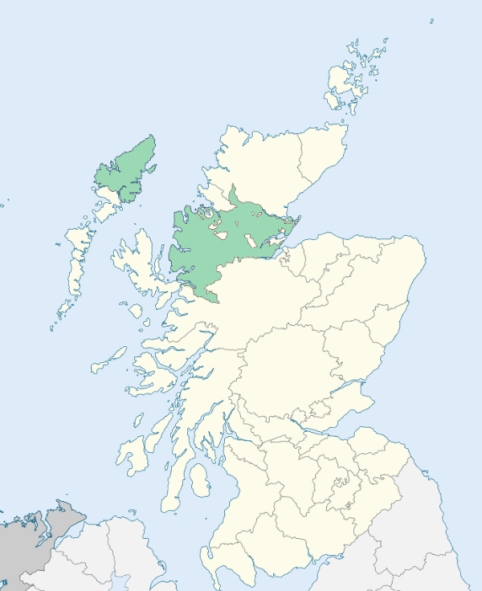
Urquhart and Logie Wester is a parish chiefly in the south-east of Ross-shire, but comprehending also a detached district of Nairnshire. It is bounded on the north-west by the River Conan and the Cromarty Firth, which separate it from Urray, Fodderty, Dingwall, and Kiltearn, on the north and east by Kirkmichael, on the south-east by Knockbain, on the south by Killearnan, and on the west by Urray. (1867: The Imperial Gazetteer of Scotland, by John Marius Wilson).
Conan Bridge, Culbockie, Duncanston, Ferintosh, Newton of Ferintosh
Balevil, Findon
A large part of the parish of Urquhart and Logie-Wester (6,385 acres out of a total acreage of 14,998) formed a detached part of the county of Nairn. It consisted simply of the barony of Ferintosh. Under various Acts, public and local, it has for some years been treated as part of Ross and Cromarty for most county purposes. The detached part is disjoined from Nairnshire and annexed to Ross and Cromarty. See affected properties and landholders. (1892: Boundary of counties and parishes in Scotland as settled by the Boundary Commissioners under the Local Government Act, 1889, by Hay Shennan)
PRE-REFORMATION GOVERNANCE:
POST-REFORMATION GOVERNANCE:
The parishes of Urquhart and Logie Wester were united in the latter half of the fifteenth century. The prebend of Urquhart was held by the Treasurer of the Cathedral of Fortrose. The church was dedicated to St Malrubh, who was murdered by pirates at Ferintosh in 722. At Bridge of Conan, in this parish, there is a mission church.
Includes ministers, licentiates, assistants, readers, and clerks.
(1928: Fasti Ecclesiæ Scoticanæ, by Hew Scott, D. D.)
Parish registers turned over to the Registrar-General, as a result of the Registration of Births, Deaths, and Marriages (Scotland) Act of 1854. The letters B. D. and M. indicate Births (or Baptisms), Deaths (or Burials), and Marriages (or Proclamations of Banns) respectively. Numbers indicate separate volumes or books. Note: These records are by no means complete or without damage; consult the Detailed List of the Old Parochial Registers of Scotland (1872) to learn more about the condition of the records.
| OPR and RD Numbers | |||
|---|---|---|---|
| Date Range | Name | Number | Type |
| 1715-1854 | Urquhart and Logie Wester | 84 | OPR |
| 1855-1967 | Urquhart and Logie Wester | 84 | RD |
| 2009 | Highland, Dingwall and Carnoch | 196 | RD |
| 2026 | Highland Council; Glenurquhart Community Council | ||
(2009: Parishes and Registration Districts of Scotland - Old and New, National Records of Scotland)
Local community councils (2026) are provided as a potential source of additional information for settlements within the original boundaries of the parish. (Source)
Statistics from informal and official censuses
Urquhart: Cameron, Fowler, Fraser, MacDonald, Mackenzie, MacLennan, MacRae, Munro, Ross, Urquhart
Logie Wester: Cameron, Fraser, MacDonald, Mackenzie, MacLean, MacLennan, MacRae, Matheson, Ross, Urquhart
Note: Names appearing in research materials, other than censuses. Simple names (First name, surname only) have been omitted unless they appear associated with large properties. All women's names, and men's names with occupations, military ranks, or peerage titles are included.
By the Reverend Mr Charles Calder.
"There are in this parish 34 masons, 16 carpenters, 8 millers, 29 weavers, 29 tailors, 18 shoemakers, and 7 smiths. Gaelic is the language commonly spoken, and universally understood in this parish. The English is, however, understood by a great many of the inhabitants. Public divine service is performed in both languages. Whilst the people of this parish enjoyed peculiar advantages, as to their external situation, their character was strongly marked, by a correspondent hospitality of disposition, and liberality to those in distress. Though, as to the generality, their ability is now circumscribed, the same dispositions still prevail, and are ready to show themselves by suitable exertions on every proper occasion. Populous as this parish is, there has not been an instance during the time of the present incumbent, which is 18 years, nor long before, to the best of his knowledge, of an individual belonging to it being guilty of a capital offence, or even suffering banishment."
(This section contains excerpts, at times restructured or paraphrased, from an article appearing in Statistical Account of Scotland, Sir John Sinclair, 1791-1799)
Primary Sources:
Statistical Account of Scotland (1791-1799), Volume 5, p. 203
New Statistical Account of Scotland (1834-1845), Volume 14, Section II, p. 363
See Parish Page Sources for all source information and links.