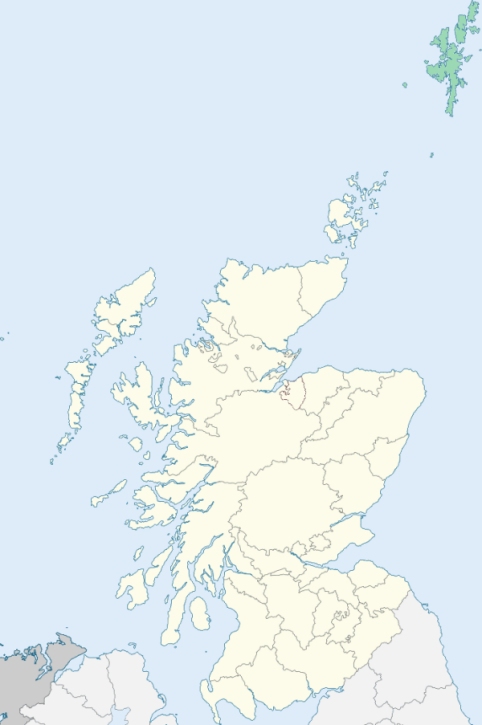
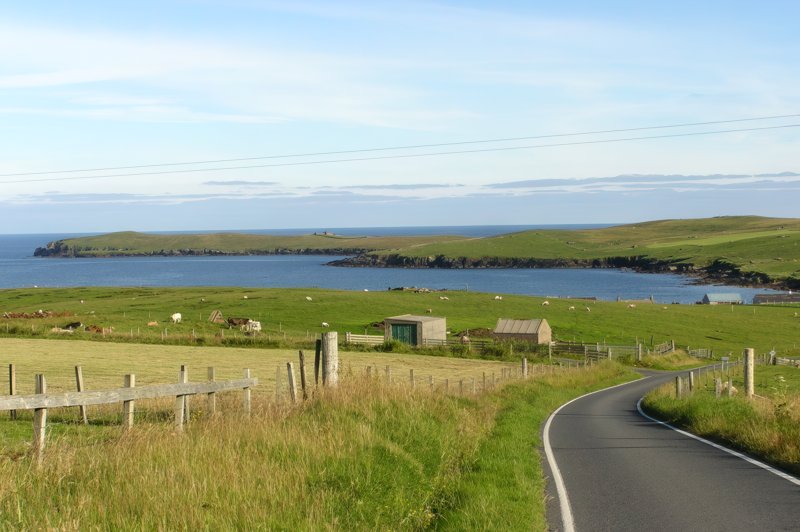
Dunrossness is a parish in the south of Shetland. The main body of it is the southern part of the mainland, to the length of about 18 miles in a straight line, bounded on the north by Lerwick, and on all other sides by the sea. (1867: The Imperial Gazetteer of Scotland, by John Marius Wilson).
Asta, Boddam, Bousta, Clumlee or Clumlie, Conningsburgh or Cunningsburgh, Cruister, Dunrossness, Exnaboe, Fladibister, Gardens, Garderhouse, Hoswick, Levanwick or Levenwick, Noness, Ockraquay, Sandwick, Scalloway
PRE-REFORMATION GOVERNANCE:
POST-REFORMATION GOVERNANCE:
These parishes were united in the 16th century. In 1600, or very soon after that, Sandwick and Cunningsburgh were joined, making a union of four parishes. The united parishes of Sandwick and Cunningsburgh were severed again quoad sacra from Dunrossness and Fair Isle, 24 Oct 1870.
Dunrossness. There has been much controversy as to the patron saint of Dunrossness. The likeliest account seems to be that which states that the parish church was dedicated to St Matthew. At St Ninian's Isle, on the western coast of Dunrossness, there stood a chapel of St Ninian. At Clumlie, also in this parish, there was a chapel of St Columba. At Bigton now stands a mission chapel.
Fair Isle. The old church of this parish was dedicated to the Holy Rood. The church of Fair is now in use as a mission chapel.
Sandwick. Sandwick was dedicated to St Magnus. At Levanwick, within the bounds, there was a chapel of St Levan.
Cunningsburgh. The church of Cunningsburgh was dedicated to St Columba. Its place is now occupied by a mission chapel.
Includes ministers, licentiates, assistants, readers, and clerks.
Dunrossness and Fair Isle (QO)
Sandwick and Cunningsburgh (QO)
(1928: Fasti Ecclesiæ Scoticanæ, by Hew Scott, D. D.)
Parish registers turned over to the Registrar-General, as a result of the Registration of Births, Deaths, and Marriages (Scotland) Act of 1854. The letters B. D. and M. indicate Births (or Baptisms), Deaths (or Burials), and Marriages (or Proclamations of Banns) respectively. Numbers indicate separate volumes or books. Note: These records are by no means complete or without damage; consult the Detailed List of the Old Parochial Registers of Scotland (1872) to learn more about the condition of the records.
| OPR and RD Numbers | |||
|---|---|---|---|
| Date Range | Name | Number | Type |
| 1730-1752 | Sandwick and Cunningsburgh | 3 | OPR |
| 1753-1766 | Dunrossness, Sandwick & Cunningsburgh | 3 | OPR |
| 1767-1854 | Dunrossness, Sandwick & Cunningsburgh, and Fair Isle | 3 | OPR |
| 1855-1971 | Sandwick and Cunningsburgh | 3-1 | RD |
| 1855-1971 | Dunrossness | 3-2 | RD |
| 1855-1971 | Fair Isle | 3-3 | RD |
| 1972-2006 | Sandwick and Cunningsburgh | 120 | RD |
| 1972-2006 | Dunrossness | 121 | RD |
| 1972-2006 | Fair Isle | 122 | RD |
| 2009 | Shetland Islands, Sandwick and Cunningsburgh | 120 | RD |
| 2009 | Shetland Islands, Dunrossness | 121 | RD |
| 2009 | Shetland Islands, Fair Isle | 122 | RD |
| 2026 | (Sandwick) Shetland Islands Council; Sandwick Community Council | ||
| 2026 | (Cunningsburgh) Shetland Islands Council; Gulberwick, Quarff and Cunningsburgh Community Council | ||
| 2026 | (Dunrossness) Shetland Islands Council; Dunrossness Community Council | ||
| 2026 | (Fair Isle) Shetland Islands Council; Fair Isle Community Council | ||
(2009: Parishes and Registration Districts of Scotland - Old and New, National Records of Scotland)
Local community councils (2026) are provided as a potential source of additional information for settlements within the original boundaries of the parish. (Source)
Statistics from informal and official censuses
Dunrossness: Duncan, Goudie, Harper, Henderson, Irvine, Jamieson, Leslie, Sinclair, Smith, Williamson
Fair Isle: Anderson, Irvine, Jamieson, Laurence, Leslie, Stout, Williamson, Wilson
Note: Names appearing in research materials, other than censuses. Simple names (First name, surname only) have been omitted unless they appear associated with large properties. All women's names, and men's names with occupations, military ranks, or peerage titles are included.
By the Reverend Mr John Mill.
"In 1790, the families, including Fair Isle, were 570; and the inhabitants 3327. The number of females greatly exceeds the males, as the young men leave the country in numbers every year; being commonly inclined to a seafaring life, they resort to England and Holland, but chiefly to London, where they serve on board the navy, merchant ships, or Greenlanders. There are no manufactures here, unless for domestic use, viz. blankets and coarse cloth, excepting, perhaps, some stockings, gloves, and garters, sold to the Dutch fishers."
(This section contains excerpts, at times restructured or paraphrased, from an article appearing in Statistical Account of Scotland, Sir John Sinclair, 1791-1799)
Primary Sources:
Statistical Account of Scotland (1791-1799), Volume 7, p. 391
New Statistical Account of Scotland (1834-1845), Volume 15, Section IV, p. 93
See Parish Page Sources for all source information and links.