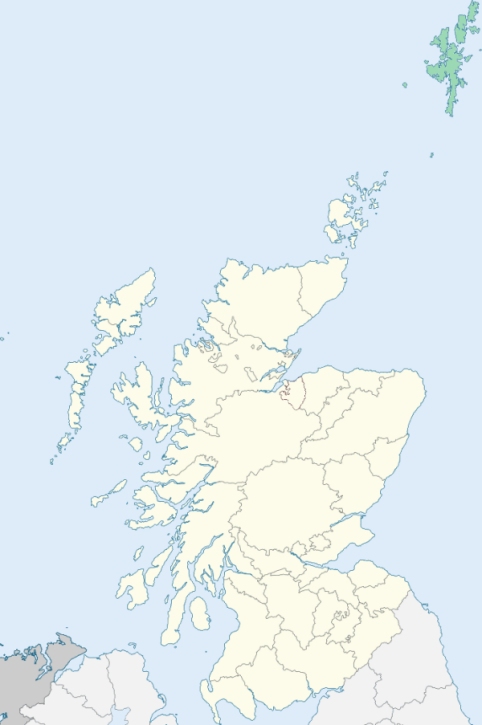
Lerwick and Gulberwick is a united parish in the mainland of Shetland. It is bounded on the north by Tingwall, on the east by the sea, and on the south by Cunningsburgh. Gulberwick was previously incorporated with Tingwall. (1867: The Imperial Gazetteer of Scotland, by John Marius Wilson).
Brae, Brenister, Brough, Dale, Fitch, Fracafield, Gulberwick, Lerwick, Sound
PRE-REFORMATION GOVERNANCE:
POST-REFORMATION GOVERNANCE:
There appears to have been a church erected in Lerwick some time before 1685. It was under repair in 1688. A sort of irregular ministry seems to have continued until 1701. The parish was disjoined from Tingwall shortly after 6 Mar 1701. A further disjunction of Sound and Gulberwick was made in 1722 and added to this charge. The present church was opened on 22 Mar 1829.
Includes ministers, licentiates, assistants, readers, and clerks.
(1928: Fasti Ecclesiæ Scoticanæ, by Hew Scott, D. D.)
Parish registers turned over to the Registrar-General, as a result of the Registration of Births, Deaths, and Marriages (Scotland) Act of 1854. The letters B. D. and M. indicate Births (or Baptisms), Deaths (or Burials), and Marriages (or Proclamations of Banns) respectively. Numbers indicate separate volumes or books. Note: These records are by no means complete or without damage; consult the Detailed List of the Old Parochial Registers of Scotland (1872) to learn more about the condition of the records.
| OPR and RD Numbers | |||
|---|---|---|---|
| Date Range | Name | Number | Type |
| 1706-1854 | Lerwick | 5 | OPR |
| 1855-1892 | Lerwick | 5 | RD |
| 1893-1971 | Lerwick | 5-1 | RD |
| 1893-1896 | Burra and Quarff | 5-2 | RD |
| 1897-1971 | Burra Isles | 5-2 | RD |
| 1972-2006 | Lerwick | 118 | RD |
| 2009 | Shetland Islands, Lerwick | 118 | RD |
| 2026 | Shetland Islands Council; Lerwick Community Council | ||
(2009: Parishes and Registration Districts of Scotland - Old and New, National Records of Scotland)
Local community councils (2026) are provided as a potential source of additional information for settlements within the original boundaries of the parish. (Source)
Statistics from informal and official censuses
Anderson, Irvine, Jamieson, Johnson, Leask, Robertson, Sinclair, Smith, Tait, Williamson
Note: Names appearing in research materials, other than censuses. Simple names (First name, surname only) have been omitted unless they appear associated with large properties. All women's names, and men's names with occupations, military ranks, or peerage titles are included.
By the Reverend Mr James Sands.
"The number of handicraftsmen and apprentices in Lerwick is very considerable. The men of the lower rank are almost all seamen and fishermen, the rest merchants and shopkeepers. Lerwick being the seat of justice, and the place of the sheriff substitute's residence, is not without a few practitioners in the law: Two licenced procurators reside in it. There are two surgeons in the parish, regularly bred to the business. The inhabitants are all of the Established Church. They are generally sober, inoffensive, and obliging; and such is the humanity and attention to those in easy circumstances, that, even in times of the greatest scarcity, none have been known to die for want."
(This section contains excerpts, at times restructured or paraphrased, from an article appearing in Statistical Account of Scotland, Sir John Sinclair, 1791-1799)
Primary Sources:
Statistical Account of Scotland (1791-1799), Volume 3, p. 414
New Statistical Account of Scotland (1834-1845), Volume 15, Section IV, p. 1
See Parish Page Sources for all source information and links.