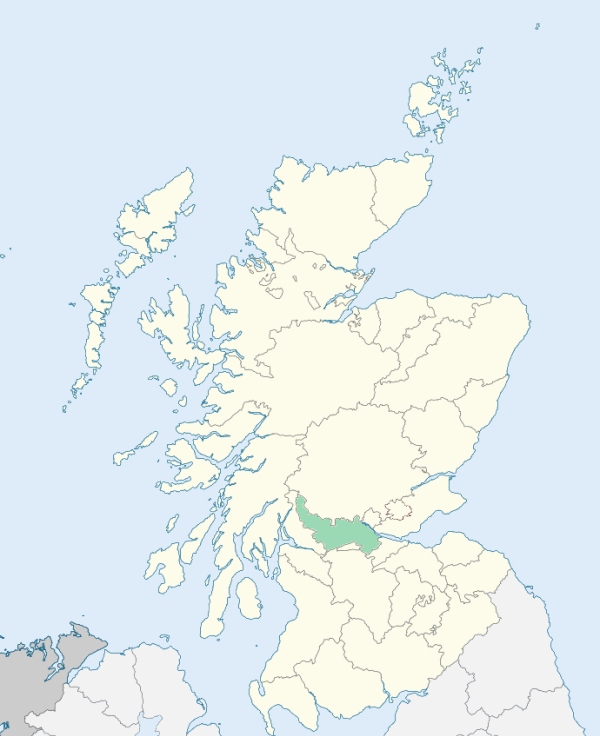
Fintry is a parish a little west of the centre of Stirlingshire. It is bounded by Killearn, Balfron, Gargunnock, St Ninians, Kilsyth, and Campsie. (1867: The Imperial Gazetteer of Scotland, by John Marius Wilson).
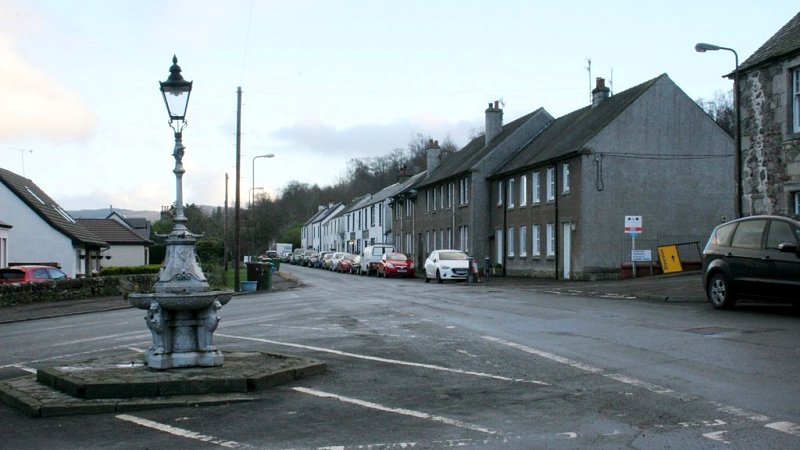
Clachan, Fintry, Gonachan or Gonnochan, Newtown
Culcreuch
PRE-REFORMATION GOVERNANCE:
POST-REFORMATION GOVERNANCE:
The church of Fintry, dedicated to St Modan, belonged to the Collegiate Church of St Mary at Dunbarton. Fintry Church was rebuilt in 1823.
Includes ministers, licentiates, assistants, readers, and clerks.
(1928: Fasti Ecclesiæ Scoticanæ, by Hew Scott, D. D.)
Parish registers turned over to the Registrar-General, as a result of the Registration of Births, Deaths, and Marriages (Scotland) Act of 1854. The letters B. D. and M. indicate Births (or Baptisms), Deaths (or Burials), and Marriages (or Proclamations of Banns) respectively. Numbers indicate separate volumes or books. Note: These records are by no means complete or without damage; consult the Detailed List of the Old Parochial Registers of Scotland (1872) to learn more about the condition of the records.
| OPR and RD Numbers | |||
|---|---|---|---|
| Date Range | Name | Number | Type |
| 1659-1854 | Fintry | 480 | OPR |
| 1855-1969 | Fintry | 480 | RD |
| 2009 | Stirling, Balfron | 472 | RD |
| 2026 | Stirling Council; Fintry Community Council | ||
(2009: Parishes and Registration Districts of Scotland - Old and New, National Records of Scotland)
Local community councils (2026) are provided as a potential source of additional information for settlements within the original boundaries of the parish. (Source)
Statistics from informal and official censuses
Adams, Alexander, Buchanan, Cowan, Edmond, Gray, Jardine, Potts, Robertson, Scott
Note: Names appearing in research materials, other than censuses. Simple names (First name, surname only) have been omitted unless they appear associated with large properties. All women's names, and men's names with occupations, military ranks, or peerage titles are included.
By the Reverend Mr Gavin Gibb, Minister of Strathblane.
"The population in 1793 was 543. Of these there are 273 males, and 270 females, 136 of whom are under 10 years of age. There are 5 weavers, 3 tailors, 2 smiths, and 1 shoemaker.
The population of this parish, like that of most other grazing countries in Scotland, has decreased very much within these 40 years. Since 1755 it has decreased more than a third part. There are several farms in the parish, upon which from 14 to 20 families formerly lived, where only from 5 to 8 families now reside. This depopulation is evidently caused by throwing several small farms into one, which enables the possessor to pay a greater rent to the proprietor, and at the same time to live better in his own family, than when parcelled out in small portions. Nor is this counted disadvantageous to those who are ejected, as the great demand for hands by manufacturing companies, affords them a ready reception; where they and their children can earn more, and live better, than upon a small farm.
This parish is on the eve of experiencing a great change, by the introduction of manufactures, on a very large scale. A cotton mill is just erected on the estate of Culcruich, which, when finished will employ 1000 hands."
(This section contains excerpts, at times restructured or paraphrased, from an article appearing in Statistical Account of Scotland, Sir John Sinclair, 1791-1799)
Primary Sources:
Statistical Account of Scotland (1791-1799), Volume 11, p. 371
New Statistical Account of Scotland (1834-1845), Volume 8, Section II, p. 38
See Parish Page Sources for all source information and links.