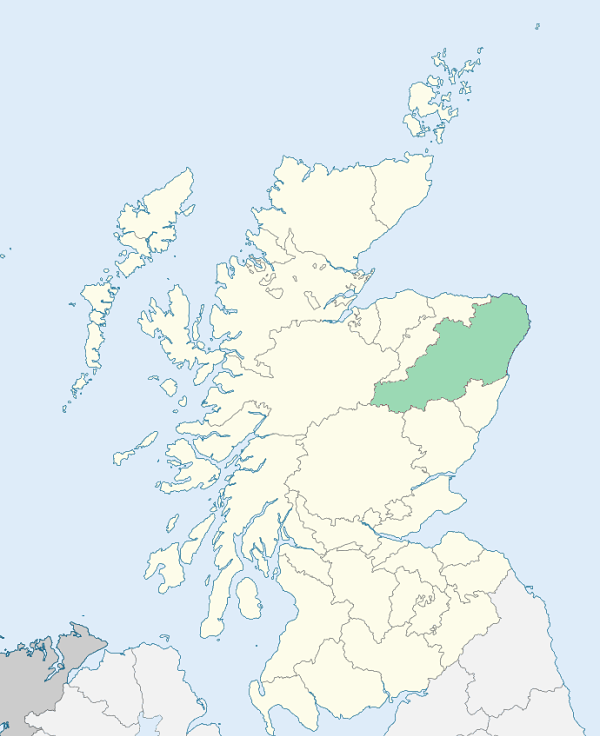
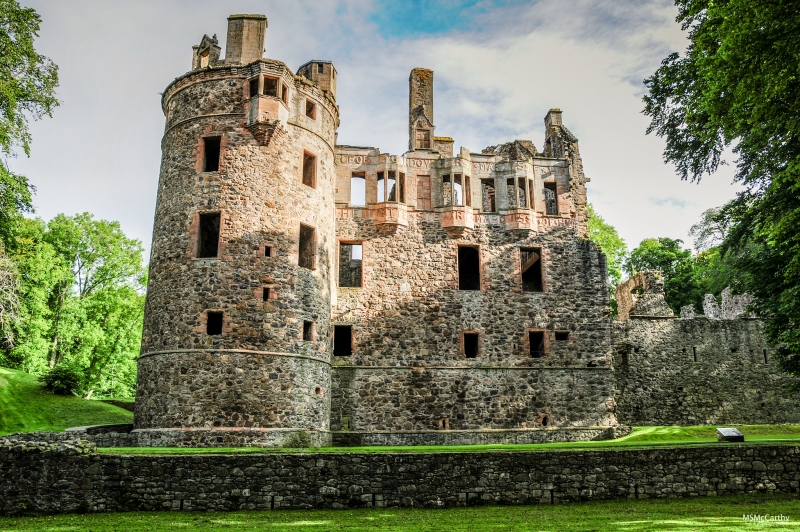
Huntly is a parish in the Strathbogie district of Aberdeenshire. It is bounded by the parishes of Rothiemay, Forgue, Drumblade, Gartly, Glass, and Cairnie. It comprehends the ancient parishes of Dumbennan and Kinnoir. Dumbennan is surrounded by hills, and is said to have thence got its name, which signifies "the foot of the hill." It is situated at the termination of the straths of the Bogie and the Deveron, and comprises the peninsular hill of Clashmach, above the confluence of these streams. Kinnoir extends about 6 miles along the right side of the Deveron, below the influx of the Bogie, but is separated from Dunbennan, for more than a quarter of a mile from the confluence of the rivers upwards, by an intersection of Drumblade. The Bogie divides the united parish, for about 2 or 3 miles, from Drumblade, and the Deveron, from portions of Glass, Cairnie, and Rothiemay. (1867: The Imperial Gazetteer of Scotland, by John Marius Wilson).
Achnacy, Huntly
PRE-REFORMATION GOVERNANCE:
POST-REFORMATION GOVERNANCE:
The parishes of Dunbennan and Kinnoir were united about 1567 and the parish was called Kinnoir and Dunbennan. About 1615 part of Drumdelgie lying on the south side of the Deveron was added. On 17 January 1725 the name Huntly was adopted for the united parish.
Dunbennan. The church of Dunbennan was dedicated to St Peter. In 1727 the parish church was removed from Dunbennan to a place called of old Tirasowl, now within the town of Huntly. Huntly held a fair of St Peter and a Lammas fair.
Kinnoir. The church of Kinnoir was dedicated to St Mungo, and in the parish is St Mungo's Hill. There were also within its bounds Wells of St Mungo and St John.
Includes ministers, licentiates, assistants, readers, and clerks.
(1928: Fasti Ecclesiæ Scoticanæ, by Hew Scott, D. D.)
Parish registers turned over to the Registrar-General, as a result of the Registration of Births, Deaths, and Marriages (Scotland) Act of 1854. The letters B. D. and M. indicate Births (or Baptisms), Deaths (or Burials), and Marriages (or Proclamations of Banns) respectively. Numbers indicate separate volumes or books. Note: These records are by no means complete or without damage; consult the Detailed List of the Old Parochial Registers of Scotland (1872) to learn more about the condition of the records.
| OPR and RD Numbers | |||
|---|---|---|---|
| Date Range | Name | Number | Type |
| 1683-1854 | Huntly | 202 | OPR |
| 1855-1971 | Huntly | 202 | RD |
| 1972-2006 | Huntly | 317 | RD |
| 2009 | Aberdeenshire, Huntly | 317 | RD |
| 2026 | Aberdeenshire Council; Huntly Community Council | ||
(2009: Parishes and Registration Districts of Scotland - Old and New, National Records of Scotland)
Local community councils (2026) are provided as a potential source of additional information for settlements within the original boundaries of the parish. (Source)
Statistics from informal and official censuses
Duncan, Fraser, Gordon, Grant, Milne, Mitchell, Morrison, Simpson, Smith, Wilson
Note: Names appearing in research materials, other than censuses. Simple names (First name, surname only) have been omitted unless they appear associated with large properties. All women's names, and men's names with occupations, military ranks, or peerage titles are included.
By the Reverend Mr Robert Innes, Minister.
"The number of inhabitants is not exactly ascertained, but old and young, in town and country may be safely stated at 3600. The return in 1755 was only 1900; there is therefore an increase of, at least, 1700.
There are employed in the town of Huntly 52 flax-dressers. There are likewise 209 weavers. There is also a cotton manufactory established in this place, but it is yet in an infant state. There are about 32 wrights, including wheel and cart-wrights. There are also masons, blacksmiths, tailors, &c. in proportion.
The inhabitants in general are of that charitable disposition, which tends to invite many poor people, and even whole families, from other parts, to reside among them."
(This section contains excerpts, at times restructured or paraphrased, from an article appearing in Statistical Account of Scotland, Sir John Sinclair, 1791-1799)
Primary Sources:
Statistical Account of Scotland (1791-1799), Volume 11, p. 467
New Statistical Account of Scotland (1834-1845), Volume 12, p. 1036
See Parish Page Sources for all source information and links.