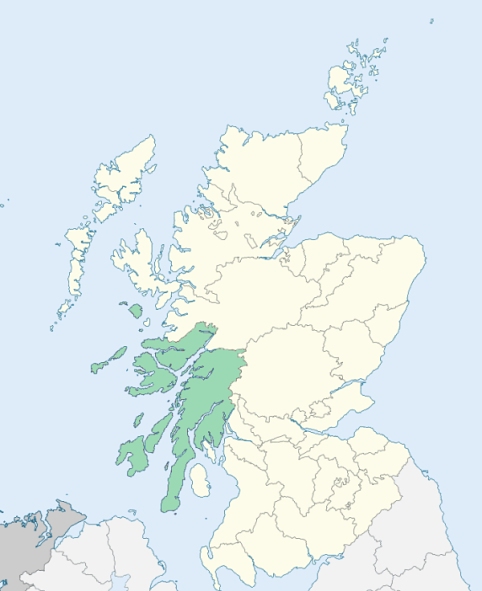
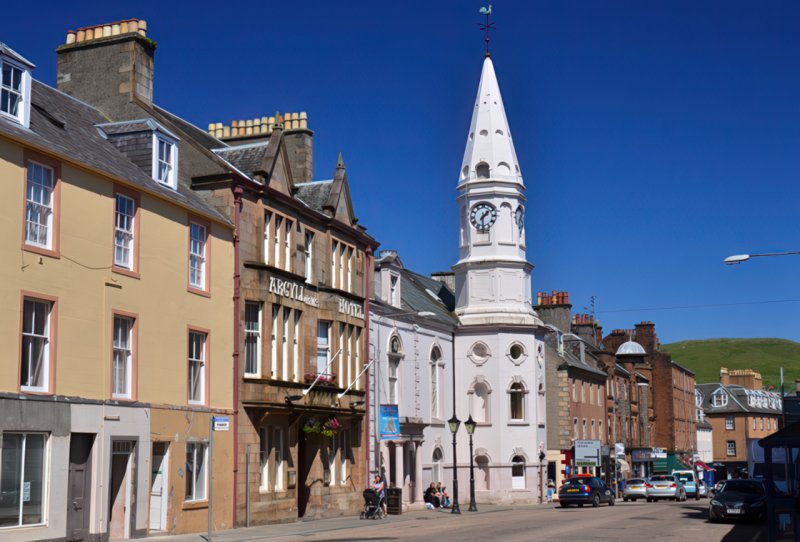
Campbeltown is a parish in the Kintyre district of Argyleshire. It is bounded on the north by the parishes of Killean and Saddell, on the east by the Firth of Clyde, on the south by the parish of Southend, and on the west by the Atlantic Ocean. (1867: The Imperial Gazetteer of Scotland, by John Marius Wilson).
Campbeltown, Daintober, Dalvaddy, Drumlemble
Ardnacross, Limcraigs
PRE-REFORMATION GOVERNANCE:
POST-REFORMATION GOVERNANCE:
The parishes of Kilchiaran, Kilchusland, and Kilmichael in Kintyre were united in 1617. Kilchievan was added to this union in 1671.
Kilchiaran. In the sixth century, St Kiaran came from Ireland as a Christian missionary to the people of Kintyre. A cavern on the seashore of this parish, called Uamh Chiarain (Kiaran's Cave), is pointed out as having served him for a temporary dwelling. The adjoining bay was termed Loch Chiarain. A church, standing of old on the side of the loch, was dedicated to St Kiaran. Kilchiaran was a prebend of Lismore, and belonged to the Abbey of Paisley. In 1662, a new church for the parish was built at Dalruadhan. From its site, this place came to be styled Ceann Loch Chiarain (the End of Loch Chiarain), and often merely Kinloch. At times we find both church and parish called Loch Head. The township appears to have been first named Campbeltown in 1672, but the parish continued to be styled Kilchiarain until 1700. In that year King William granted a charter, making the place a royal burgh, and calling it Campbeltown. A building in the town, which was once the parish church, and is now used for mission services, is styled Kinloch Chapel. Fairs used to be held in Campbeltown, at Lammas and Michaelmas. During the seventeenth century many refugees from the western Lowlands found shelter in this part of Kintyre under the protection of the Marquess of Argyll. Not knowing Gaelic, they could not join in the worship of the parish churches. Therefore, in 1638 a chapel was built for them at Kilchiaran.
Kilchuslan. The ancient church of Kilchuslan now stands ruined in its old churchyard near the shore. It was dedicated to St Constantine the Martyr.
Kilmichael in Kintyre. The church of Kilmichael was a prebend of Lismore. It was dedicated to St Michael.
Kilchievan. The ancient church of Kilchievan was dedicated to Caomhghan (Kevin) of Glendalough. In 1617 the parish of Kilchievan was united to Kilcholumkill and Kilblaan. In 1671 that union was dissolved, and Kilchievan was then joined to Kilchiaran, Kilchusland, and Kilmichael.
Includes ministers, licentiates, assistants, readers, and clerks.
Campbeltown (Kilchiaran, Kilchusland, and Kilmichael) (QO)
Kilchievan (QO)
(1928: Fasti Ecclesiæ Scoticanæ, by Hew Scott, D. D.)
Parish registers turned over to the Registrar-General, as a result of the Registration of Births, Deaths, and Marriages (Scotland) Act of 1854. The letters B. D. and M. indicate Births (or Baptisms), Deaths (or Burials), and Marriages (or Proclamations of Banns) respectively. Numbers indicate separate volumes or books. Note: These records are by no means complete or without damage; consult the Detailed List of the Old Parochial Registers of Scotland (1872) to learn more about the condition of the records.
| OPR and RD Numbers | |||
|---|---|---|---|
| Date Range | Name | Number | Type |
| 1659-1854 | Campbeltown | 507 | OPR |
| 1855-1856 | Campbeltown Burgh | 507-1 | RD |
| 1855-1856 | Campbeltown Landward | 507-2 | RD |
| 1857-1971 | Campbeltown | 507 | RD |
| 1972-2006 | Campbeltown | 536 | RD |
| 2007-2008 | Campbeltown, Argyll and Bute | 536 | RD |
| 2009 | Argyll and Bute, Campbeltown | 536 | RD |
| 2026 | Argyll and Bute Council; Campbeltown Community Council | ||
(2009: Parishes and Registration Districts of Scotland - Old and New, National Records of Scotland)
Local community councils (2026) are provided as a potential source of additional information for settlements within the original boundaries of the parish. (Source)
Statistics from informal and official censuses
Brown, Campbell, Galbraith, Kelly, Martin, Mitchell, Morrison, Smith, Stewart, Thomson
Note: Names appearing in research materials, other than censuses. Simple names (First name, surname only) have been omitted unless they appear associated with large properties. All women's names, and men's names with occupations, military ranks, or peerage titles are included.
By the Reverend Dr John Smith, Minister.
"The inhabitants of the town are so apt to fluctuate, that it is not easy to ascertain their numbers with precision. They are computed at 5000. In spring 1791, the exact number of souls in the landward part of the parish was 3715.
Campbeltown, originally a small fishing village, was erected into a royal burgh in 1701. It is governed by a provost, two baillies, a dean of guild, counsellors, and a treasurer.
The principal trade of the place is the fishing of herrings. Next to the fishing of herrings, the business most attended to in Campbelton, is the distilling of whisky. For these 2 or three years past, a number of young girls are profitably employed, in tambouring muslins sent from Glasgow, and contribute to the support of themselves and parents. About 50 weavers are also employed in working cotton yarn from the same place.
The people of Campbelton, in their dress and manners, differ little from those of other seaport towns in the kingdom, of the same magnitude. They are, in general, orderly and well behaved; courteous to strangers, and kind to the poor. They afford perhaps too much business to attorneys or writers, of whom half a dozen reside in the town. In the country part of the parish, the people are more regular and frugal. There they usually work hard, live poorly, and are soon old."
(This section contains excerpts, at times restructured or paraphrased, from an article appearing in Statistical Account of Scotland, Sir John Sinclair, 1791-1799)
Primary Sources:
Statistical Account of Scotland (1791-1799), Volume 10, p. 571
New Statistical Account of Scotland (1834-1845), Volume 7, Section II, p. 453
See Parish Page Sources for all source information and links.