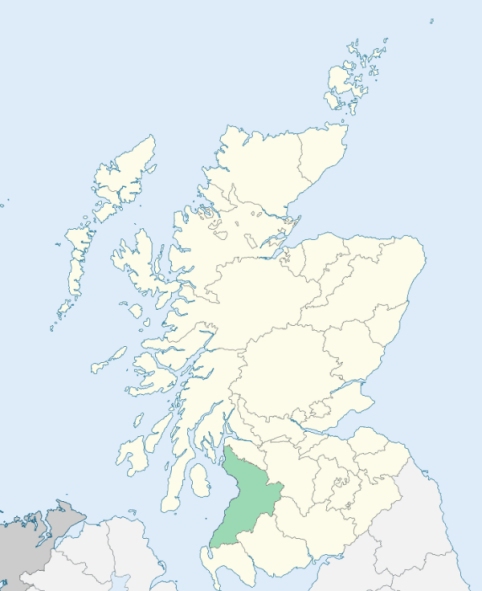
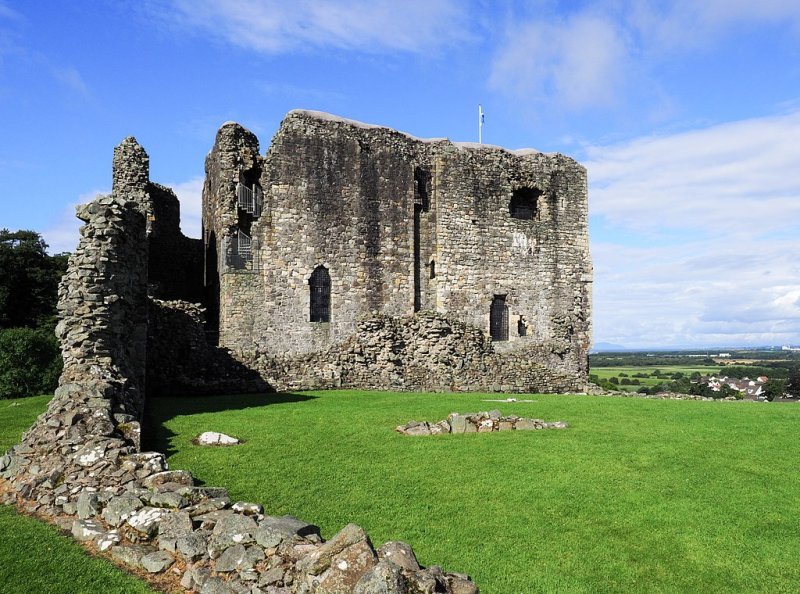
Dundonald is a parish in the north-west of Kyle, Ayrshire. It is bounded on the north by Irvine Water, which separates it from Irvine, Dreghorn, and Kilmaurs, on the east by Riccarton and Craigie, on the south-east by Symington and Monkton, and on the south-west and west by the Firth of Clyde. (1867: The Imperial Gazetteer of Scotland, by John Marius Wilson).
Dundonald, Fullarton, Loans, Old Rome, Rumford, Shewalton, Troon
Auchans, Curreath, Fullarton House, Hillhouse, Newfield, Shewalton House
PRE-REFORMATION GOVERNANCE:
POST-REFORMATION GOVERNANCE:
The church of Dundonald was dedicated to St Giles. It belonged to the Abbey of Paisley. There was a chapel in the parish at Crosbie. In 1651 the Presbytery of Ayr annexed the lands of Crosbie to the parish of Monkton, but in 1688 the lands thus conveyed were given back again to Dundonald. There was a chapel of St Ninian near the Castle of Dundonald. At the Friars' Croft, on the Water of Irvine, in this parish, the Carmelites had a small priory. It stood on the river bank opposite the Burgh of Irvine. Dundonald church was rebuilt in 1803.
Disjoined Quoad Sacra Parishes:
Fullarton. The church, erected in 1836, was constituted a Chapel-of-Ease and annexed to the Presbytery of Irvine by General Assembly, 29 May 1837. The parish was disjoined from Dundonald and erected by the Court of Teinds, 23 November 1874, and annexed to the Presbytery of Ayr.
Troon. There was previously at Troon a chapel of St Medan. In 1836 a mission chapel was built here, and the General Assembly granted a constitution and assigned a district to the chapel. The parish of Troon was disjoined from Dundonald, 18 March 1878.
Includes ministers, licentiates, assistants, readers, and clerks.
Dundonald (QO)
Fullarton (QS)
Troon (QS)
(1928: Fasti Ecclesiæ Scoticanæ, by Hew Scott, D. D.)
Parish registers turned over to the Registrar-General, as a result of the Registration of Births, Deaths, and Marriages (Scotland) Act of 1854. The letters B. D. and M. indicate Births (or Baptisms), Deaths (or Burials), and Marriages (or Proclamations of Banns) respectively. Numbers indicate separate volumes or books. Note: These records are by no means complete or without damage; consult the Detailed List of the Old Parochial Registers of Scotland (1872) to learn more about the condition of the records.
| OPR and RD Numbers | |||
|---|---|---|---|
| Date Range | Name | Number | Type |
| 1673-1854 | Dundonald | 590 | OPR |
| 1855-1869 | Dundonald | 590 | RD |
| 1870-1969 | Dundonald | 590-1 | RD |
| 1870-1971 | Troon | 590-2 | RD |
| 1972-2005 | Troon | 674 | RD |
| 2006-2008 | Troon, South Ayrshire | 674 | RD |
| 2009 | South Ayrshire, Troon | 674 | RD |
| 2026 | (Dundonald) South Ayrshire Council; Dundonald Community Council | ||
| 2026 | (Troon) South Ayrshire Council; Troon Community Council | ||
(2009: Parishes and Registration Districts of Scotland - Old and New, National Records of Scotland)
Local community councils (2026) are provided as a potential source of additional information for settlements within the original boundaries of the parish. (Source)
Statistics from informal and official censuses
Dundonald: Boyd, Brown, Campbell, Hunter, Reid, Smith, Stewart, Wallace, Wilson, Young
Troon: Bulger, Carmichael, Crossan, Hill, Ingram, Kelly, Nicolson, Ryan, Sutherland, Withers
Note: Names appearing in research materials, other than censuses. Simple names (First name, surname only) have been omitted unless they appear associated with large properties. All women's names, and men's names with occupations, military ranks, or peerage titles are included.
By the Reverend Mr Robert Duncan.
"In 1792 the number of souls was 1317; of these there were 658 males, and 659 females, of whom 338 were below 10 years of age. On account of a coalwork, a village, named Rumford, has of late years started up close by Fairlie bridge. It contains at present 74 inhabitants. A cotton work has lately been erected in the village of Dundonald, which employs 30 persons, old and young. Excepting 6 weavers, 3 tailors, 4 shoemakers, 2 masons, 4 joiners, and 3 smiths, the rest of the inhabitants, able for work, are employed in agriculture.
There are 4 licensed public houses in the parish; but the inhabitants are, in general, very sober and industrious. Their mode of living is much improved within these 20 years. Their way of living and their industry have a mutual influence.
The Troon is an excellent situation for sea bathing, and is much resorted to by the inhabitants of Kilmarnock, and of other inland parts. People from Elgin carry on fishing of salmon at the Troon."
(This section contains excerpts, at times restructured or paraphrased, from an article appearing in Statistical Account of Scotland, Sir John Sinclair, 1791-1799)
Primary Sources:
Statistical Account of Scotland (1791-1799), Volume 7, p. 615
New Statistical Account of Scotland (1834-1845), Volume 5, Section I, p. 666
See Parish Page Sources for all source information and links.