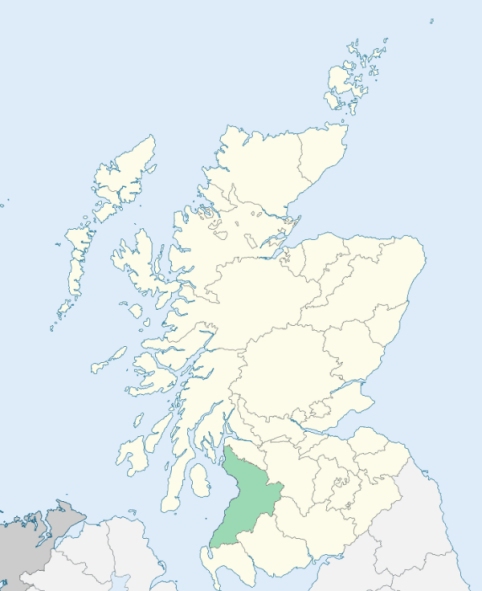
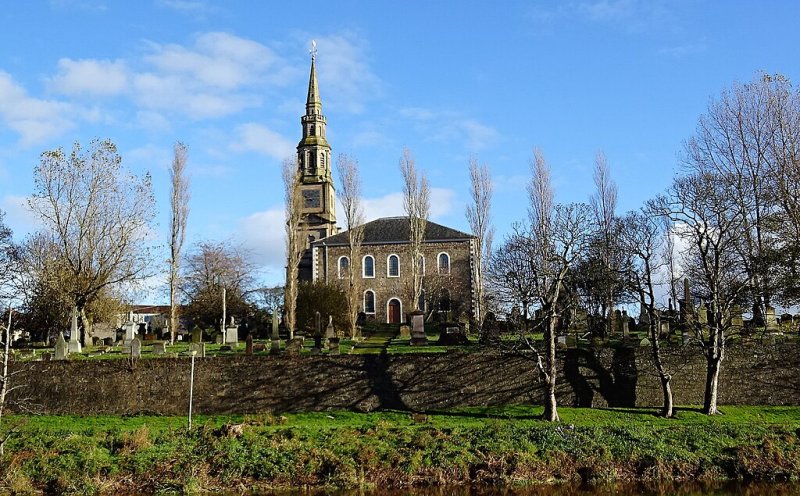
Irvine is a parish on the southern border of the district of Cunningham, Ayrshire. It is bounded by the parishes of Stevenston, Kilwinning, Stewarton, Dreghorn, and Dundonald. On all sides, except the north-east, its boundary is traced by river; on the east and south-east by the Annack, on the south, by the Irvine, on the south-west by the Garnock, and on the north-west and north, by the Lugton. (1867: The Imperial Gazetteer of Scotland, by John Marius Wilson).
Alnick or Annick Lodge, Bartonholm, Irvine
PRE-REFORMATION GOVERNANCE:
POST-REFORMATION GOVERNANCE:
The church of Irvine belonged to the Abbey of Kilwinning. In early times it was dedicated to St Inan, but there was a later dedication to St Mary. There were two chapels in the parish, St Mary's on the Water of Irvine near the church, and the other at Bourtriehill. Close to the churchyard stood the priory of the White Friars of Irvine, founded in the fourteenth century by one of the Fullartons of that ilk. Irvine church was rebuilt on a new site in 1774. Two fairs in the year were held at Irvine in honour of St Mary, the one on the 15th of August, the feast of her Assumption, and the other on the 8th of September, the day of her Nativity.
Disjoined Quoad Sacra Parishes:
Fergushill. A church was built here in 1880. The parish was disjoined from Kilwinning, Irvine, and Stewarton, 15 March 1886.
Includes ministers, licentiates, assistants, readers, and clerks.
Irvine (QO)
Fergushill (QS)
(1928: Fasti Ecclesiæ Scoticanæ, by Hew Scott, D. D.)
Parish registers turned over to the Registrar-General, as a result of the Registration of Births, Deaths, and Marriages (Scotland) Act of 1854. The letters B. D. and M. indicate Births (or Baptisms), Deaths (or Burials), and Marriages (or Proclamations of Banns) respectively. Numbers indicate separate volumes or books. Note: These records are by no means complete or without damage; consult the Detailed List of the Old Parochial Registers of Scotland (1872) to learn more about the condition of the records.
| OPR and RD Numbers | |||
|---|---|---|---|
| Date Range | Name | Number | Type |
| 1687-1854 | Irvine | 595 | OPR |
| 1855-1855 | Irvine Burgh | 595-1 | RD |
| 1855-1855 | Irvine Landward | 595-2 | RD |
| 1856-1971 | Irvine | 595 | RD |
| 1972-2004 | Irvine | 672 | RD |
| 2005-2008 | Irvine, North Ayrshire | 672 | RD |
| 2009 | North Ayrshire, Irvine | 672 | RD |
| 2026 | North Ayrshire Council; Irvine Community Council | ||
(2009: Parishes and Registration Districts of Scotland - Old and New, National Records of Scotland)
Local community councils (2026) are provided as a potential source of additional information for settlements within the original boundaries of the parish. (Source)
Statistics from informal and official censuses
Brown, Campbell, Clark, Dunlop, Muir, Reid, Smith, Stewart, Watson, Wilson
Note: Names appearing in research materials, other than censuses. Simple names (First name, surname only) have been omitted unless they appear associated with large properties. All women's names, and men's names with occupations, military ranks, or peerage titles are included.
By the Reverend Mr James Richmond.
"From an enumeration made in 1781, it appears, that there were in the town, country, and suburbs, 4391 souls; and, from an enumeration made in December 1790, their numbers are 4500.
The number of the incorporated trades are nearly as follows, viz. 116 weavers, 56 shoemakers, 24 smiths, 27 tailors, 7 coopers, 80 masons and wrights. There are of other employments: 10 maltsters, 6 master butchers, 7 bakers, 6 cloth merchants, 2 chandlers, 1 physician, 3 surgeons, 5 writers, 2 saddlers, 2 druggists, 3 coppersmiths, 4 tinkers, 6 barbers, 150 coal hewers, 60 carters. There are three master ship-builders, a tanwork, a ropework, and a bleachfield. There are a great many grocers and small huckster shops, and four or five hardware shops. Weavers and some other tradesmen employed in the town and suburbs, not entered in the corporations, are not included in the above list. Their numbers are daily increasing.
Manufactures, as yet, are not carried on here to any extent. The young men, in general, are sailors, or go abroad to the West Indies and America as storekeepers and planters. Many from this place and the neighbourhood have gone to the East Indies, and are still going out. Some in the mercantile line, others in the physical, seafaring and military, and some in each of these professions, have lately returned from thence with large fortunes. Many of our young men are also employed as shipmasters and sailors from Clyde.
Perhaps in no seaport town of the same extent are the inhabitants more sober and industrious than in this. They are social and cheerful, but seldom riotous, it being very unusual for any persons to be seen upon the street after 12 o'clock at night. The people, in general, are in easy circumstances; many of them are wealthy, and all of them remarkably hospitable. They are happy in each other's society, and entertain frequently and well."
(This section contains excerpts, at times restructured or paraphrased, from an article appearing in Statistical Account of Scotland, Sir John Sinclair, 1791-1799)
Primary Sources:
Statistical Account of Scotland (1791-1799), Volume 7, p. 169
New Statistical Account of Scotland (1834-1845), Volume 5, Section I, p. 619
See Parish Page Sources for all source information and links.