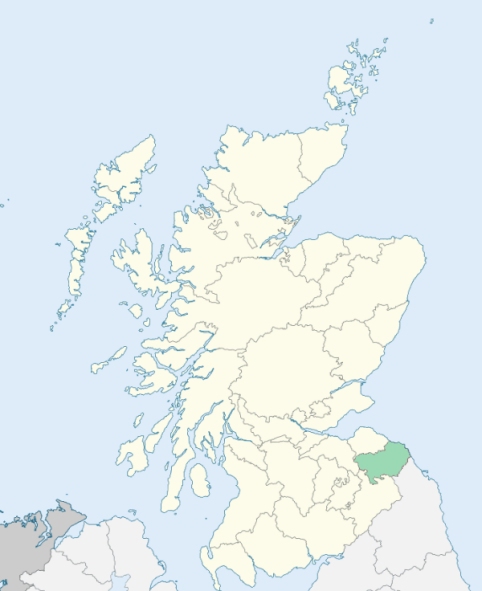
Langton is a parish nearly in the centre of Berwickshire. It lies partly in the Lammermoors and partly in the Merse, and approaches within 1¼ miles of the town of Duns. It is bounded by the parishes of Longformacus, Duns, Edrom, and Polwarth. (1867: The Imperial Gazetteer of Scotland, by John Marius Wilson).
Gavinton, Langton, Woodend
PRE-REFORMATION GOVERNANCE:
POST-REFORMATION GOVERNANCE:
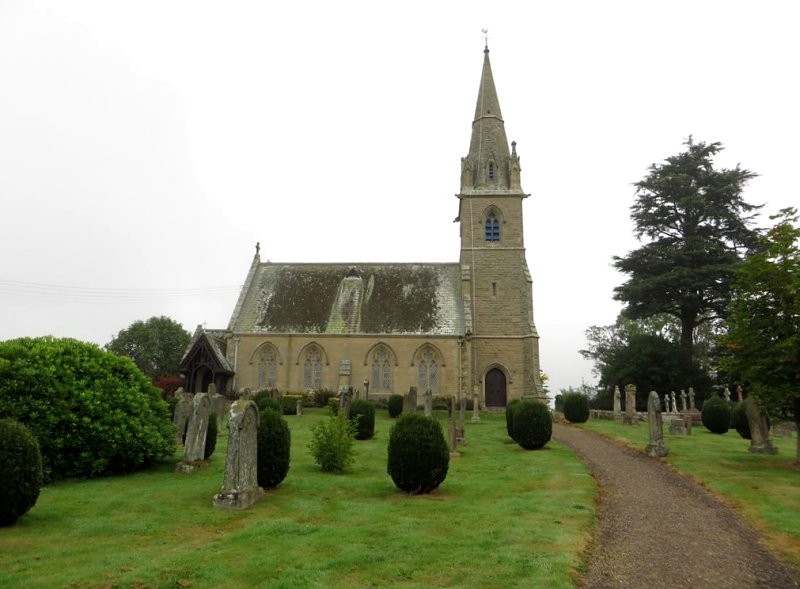
Previous to the Reformation the church, dedicated to St Cuthbert, belonged to the Abbey of Kelso. The original edifice stood in the old churchyard, near Langton House. A church was built in 1798 at the village of Gavinton. This was replaced in 1872 by a new building.
Includes ministers, licentiates, assistants, readers, and clerks.
(1928: Fasti Ecclesiæ Scoticanæ, by Hew Scott, D. D.)
Parish registers turned over to the Registrar-General, as a result of the Registration of Births, Deaths, and Marriages (Scotland) Act of 1854. The letters B. D. and M. indicate Births (or Baptisms), Deaths (or Burials), and Marriages (or Proclamations of Banns) respectively. Numbers indicate separate volumes or books. Note: These records are by no means complete or without damage; consult the Detailed List of the Old Parochial Registers of Scotland (1872) to learn more about the condition of the records.
| OPR and RD Numbers | |||
|---|---|---|---|
| Date Range | Name | Number | Type |
| 1729-1854 | Langton | 747 | OPR |
| 1855-1947 | Langton | 747 | RD |
| 2009 | Scottish Borders, Duns | 785 | RD |
| 2026 | Scottish Borders Council; Gavinton, Fogo and Polwarth Community Council | ||
(2009: Parishes and Registration Districts of Scotland - Old and New, National Records of Scotland)
Local community councils (2026) are provided as a potential source of additional information for settlements within the original boundaries of the parish. (Source)
Statistics from informal and official censuses
Anderson, Cockburn, Lauder, Lawrie, Middlemiss, Rae, Scott, Spiers, Stobie, Wilson
Note: Names appearing in research materials, other than censuses. Simple names (First name, surname only) have been omitted unless they appear associated with large properties. All women's names, and men's names with occupations, military ranks, or peerage titles are included.
By the Reverend Mr Alexander Girvan.
"The number of souls in the parish, according to a correct list taken in the month of July, 1793, is 435. Of these 211 are males, and 224 females; there are 120 under age 10. The number of inhabited houses is 87; a few are at present uninhabited. The great bulk of the people are hearers of the Established Church, but a considerable number are attached to the Relief, Burghers, Antiburghers, and Cameronians, and go to Dunse and Chirnside to hear sermon.
There are 12 farmers, besides those who occupy small possessions, 9 masons, 7 house carpenters and plough-wrights, 8 weavers, 3 shoemakers, 2 blacksmiths, 2 tailors, 2 thatchers, 1 cooper, 3 hedgers, apprentices included, and 4 day labourers. The rest of the men are in general hinds, ploughmen, barnmen, and shepherds. The unmarried women, who are not hired from year to year, are employed in spinning to manufacturers and others throughout the winter, and in the summer and harvest are occupied in hoeing potatoes and turnips, hay-making, reaping corn, &c.
The people are in general above the middle stature, and dress, perhaps, better than their circumstances can well afford."
(This section contains excerpts, at times restructured or paraphrased, from an article appearing in Statistical Account of Scotland, Sir John Sinclair, 1791-1799)
Primary Sources:
Statistical Account of Scotland (1791-1799), Volume 14, p. 577
New Statistical Account of Scotland (1834-1845), Volume 2, Section III, p. 236
See Parish Page Sources for all source information and links.