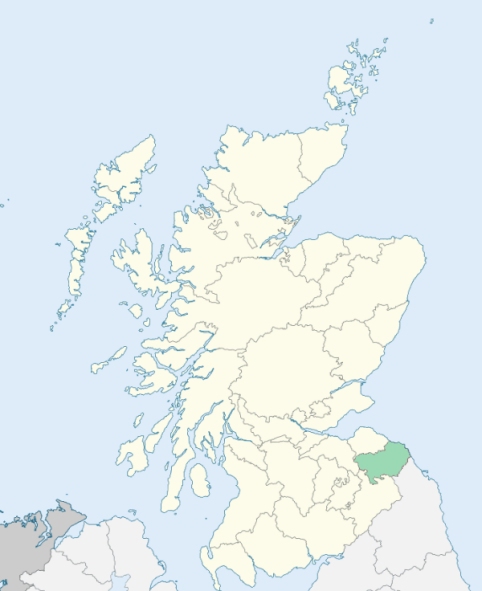
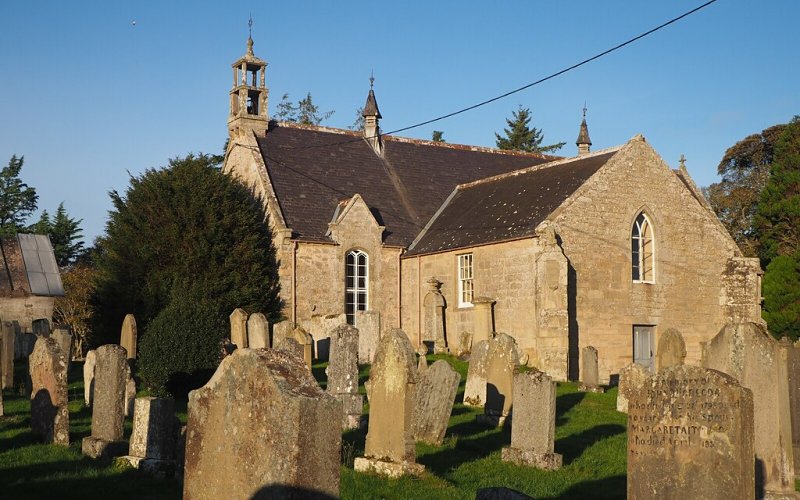
Edrom is a parish in the district of Merse, Berwickshire. It is bounded by Bunkle, Chirnside, Hutton, Whitsome, Swinton, Fogo, Langton, and Duns. (1867: The Imperial Gazetteer of Scotland, by John Marius Wilson).
Allanton, Edrom, Kelloe-Bastile
Blackadder, Broomhouse, Kimmerghame
PRE-REFORMATION GOVERNANCE:
POST-REFORMATION GOVERNANCE:
The church was granted to Coldingham Priory by Earl Gospatrick in 1139. There were subordinate chapels at Kimmerghame, Blackadder, East Nisbet, and Earlston. By 1450 land at Kelloe was granted to found the prebend of Kelloe in the collegiate church of Dunglass, and a papal bull of 1459 gave Dunglass the vicarage of Edrom. The old Norman church was taken down in 1737, all that survives being a fine doorway, and a transept chapel built in 1499 by Robert Blackadder, Archbishop of Glasgow, whose ancestors held the lands of Blackadder in the parish.
Includes ministers, licentiates, assistants, readers, and clerks.
(1928: Fasti Ecclesiæ Scoticanæ, by Hew Scott, D. D.)
Parish registers turned over to the Registrar-General, as a result of the Registration of Births, Deaths, and Marriages (Scotland) Act of 1854. The letters B. D. and M. indicate Births (or Baptisms), Deaths (or Burials), and Marriages (or Proclamations of Banns) respectively. Numbers indicate separate volumes or books. Note: These records are by no means complete or without damage; consult the Detailed List of the Old Parochial Registers of Scotland (1872) to learn more about the condition of the records.
| OPR and RD Numbers | |||
|---|---|---|---|
| Date Range | Name | Number | Type |
| 1721-1854 | Edrom | 738 | OPR |
| 1855-1966 | Edrom | 738 | RD |
| 2009 | Scottish Borders, Duns | 785 | RD |
| 2026 | Scottish Borders Council; Allanton, Whitsome and Edrom Community Council | ||
(2009: Parishes and Registration Districts of Scotland - Old and New, National Records of Scotland)
Local community councils (2026) are provided as a potential source of additional information for settlements within the original boundaries of the parish. (Source)
Statistics from informal and official censuses
Ainslie, Anderson, Bell, Brown, Johnston, Patterson, Purves, Renton, Simpson, Wood
Note: Names appearing in research materials, other than censuses. Simple names (First name, surname only) have been omitted unless they appear associated with large properties. All women's names, and men's names with occupations, military ranks, or peerage titles are included.
By the Reverend Mr William Redpath.
"The population of this parish in 1790 was 1336 souls, of whom 613 were males, and 723 were females. There were 38 farmers, 34 mechanics, and 211 inhabited houses.
There is a paper-mill, a lint-mill, and a wheel-wright manufacture. Fifty-five persons are employed in the paper-mill, 5 in the lint-mill, and about 5 or 6 in the wheel-wright manufactory.
There is a very great alteration in the manners, customs, dress, and style of living, of the inhabitants of this parish, within these 30 years. All ranks have more elegant or commodious houses, finer clothes, and better food."
(This section contains excerpts, at times restructured or paraphrased, from an article appearing in Statistical Account of Scotland, Sir John Sinclair, 1791-1799)
Primary Sources:
Statistical Account of Scotland (1791-1799), Volume 1, p. 116
New Statistical Account of Scotland (1834-1845), Volume 2, Section III, p. 266
See Parish Page Sources for all source information and links.