Denino
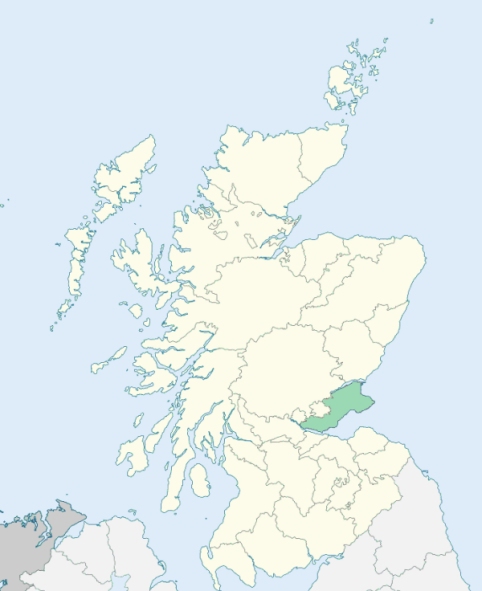
Dunino is a parish in the east of Fife. It is bounded by Cameron, St Andrews, Kingsbarns, Crail, and Carnbee. (1867: The Imperial Gazetteer of Scotland, by John Marius Wilson).
Bannafield, Beley, Beleybridge, Chesters, Dunino, High Beley, Limelands, Pathhead, Primrose, South Kinaldy, Stravithie, Tosh, Woodend
Balcaithly or Balkaithly
The parish of Dunino was represented on the Ordnance Survey maps as having a detached part lying to the south of the main portion of the parish, and surrounded by the parish of Crail. The authorities of the two parishes, however, concurred in stating that the parish boundary as recognised in practice lay to the south of that shown on the map, and really included within the parish of Dunino not only the part marked on the maps as detached, but also a considerable portion of what was shown as belonging to the parish of Crail. The following subjects were included in the area marked on the maps as belong to the parish of Crail, and now declared to form part of the parish of Dunino. See affected properties and landholders. (1892: Boundary of counties and parishes in Scotland as settled by the Boundary Commissioners under the Local Government Act, 1889, by Hay Shennan)
PRE-REFORMATION GOVERNANCE:
POST-REFORMATION GOVERNANCE:
The rectory of Dunino belonged to the college of St Salvator at St Andrews. (1928: Fasti Ecclesiæ Scoticanæ, by Hew Scott, D. D.)
Includes ministers, licentiates, assistants, readers, and clerks.
(1928: Fasti Ecclesiæ Scoticanæ, by Hew Scott, D. D.)
Parish registers turned over to the Registrar-General, as a result of the Registration of Births, Deaths, and Marriages (Scotland) Act of 1854. The letters B. D. and M. indicate Births (or Baptisms), Deaths (or Burials), and Marriages (or Proclamations of Banns) respectively. Numbers indicate separate volumes or books. Note: These records are by no means complete or without damage; consult the Detailed List of the Old Parochial Registers of Scotland (1872) to learn more about the condition of the records.
| OPR and RD Numbers | |||
|---|---|---|---|
| Date Range | Name | Number | Type |
| 1643-1854 | Dunino | 425 | OPR |
| 1855-1965 | Dunino | 425 | RD |
| 2009 | Fife, St Andrews | 413 | RD |
| 2026 | Fife Council; Boarhills and Dunino Community Council | ||
(2009: Parishes and Registration Districts of Scotland - Old and New, National Records of Scotland)
Local community councils (2026) are provided as a potential source of additional information for settlements within the original boundaries of the parish. (Source)
Statistics from informal and official censuses
Dalrymple, Grandison, Mitchell, Niven, Oliphant, Ramsay, Robertson, Ross, Smith, Webster
Note: Names appearing in research materials, other than censuses. Simple names (First name, surname only) have been omitted unless they appear associated with large properties. All women's names, and men's names with occupations, military ranks, or peerage titles are included.
By the Mr William West, Session Clerk and Schoolmaster.
"The total amount of souls, according to a very recent and exact calculation are 230 inhabitants in Denino, 153 in Kings Muir. The number of males in Denino 107, females 123. There are about 38 inhabited houses, and 6 houses uninhabited. There are 151 members of the Established Church, 11 Burgher Seceders, and 3 Relief Seceders. 144 persons were born out of the parish. There are 12 farmers, 3 shopkeepers, 1 innkeeper, 1 smith, 2 carpenters, 4 weavers, 3 tailors, 4 millers, 24 male servants, 11 female servants, 1 flax-dresser, and 2 day-labourers. The inhabitants, though commonly healthy, and many of them long-lived, furnish no instances of remarkable longevity.
Of the inhabitants of this parish it may justly be asserted, that industry and hospitality, sincerity and an obliging behaviour, are their general characteristics. They are also noted for moderation and sobriety, generosity, and candour. From these virtues there may be, however, as is but too natural, not a few deviations. The bulk of the people, though poor, are contented and resigned. The minority, whose circumstances are more affluent, appear to indulge as much in the luxuries of the table, and of dress, as the superiority of their fortunes can well countenance. The inferior classes seem to be uncommonly fond of personal decoration; and rather than (as they imagine) disgrace the back, they will often starve its supporter. This remark is, perhaps, not more applicable to the one sex than to the other; or to this district more than to other parishes."
(This section contains excerpts, at times restructured or paraphrased, from an article appearing in Statistical Account of Scotland, Sir John Sinclair, 1791-1799)
Primary Sources:
Statistical Account of Scotland (1791-1799), Volume 11, p. 352
New Statistical Account of Scotland (1834-1845), Volume 9, Section I, p. 356
See Parish Page Sources for all source information and links.