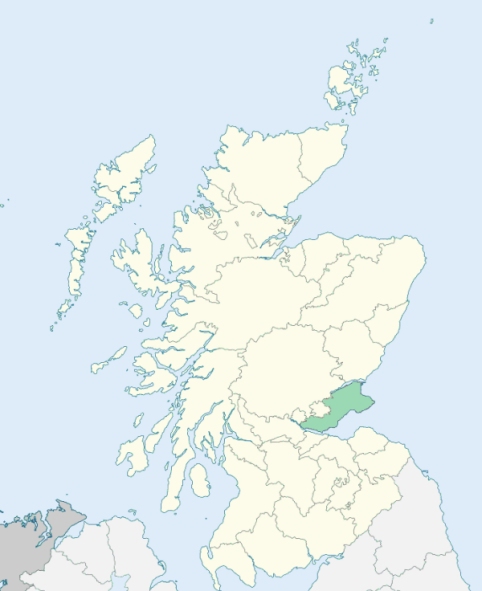
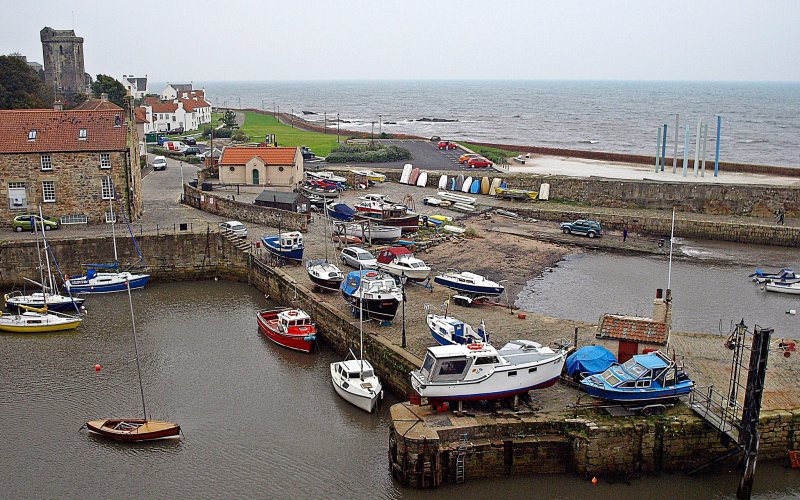
Dysart is a parish on the south coast of Fife. It is bounded by the Firth of Forth, and by the parishes of Kirkcaldy, Auchterderran, Kinglassie, Markinch, and Wemyss. (1867: The Imperial Gazetteer of Scotland, by John Marius Wilson).
Boreland, Dysart, Gallatown, Hawkly Muir, Pathhead, Redford, Sinclairtown
Dysart
PRE-REFORMATION GOVERNANCE:
POST-REFORMATION GOVERNANCE:
The old church of Dysart is dedicated to St Serf. The parish of Dysart was a prebend of the Collegiate Church of St Mary on the Kirk Heugh at St Andews. A new parish church was built in 1802. There was within the bounds a chapel of St Denys.
Disjoined Quoad Sacra Parishes:
Pathhead. The parish of Pathhead was disjoined from Dysart, 16 March 1859.
Sinclairtown. A chapel was opened here on 3 November 1878. The parish of Sinclairtown was disjoined from Dysart on 9 February 1912.
Thornton. A chapel was built here in 1837, and had a constitution from General Assembly, 28 May 1838. The parish was disjoined from Markinch, Dysart, and Kinglassie on 18 February 1878.
(1928: Fasti Ecclesiæ Scoticanæ, by Hew Scott, D. D.)
Includes ministers, licentiates, assistants, readers, and clerks.
Dysart (QO)
Pathhead (QS)
Sinclairtown (QS)
Thornton (QS)
(1928: Fasti Ecclesiæ Scoticanæ, by Hew Scott, D. D.)
Parish registers turned over to the Registrar-General, as a result of the Registration of Births, Deaths, and Marriages (Scotland) Act of 1854. The letters B. D. and M. indicate Births (or Baptisms), Deaths (or Burials), and Marriages (or Proclamations of Banns) respectively. Numbers indicate separate volumes or books. Note: These records are by no means complete or without damage; consult the Detailed List of the Old Parochial Registers of Scotland (1872) to learn more about the condition of the records.
| OPR and RD Numbers | |||
|---|---|---|---|
| Date Range | Name | Number | Type |
| 1582-1854 | Dysart | 426 | OPR |
| 1855-1855 | Dysart Burgh | 426-1 | RD |
| 1855-1855 | Dysart Landward | 426-2 | RD |
| 1856-1930 | Dysart | 426 | RD |
| 1968-1971 | East Neuk | 426 | RD |
| 1972-2008 | East Neuk | 414 | RD |
| 2009 | (Dysart) Fife, Kirkcaldy | 421 | RD |
| 2009 | (East Neuk) Fife, East Neuk | 414 | RD |
| 2026 | (Dysart) Fife Council; Dysart Community Council | ||
| 2026 | (East Neuk) Fife Council; Boarhills and Dunino Cameron Carnbee and Arncroach Colinsburgh and Kilconquhar Royal Burgh of Crail and District Elie and Royal Burgh of Earlsferry Kilrenny, Anstruther and Cellardyke Community Council Kingsbarns Largo Area Royal Burgh of Pittenweem and District St Monans, Abercrombie and District | ||
(2009: Parishes and Registration Districts of Scotland - Old and New, National Records of Scotland)
Local community councils (2026) are provided as a potential source of additional information for settlements within the original boundaries of the parish. (Source)
Statistics from informal and official censuses
Adamson, Anderson, Duncan, Henderson, Mitchell, Robertson, Simpson, Smith, Taylor, Thomson
Note: Names appearing in research materials, other than censuses. Simple names (First name, surname only) have been omitted unless they appear associated with large properties. All women's names, and men's names with occupations, military ranks, or peerage titles are included.
By the Reverend Mr George Muirhead.
"In 1792 the population of the parish was 4862. In the town of Dysart the number of inhabitants was 1736, of whom 819 were males and 917 female; the population in Pathhead, including Sinclairton, was 2089, of whom 1062 were male, and 1027 female; in Galaton the number of inhabitants was 432, of whom 227 were male and 205 female; in Borland 127, of whom 87 were male, and 109 female; and in the country part of the parish 190 male and 219 female, total 409.
There are two villages, Galaton and Borland. In the former, nailing was the chief business and is still carried on, but many weavers now reside there, who are employed by the manufacturers in Dysart and Pathhead. There are 43 smiths, who make about 6 million nails annually. Borland was begun in 1756, for accommodating the colliers.
The number of looms in the parish is from 700 to 750, employed in making checks and ticks. In the linen trade, 10 hands are reckoned to be employed by each loom. A ship carpenter employing about 6 men, settled here in 1764. His business gradually increased, till he found employment for upwards of 30 men. In 1778, another carpenter bred under the former, began to build; about 45 men are at present employed.
The people are well clothed, have good houses, and live comfortably. They ought to be, and it is to be hoped, are, contented with their lot. No doubt complaints are heard, and not altogether without reason, from some in the lower ranks, of the hardness of the times. Women, especially in the decline of life, find it hard to gain a livelihood by spinning, which is almost their only employment. Farmers too complain of the difficulty of getting hands for their work. And it is to be regretted, that agriculture, useful to health, favourable to morals, and indispensably necessary to the well-being of a state, should be so much neglected."
(This section contains excerpts, at times restructured or paraphrased, from an article appearing in Statistical Account of Scotland, Sir John Sinclair, 1791-1799)
Primary Sources:
Statistical Account of Scotland (1791-1799), Volume 12, p. 502
New Statistical Account of Scotland (1834-1845), Volume 9, Section I, p. 127
See Parish Page Sources for all source information and links.