Markinch and Kirkforthar
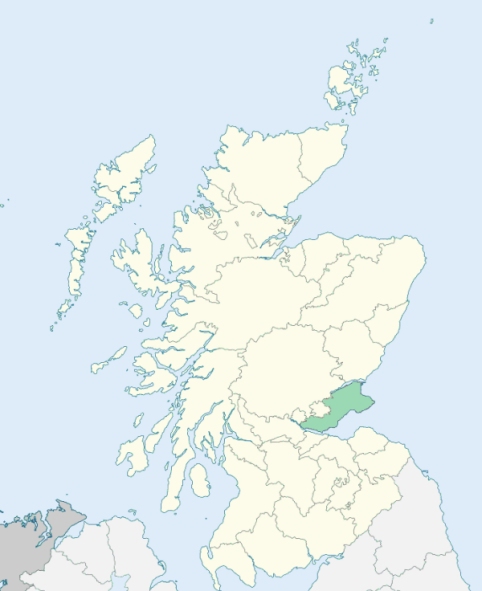
Markinch is a parish, comprising a main body and a detached section, in the Kirkcaldy district of Fife. The main body is bounded by Kettle, Kennoway, Wemyss, Dysart, Kinglassie, and Falkland. The detached section lies 1¼ miles east of the nearest part of the main body, and is situated on the Firth of Forth, and on the right bank of the River Leven, between Wemyss and Scoonie. (1867: The Imperial Gazetteer of Scotland, by John Marius Wilson).
Auchmuty, Balbirnie, Balbirnie Mills, Balcurrie, Balgonie, Burns, Cameron Bridge, Coalton of Balgonie, Coull, Gateside, Haughmill, Inverleven, Kirkforthar, Markinch, Milton of Bagonie, Rothes, Scythrum, Starr, Thornton, Windygates, Woodside
Balbirnie, Balfour, Balgonie, Barnslee, Kirkforthar House
The parish of Markinch had a detached part situated at Dubbieside (or Innerleven) and adjoining the parish of Wemyss. This detached part was annexed to the parish of Wemyss. See affected properties and landholders. (1892: Boundary of counties and parishes in Scotland as settled by the Boundary Commissioners under the Local Government Act, 1889, by Hay Shennan)
PRE-REFORMATION GOVERNANCE:
POST-REFORMATION GOVERNANCE:
The parishes of Markinch and Kirkforthar were united in 1641.
Markinch. The church of Markinch was dedicated of old to St Drostan, but there was a later dedication to St John the Baptist. The church belonged to the Priory of St Andrews.
Kirkforthar. Kirkforthar was a parsonage. Its ruined church still stands.
Disjoined Quoad Sacra Parishes:
Buckhaven. A chapel was built here in 1902. On 6 June 1913 the parish of Buckhaven was disjoined from Wemyss, Methil, and Milton of Balgonie.
Methil. A chapel opened here on 1 April 1838, had a constitution from the General Assembly, 18 May 1839. The parish was disjoined from Wemyss and Markinch on 6 March 1876.
Milton of Balgonie. A chapel was opened here in 1836, and had a constitution from the General Assembly, 29 May 1837. The parish was disjoined from Markinch and erected 21 February 1876.
Thornton. A chapel was built here in 1837, and had a constitution from General Assembly 28 May 1838. The parish was disjoined from Markinch, Dysart, and Kinglassie on 18 February 1878.
(1928: Fasti Ecclesiæ Scoticanæ, by Hew Scott, D. D.)
Includes ministers, licentiates, assistants, readers, and clerks.
Markinch (QO)
Kirkforthar (QO)
Buckhaven (QS)
Methil (QS)
Milton of Balgonie (QS)
Thornton (QS)
(1928: Fasti Ecclesiæ Scoticanæ, by Hew Scott, D. D.)
Parish registers turned over to the Registrar-General, as a result of the Registration of Births, Deaths, and Marriages (Scotland) Act of 1854. The letters B. D. and M. indicate Births (or Baptisms), Deaths (or Burials), and Marriages (or Proclamations of Banns) respectively. Numbers indicate separate volumes or books. Note: These records are by no means complete or without damage; consult the Detailed List of the Old Parochial Registers of Scotland (1872) to learn more about the condition of the records.
| OPR and RD Numbers | |||
|---|---|---|---|
| Date Range | Name | Number | Type |
| 1635-1854 | Markinch | 447 | OPR |
| 1855-1898 | Markinch | 447 | RD |
| 1899-1967 | Markinch | 447-1 | RD |
| 1899-1967 | Windygates | 447-2 | RD |
| 2009 | (Markinch) Fife, Glenrothes | 420 | RD |
| 2009 | (Windygates) Fife, Kennoway | 419 | RD |
| 2026 | (Markinch) Fife Council; Star of Markinch Community Council | ||
| 2026 | (Windygates) Fife Council; Windygates Community Council | ||
(2009: Parishes and Registration Districts of Scotland - Old and New, National Records of Scotland)
Local community councils (2026) are provided as a potential source of additional information for settlements within the original boundaries of the parish. (Source)
Statistics from informal and official censuses
Brown, Henderson, Mackie, Mitchell, Patton, Reid, Robertson, Scott, Thomson, Wilson
Note: Names appearing in research materials, other than censuses. Simple names (First name, surname only) have been omitted unless they appear associated with large properties. All women's names, and men's names with occupations, military ranks, or peerage titles are included.
By the Reverend Mr John Thomson.
"Markinch is, perhaps, one of the most populous country parishes in Fife; the number of souls amounting to nearly 2800. This extraordinary population may be accounted for from the following circumstances: There are 7 villages in the parish, which contain about 400 families; and two large collieries, which employ a great number of hands. The feuars are very numerous, being about 120. There are a great many mills of different kinds, upon the Leven. Every farm of any considerable extent has a cottage town upon it; and there is a great proportion of the heritors resident, who, besides the extraordinary number of servants they keep, employ a much greater number of labouring people, than tenants could be supposed to do.
There are in the parish of Markinch, 2790 souls, of whom 1364 are males and 1426 females. There are 120 feuars, 60 farmers, 7 teachers, 2 notary publics, 1 plasterer, 160 weavers, 24 masons, 16 wrights, 11 smiths, 20 shoemakers, 9 tailors, 4 brewers, 5 gardeners, 2 midwives, 100 colliers, including overseers, drawers, &c, 2 coopers, 3 bakers, 2 wheelwrights, 8 flax-dressers, 2 stocking-makers, 2 dyers, 1 turner, 4 shopkeepers, 136 male servant, 120 female servants, and 65 labourers.
The village of Dubieside, which contains near 200 inhabitants, and lies upon the Firth of Forth on the west side of the mouth of the Leven, forms a part of this parish, though totally detached by the intervention of the parish of Wemyss.
It would be sacrificing truth to complaisance, to say that there are no worthless or exceptionable characters in this parish. The number of such, however, is comparatively small. The great body of the people are sober, peaceable, and industrious. Their attendance on the public ordinances of religion is punctual and exemplary, and their moral conduct correspondent to their profession. It is worthy of notice, that the colliers of Markinch possess a respectability in point of character, to which few other colliers in the kingdom can pretend. In them you see nothing of that gross ignorance, that roughness and barbarity of manners, that extravagance and disorderly behaviour, but too generally characteristic of this description of men. On the contrary, with a very few exceptions, they are remarkably intelligent, attentive to the duties of religion, civil and obliging in their manners, sober, frugal and diligent; in consequence of which, they and their families live comfortably, and make a decent appearance."
(This section contains excerpts, at times restructured or paraphrased, from an article appearing in Statistical Account of Scotland, Sir John Sinclair, 1791-1799)
Primary Sources:
Statistical Account of Scotland (1791-1799), Volume 12, p. 525
New Statistical Account of Scotland (1834-1845), Volume 9, Section I, p. 655
See Parish Page Sources for all source information and links.