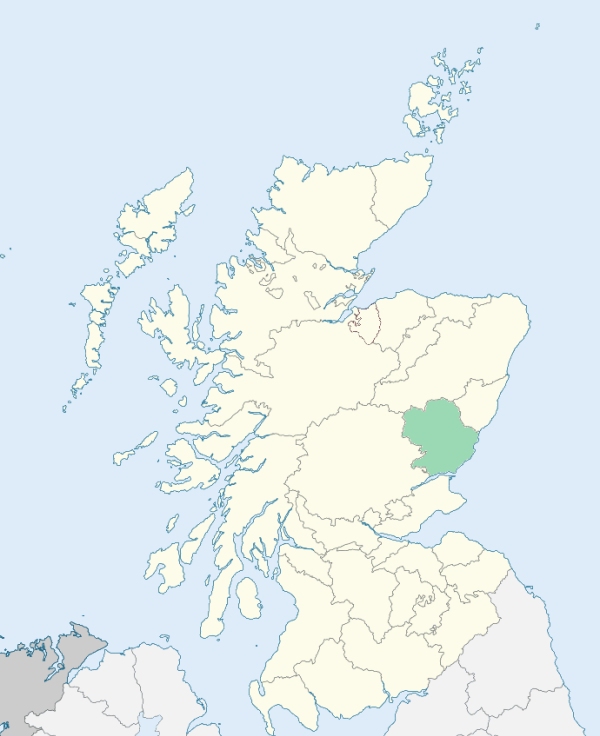
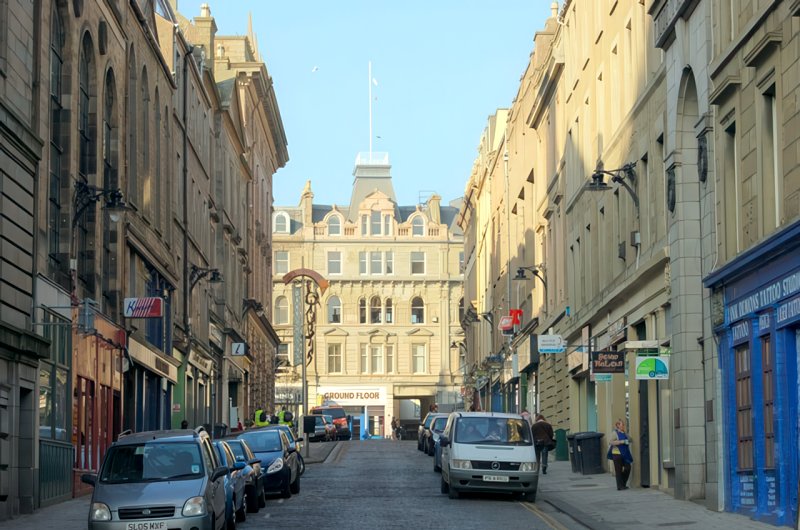
Dundee is a parish on the southern border of Forfarshire. It comprises a main body and a detached district. The main body lies along the Firth of Tay, and contains the greater part of the town of Dundee. It is bounded on the north by Liff, Mains, and Murroes, on the east by Monifeith, and on the west by Liff. (1867: The Imperial Gazetteer of Scotland, by John Marius Wilson).
Baldovie, Brewhead, Broughty Ferry, Drumgeith, Dundee, Honeygreen, Luckieslap
Craigie
The parish of Dundee had a detached part situated at Duntrune, and almost surrounded by the parish of Murroes. It has been transferred to Murroes. See affected properties and landholders. (1892: Boundary of counties and parishes in Scotland as settled by the Boundary Commissioners under the Local Government Act, 1889, by Hay Shennan)
PRE-REFORMATION GOVERNANCE:
POST-REFORMATION GOVERNANCE:
St Mary's. Dundee's ancient parish church was dedicated to St Clement. Toward the end of the twelfth century, David, Earl of Huntington, built beside his Castle of Dundee, the Church of St Mary, now the High Kirk of the city. The church was bestowed upon the Abbey of Lindores. St Clement's was the original parish church, but being beyond restoration, St Mary's became the parish church in 1588. A series of fires occurred from 1588 to 1841, with the church severely damaged and restored several times. A complete restoration was carried out in 1843. The nuns of St Clara established a convent in Dundee in 1260. The Red Friars of the Holy Trinity made a settlement in 1283. The Black Friars came early, and the Grey Friars founded a priory in 1292. In old times there were several chapels in this large parish. Of these, the best known was perhaps St Roque's, outside the Cowgate Port of the town. There were also the Chapel of the Holy Rood at Kilcraig, St Mary's beside Our Lady's Well, St Nicholas' on the Ship Craig, west of the harbour, and in the town another Chapel of the Holy Rood, and those of St Salvator, St John, St Paul, St Michael, and St Anthony. Two fairs were held in honour of St Mary, one in August on Our Lady Day in autumn, and the other in September on Marymas Day in harvest. There are now mission chapels in the parish at Blackscroft and Drumgeith.
St Clement's. In 1789 the nave of St Mary's Church was occupied by a body known as the Steeple Kirk Congregation, or the Fifth Charge of Dundee. A new church was erected on 23 July 1788 and opened 17 May 1789. St Clement's parish was disjoined by the Court of Teinds from St Mary's on 3 December 1834.
St David's. A chapel was built in North Tay Street in 1800 by the Haldaneites or Independents, who called it the Tabernacle. After divisions in the congregation it was bought by the Town Council, and the parish of St David's was erected by the Commissioners of Teinds, 18 June 1823.
St John's. The part of St Mary's Church called the Cross Kirk, after being destroyed by fire in 1645, was occupied as a stable in 1651 by General Monk's cavalry, and again in 1745 by those of Prince Charles Edward. It was repaired and fitted up for divine service in 1759, and was occupied as the Fourth Charge of Dundee. This was erected as a chapel by the Court of Teinds, 23 July 1788, rebuilt in 1839. St John's parish was disjoined from St Mary's on 3 December 1834. In 1912 a new church was erected in Blackness Avenue, and a portion of Liff and Benvie parish added quoad sacra.
St Paul's. From 1609 onwards part of St Mary's Church was occupied by the Third Charge of Dundee. Out of this grew up the congregation for which St Paul's Parish was disjoined from St Mary's on 3 December 1834.
South Church. The church building called the South Kirk was destroyed by fire in 1645. In 1836 it was rebuilt and called the Greyfriars Church. It was again burned on 3 January 1841.
Gaelic Chapel. In 1791 a number of Highland families formed a congregation for worship and religious instruction in the Gaelic language, and a chapel was erected in Long Wynd. Both minister and congregation joined the Free Church in 1843.
Note: Also see Dundee Disjoined Quoad Sacra Parishes
Includes ministers, licentiates, assistants, readers, and clerks.
Note: Also see Dundee Quoad Sacra Parishes clergy
St Mary's (QO)
St Clement's (QO)
St David's (QO)
St John's (QO)
St Paul's (QO)
South Church (QO)
Gaelic Chapel (QO)
(1928: Fasti Ecclesiæ Scoticanæ, by Hew Scott, D. D.)
Parish registers turned over to the Registrar-General, as a result of the Registration of Births, Deaths, and Marriages (Scotland) Act of 1854. The letters B. D. and M. indicate Births (or Baptisms), Deaths (or Burials), and Marriages (or Proclamations of Banns) respectively. Numbers indicate separate volumes or books. Note: These records are by no means complete or without damage; consult the Detailed List of the Old Parochial Registers of Scotland (1872) to learn more about the condition of the records.
| OPR and RD Numbers | |||
|---|---|---|---|
| Date Range | Name | Number | Type |
| 1645-1854 | Dundee | 282 | OPR |
| 1855-1855 | Dundee, 1st District (Burgh & Landward) | 282-1 | RD |
| 1855-1867 | Dundee, 2nd District (Landward) | 282-2 | RD |
| 1855-1867 | Dundee, 3rd District (Lochee) | 282-3 | RD |
| 1856-1867 | Dundee, 1st District (Burgh) | 282-1 | RD |
| 1868-1918 | St Peter | 282-1 | RD |
| 1868-1918 | St Mary | 282-2 | RD |
| 1868-1918 | St Clement | 282-3 | RD |
| 1868-1918 | St Andrew | 282-4 | RD |
| 1868-1918 | Lochee | 282-5 | RD |
| 1919-1951 | St Mary and St Peter | 282-1 | RD |
| 1919-1951 | St Clement | 282-2 | RD |
| 1919-1951 | St Andrew | 282-3 | RD |
| 1919-1951 | Lochee | 282-4 | RD |
| 1923-1951 | Broughty Ferry | 282-5 | RD |
| 1952-1966 | Dundee, West | 282-1 | RD |
| 1952-1966 | Dundee, East | 282-2 | RD |
| 1952-1971 | Lochee | 282-3 | RD |
| 1952-1971 | Broughty Ferry | 282-5 | RD |
| 1967-1971 | Dundee East and West | 350 | RD |
| 1972-1976 | Dundee East and West | 350-353 | RD |
| 1972-1976 | Broughty Ferry | 356 | RD |
| 1972-1976 | Lochee | 355 | RD |
| 1977-1983 | Lochee | 350 | RD |
| 1977-2007 | Dundee | 350-353 | RD |
| 2009 | Dundee City | 350-353 | RD |
| 2026 | Dundee City Community Councils (See list below) | ||
(2009: Parishes and Registration Districts of Scotland - Old and New, National Records of Scotland)
Local community councils (2026) are provided as a potential source of additional information for settlements within the original boundaries of the parish. (Source)
Dundee City Community Councils:
Statistics from informal and official censuses
Anderson, Brown, Duncan, Mitchell, Robertson, Scott, Smith, Stewart, Thomson, Wilson
Note: Names appearing in research materials, other than censuses. Simple names (First name, surname only) have been omitted unless they appear associated with large properties. All women's names, and men's names with occupations, military ranks, or peerage titles are included.
By the Reverend Mr Robert Small, D. D., one of the Ministers of the City.
"We have of late years, three actual enumerations of the inhabitants, one in 1766 when their number was found to be 12,426; one in 1781 when it turned out 15,700; and one in 1788 when it was 19,329. Since the enumeration in 1788, the town continues to increase with greater rapidity than before; and the whole inhabitants of the town and parish can hardly be estimated at less than 24,000; they are certainly rated sufficiently low at 23,000. They reside chiefly in the town and suburbs; and, as the inhabitants, of what may be properly called the country parish, do not exceed 1100, the town and suburbs of Dundee may be said to contain from 22,000 to 22,500 souls. The number of people, who have farms, is 31 or 32. But of farmers, properly so called, and who make farming their only business, there are not more than 15.
The principal and staple manufacture of Dundee is linen of various kinds. Besides linen, the manufacture of cotton has been lately introduced, and will probably soon become a very important branch of business. Seven companies are already engaged in it. They employ about 400 men, women, and children, in spinning cotton into yarn for wool. About 32 persons are employed in tanning, about 12 as curriers, in dressing part of what is tanned for upper leathers to shoes; 95 in making boots and shoes for exportation, and 200 in supplying the consumption of the town. Two companies are engaged in manufacturing cordage of all kinds for shipping, and ropes for all the various uses of the country. They employ about 30 persons. Within these 3 or 4 years, the manufacture of glass has been introduced, and the company engaged in it has erected two glass-houses; one for bottles, and the other for window glass. They employ 100 persons. Many persons are also employed in manufacturing tobacco and snuff; and one company is engaged in a sugar house.
The people of Dundee have been for a long time entitled to the reputation of industry, regularity and economy; and, notwithstanding the increase of their wealth and numbers, a just claim to this reputation still continues. As their wealth has been almost entirely the result of great attention and industry, it is preserved by the same virtues, and they are still strangers to extravagant and ruinous luxuries. The people of Dundee are inferior to none in generous exertions and contributions, either for the relief of particular distresses and misfortunes, or for the establishment and maintenance of public beneficent institutions."
(This section contains excerpts, at times restructured or paraphrased, from an article appearing in Statistical Account of Scotland, Sir John Sinclair, 1791-1799)
Primary Sources:
Statistical Account of Scotland (1791-1799), Volume 8, p. 192
New Statistical Account of Scotland (1834-1845), Volume 11, Section I, p. 1
See Parish Page Sources for all source information and links.