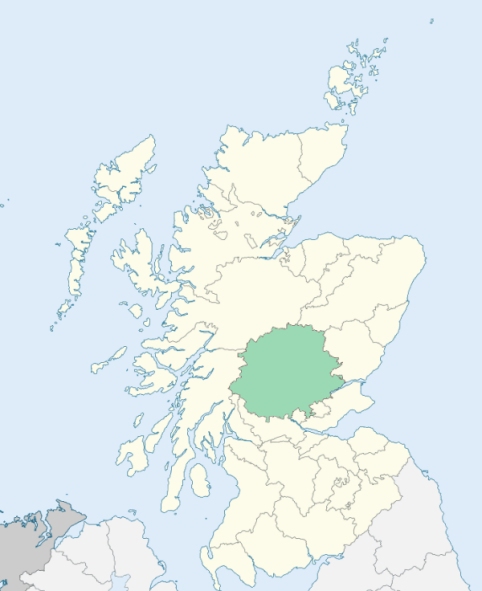
Cargill is a parish in the Strathmore portion of the eastern border of Perthshire. It is bounded by the parishes of Coupar-Angus, Lethendy, Kinclaven, St Martins, and Collace. (1867: The Imperial Gazetteer of Scotland, by John Marius Wilson).
Burrelton, Cargill, Lawton, Wolfhill, Woodside
Lintrose, Lawton, Stobhall
The district at West Kinnochtry, whether considered as a detached part of Scone or as a part of the parish of Kettins situated in the county of Perth (the rest of the parish being in the county of Forfar), was annexed to Cargill. See affected properties and landholders. (1892: Boundary of counties and parishes in Scotland as settled by the Boundary Commissioners under the Local Government Act, 1889, by Hay Shennan)
PRE-REFORMATION GOVERNANCE:
POST-REFORMATION GOVERNANCE:
The parish of Cargill was disjoined from Coupar Angus by the Bishop of Dunkeld in 1514. It was a mensal parish of the Bishop. The Abbot of Coupar-Angus had a residence at Campsie, within the bounds. Near it, at the Craig of Campsie, stood a chapel of St Adamnan belonging to the Abbey of Coupar.
Includes ministers, licentiates, assistants, readers, and clerks.
(1928: Fasti Ecclesiæ Scoticanæ, by Hew Scott, D. D.)
Parish registers turned over to the Registrar-General, as a result of the Registration of Births, Deaths, and Marriages (Scotland) Act of 1854. The letters B. D. and M. indicate Births (or Baptisms), Deaths (or Burials), and Marriages (or Proclamations of Banns) respectively. Numbers indicate separate volumes or books. Note: These records are by no means complete or without damage; consult the Detailed List of the Old Parochial Registers of Scotland (1872) to learn more about the condition of the records.
| OPR and RD Numbers | |||
|---|---|---|---|
| Date Range | Name | Number | Type |
| 1652-1854 | Cargill | 338 | OPR |
| 1855-1968 | Cargill | 338 | RD |
| 2009 | Perth and Kinross, Cargill | 389 | RD |
| 2026 | Perth and Kinross; Mid Atholl, Strathtay and Grandtully Community Council | ||
(2009: Parishes and Registration Districts of Scotland - Old and New, National Records of Scotland)
Local community councils (2026) are provided as a potential source of additional information for settlements within the original boundaries of the parish. (Source)
Statistics from informal and official censuses
Adam, Brown, Cameron, Clark, Robertson, Scott, Steuart, Stewart, Taylor, Thomson
Note: Names appearing in research materials, other than censuses. Simple names (First name, surname only) have been omitted unless they appear associated with large properties. All women's names, and men's names with occupations, military ranks, or peerage titles are included.
By the Reverend Mr James Patrick Bannerman.
"By an accurate enumeration of the inhabitants made in February 1793, there were then in the parish of Cargill, 376 families, containing 1720 souls. Of these, the males bear a near proportion to the females. In the parish, there are 314 tradesmen. Of these, 152 are weavers, 20 carpenters, 16 shoemakers, 3 gardeners, 12 flax-dressers, 24 masons, 13 tailors, 6 corn-millers, 5 lint-millers, 5 blacksmiths, 4 dealers in cattle, 1 dealer in horses, 3 distillers, 2 household male servants, 1 maltman, 20 bleachers, 2 ragmen, 12 fishers, 1 butcher, 3 midwives, 1 tollman, 3 schoolmasters, and a proportional number of apprentices. The remainder of the inhabitants are employed in the purposes of agriculture. All the parishioners are of the Established relgion, except about 12 Seceders, 24 Roman Catholics, 30 who attend the Church of Relief, 6 Episcopals, and about a dozen of deluded people, who call themselves covenanters.
The only manufacture of any consequence carried on in this parish, is that of brown linen, made out of the flax produced in the parish, and which is spun, wrought and bleached in the parish, and sent to the London market. There is also in this parish a small manufacture of white thread; and we have 3 bleachfields, which are carried on to considerable advantage.
The people are generally sober, honest and industrious, punctual in their attendance on religious ordinances, and more knowing in general than what might be conceived. Their manner of living and dress is much altered and improved of late years; and to their credit, it may be added, that none of them have been subjected to punishment for capital crimes, during the memory of the longest lived."
(This section contains excerpts, at times restructured or paraphrased, from an article appearing in Statistical Account of Scotland, Sir John Sinclair, 1791-1799)
Primary Sources:
Statistical Account of Scotland (1791-1799), Volume 13, p. 529
New Statistical Account of Scotland (1834-1845), Volume 10, p. 1167
See Parish Page Sources for all source information and links.