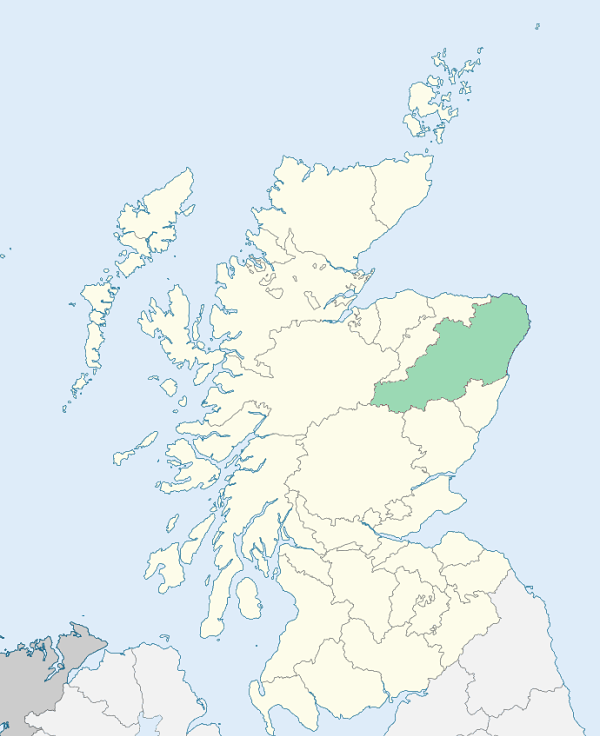
Aboyne is a parish in the Deeside district of Aberdeenshire. It is bounded on the south by Forfarshire, and on other sides by the parishes of Glenmuick, Coull, Lumphanan, and Birse. (1867: The Imperial Gazetteer of Scotland, by John Marius Wilson).
Aboyne, Charleston or Charlestown
Dalsack, Finzean, Percie, South Lodge
The parish of Aboyne & Glentanner had one detached part, which was wholly surrounded by the parish of Birse. This detached part was transferred to the parish of Birse. See affected properties and landholders. (1892: Boundary of counties and parishes in Scotland as settled by the Boundary Commissioners under the Local Government Act, 1889, by Hay Shennan)
PRE-REFORMATION GOVERNANCE:
POST-REFORMATION GOVERNANCE:
The parishes of Aboyne and Glentanar were united about the beginning of the seventeenth century.
Aboyne. The church of Aboyne was dedicated to St Adamnan. In 1232 a Preceptory of the Order of the Temple (Knights Templar) was founded at Aboyne. The church belonged to the Templars, as did also some adjoining property. After the fall of the Templars, in or about 1314, these lands and the church were held by the Knights of St John (Knights Hospitaller) at Torphichen. Fairs were held at Aboyne on Candlemas, Michaelmas, and Hallowmas. There were in this parish Wells of Our Lady, St Adamnan, and St Malrubh.
Glentanar. The medieval parish church was dedicated to St Lesino. It was in regular use till 1763.
Disjoined Quoad Sacra Parishes:
Dinnet. A priory of the Red Friars was founded at Dinnet in 1297 by Alexander, third Earl of Buchan. The parish of Dinnet was disjoined from Aboyne, Logie-Coldstone, and Glenmuick on 14 March 1886.
Includes ministers, licentiates, assistants, readers, and clerks.
Aboyne (QO)
Glentanar (QO)
Dinnet (QS)
(1928: Fasti Ecclesiæ Scoticanæ, by Hew Scott, D. D.)
Parish registers turned over to the Registrar-General, as a result of the Registration of Births, Deaths, and Marriages (Scotland) Act of 1854. The letters B. D. and M. indicate Births (or Baptisms), Deaths (or Burials), and Marriages (or Proclamations of Banns) respectively. Numbers indicate separate volumes or books. Note: These records are by no means complete or without damage; consult the Detailed List of the Old Parochial Registers of Scotland (1872) to learn more about the condition of the records.
| OPR and RD Numbers | |||
|---|---|---|---|
| Date Range | Name | Number | Type |
| 1752-1854 | Aboyne | 170 | OPR |
| 1855-1971 | Aboyne | 170 | RD |
| 1972-2001 | Aboyne | 330 | RD |
| 1972-2001 | Torphins | 331 | RD |
| 2002-2004 | Aboyne and Torphins | 330 | RD |
| 2005-2006 | Aboyne | 330 | RD |
| 2009 | Aberdeenshire, Aboyne | 330 | RD |
| 2026 | Aberdeenshire Council; Mid Deeside Community Council | ||
(2009: Parishes and Registration Districts of Scotland - Old and New, National Records of Scotland)
Local community councils (2026) are provided as a potential source of additional information for settlements within the original boundaries of the parish. (Source)
Statistics from informal and official censuses
Anderson, Coutts, Davidson, Duncan, Esson, Ewen, Grant, Milne, Smith, Thomson
Note: Names appearing in research materials, other than censuses. Simple names (First name, surname only) have been omitted unless they appear associated with large properties. All women's names, and men's names with occupations, military ranks, or peerage titles are included.
By a Friend to Statistical Inquiries.
"The number of inhabitants is 1050. They are sober and alert; but not so patient of labour as the inhabitants of the low country. They are generally very decent, and regular in attending on religious ordinances."
(This section contains excerpts, at times restructured or paraphrased, from an article appearing in Statistical Account of Scotland, Sir John Sinclair, 1791-1799)
Primary Sources:
Statistical Account of Scotland (1791-1799), Volume 19, p. 296
New Statistical Account of Scotland (1834-1845), Volume 12, p. 1047
See Parish Page Sources for all source information and links.