Glenmuick, Tullich, and Inchmarnoch
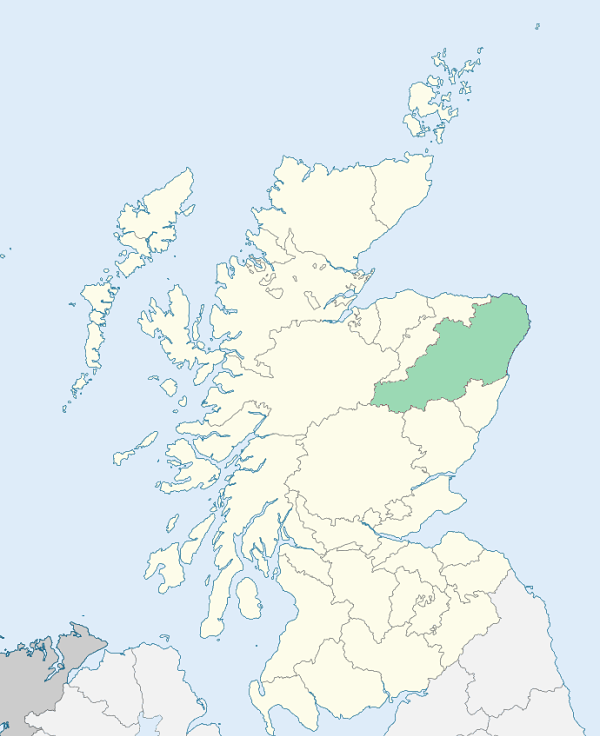
Glenmuick, Tullich, and Glengairn is a parish in the district of Mar, Aberdeenshire, bounded on the north by Strathdon and Logie Coldstone, on the east by Aboyne and Glentanar, on the south by Forfarshire, and on the west by Crathie and Braemar. Glengairn, the least and most compact of the three districts, lies chiefly to the north-west, on both banks of the rocky Gairns, extending 6 miles north-west of the church, where the upper parts of Tulloch begin, and separate it from the parish of Crathie. A small part of it, called Strathgirnie, lies on the south side of the Dee. (1867: The Imperial Gazetteer of Scotland, by John Marius Wilson).
Abergairn, Ballater, Kirkton, Tullich
PRE-REFORMATION GOVERNANCE:
POST-REFORMATION GOVERNANCE:
The parishes of Glenmuick, Tullich, and Inchmarnoch were united about the year 1500. Early in the seventeenth century Glengairn was added to the union. It was severed again, quoad sacra, in 1863.
Glenmuick. The church of Glenmuick was dedicated to St Mary. It was removed to Ballater in 1798.
Tullich. The church of Tullich was dedicated to St Neachtan. It belonged to the Knights of the Order of the Temple (Knights Templar) who had a preceptory at Tullich. After the suppression of the Templars, the property was held by the Knights of St John (Knights Hospitaller) at Torphichen.
Inchmarnoch. The parish church was dedicated to St Marnoch of Aberchirder. Its ruins can still be seen on the inch, or island, in the Dee.
Glengairn. The church of the ancient parish of Glengairn was dedicated to St Mungo. The three parishes of Glenmuick, Tullich, and Glengairn were united early in the seventeenth century, but Glengairn was disjoined from the others on 28 January 1863. Its ancient church stands roofless in the churchyard at Abergairn. A tryst was long held nearby and was styled St Mungo's Fair. This parish had another yearly market, St Martin's Fair, at Ballater.
Disjoined Quoad Sacra Parishes:
Dinnet. A priory of the Red Friars was founded at Dinnet in 1297 by Alexander, third Earl of Buchan. The parish of Dinnet was disjoined from Aboyne, Logie-Coldstone, and Glenmuick on 14 March 1886.
Includes ministers, licentiates, assistants, readers, and clerks.
Glenmuick (QO)
Tullich (QO)
Glengairn (QO)
Dinnet (QS)
(1928: Fasti Ecclesiæ Scoticanæ, by Hew Scott, D. D.)
Parish registers turned over to the Registrar-General, as a result of the Registration of Births, Deaths, and Marriages (Scotland) Act of 1854. The letters B. D. and M. indicate Births (or Baptisms), Deaths (or Burials), and Marriages (or Proclamations of Banns) respectively. Numbers indicate separate volumes or books. Note: These records are by no means complete or without damage; consult the Detailed List of the Old Parochial Registers of Scotland (1872) to learn more about the condition of the records.
| OPR and RD Numbers | |||
|---|---|---|---|
| Date Range | Name | Number | Type |
| 1683-1854 | Tullich | 201 | OPR |
| 1744-1854 | Glenmuick, Tullich and Glengairn | 201 | OPR |
| 1855-1967 | Glenmuick, Tullich, and Glengairn | 201 | RD |
| 1968-1971 | Ballater | 201 | RD |
| 1972-2006 | Ballater | 329 | RD |
| 2009 | Aberdeenshire, Ballater | 329 | RD |
| 2026 | Aberdeenshire Council; Glenmuick, Tullich & Glengairn Community Council | ||
| 2026 | (Ballater) Aberdeenshire Council; Ballater & Crathie Community Council | ||
(2009: Parishes and Registration Districts of Scotland - Old and New, National Records of Scotland)
Local community councils (2026) are provided as a potential source of additional information for settlements within the original boundaries of the parish. (Source)
Statistics from informal and official censuses
Glenmuick & Tullich: Anderson, Coutts, Duncan, Forbes, Gordon, Grant, Mitchell, Ritchie, Stewart, Stuart
Glengairn: Emslie, Ewen, Fleming, Fyffe, Gauld, Grant, Knowles, Reid, Smith, West
Note: Names appearing in research materials, other than censuses. Simple names (First name, surname only) have been omitted unless they appear associated with large properties. All women's names, and men's names with occupations, military ranks, or peerage titles are included.
By the Reverend Mr George Brown.
"At present the population is 2117: 965 males, 1152 females. There are 1763 Protestants and 354 Papists. That the number of males should be so much less than that of females, is owing to many of the young men going to the South and Low Countries to service, because they cannot get employment at home. There are in this parish 63 men servants, 87 maid servants, 4 masons, 16 square wrights, 8 millers, 15 tailors, 18 weavers, 4 shoemakers, 7 blacksmiths, 9 merchants, and 3 schoolmasters. A Popish Priest resides in this parish, and performs divine worship every 2d Sunday, in a chapel built for the purpose.
The people are honest, economical, sober, contented, and hospitable; very regular in attending upon divine workshop, and warmly attached to their country; their language is English, except in the upper parts of the parishes of Tulloch and Glengairn, where some of them use a barbarous dialect of the Gaelic among themselves, but they all understand the English. Their size, in general, is from 5 feet 5 inches, to 5 feet 8 inches high; they are stout made, healthy, and capable of great fatigue."
(This section contains excerpts, at times restructured or paraphrased, from an article appearing in Statistical Account of Scotland, Sir John Sinclair, 1791-1799)
Primary Sources:
Statistical Account of Scotland (1791-1799), Volume 12, p. 215
New Statistical Account of Scotland (1834-1845), Volume 12, p. 772
See Parish Page Sources for all source information and links.