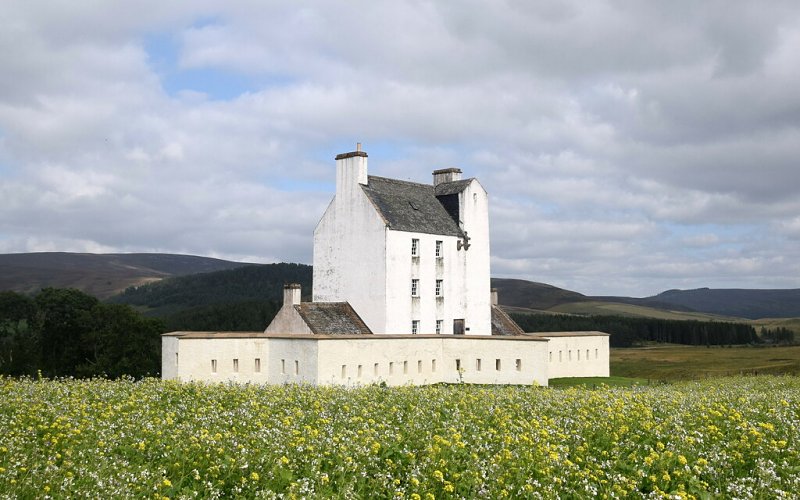
Innernochtie
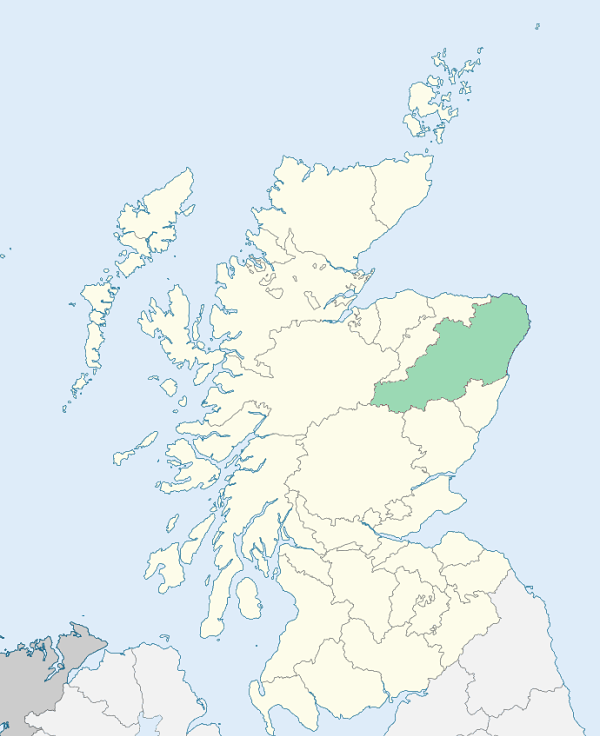
Strathdon is a parish on the west border of Aberdeenshire. It is bounded by Banffshire, and by the parishes of Glenbucket, Migvie, Logie Coldstone, Glenmuick, and Braemar, but it embosoms a part of Tarland. (1867: The Imperial Gazetteer of Scotland, by John Marius Wilson).
Glenkindy, Heughhead, Strathdon
Achernach, Candacraig, Edinblassie or Edinglassie, Glenkindie, Invernan, New-Ardgeith, SKellater
These four parishes (Logie Coldstone, Strathdon, Tarland and Migvie, and Towie) form a group, and can best be dealt with together.
The parish of Strathdon had a detached part in Glenkindie, bounded on the east by the parish of Towie and on the west by the parish of Glenbucket. This detached part was so situated as to separate a part of the parish of Towie at Glencuie from the rest of that parish. In the case of these two detached parts these defects have been cured by transferring the detached part of Strathdon to Towie, thus uniting the detached part of Towie with the main portion of that parish.
The parish of Tarland and Migvie had three detached parts. Tarland and Migvie detached No. 1 was situated at Deskry, and had the parish of Strathdon on the west and the parish of Towie on the east. Tarland and Migvie detached No. 2, situated at Migvie, was bounded on the north by the parish of Towie and elsewhere by the parish of Logie-Coldstone. Tarland and Migvie detached No. 3 was almost entirely surrounded by the parish of Strathdon. Detached No. 3 was transferred to Strathdon; Tarland and Migvie detached No. 1 was divided between Strathdon and Towie, Strathdon receiving the part situated on the left bank of the Deskry, and Towie receiving the remainder; and Tarland and Migvie detached No. 2 was transferred to the parish of Logie-Coldstone. The north-east corner of Logie-Coldstone was transferred to Tarland and Migvie.
See affected properties and landholders. (1892: Boundary of counties and parishes in Scotland as settled by the Boundary Commissioners under the Local Government Act, 1889, by Hay Shennan)
PRE-REFORMATION GOVERNANCE:
POST-REFORMATION GOVERNANCE:
The church of Innernochtie was dedicated to St Andrew. There was in the parish a Well of St Ronan.
Disjoined Quoad Sacra Parishes:
Corgarff. A mission was set up at Corgarff in 1740. Sir Charles Forbes of Newe, Bart., built a new chapel and a manse for the mission in 1834. The parish of Corgarff was disjoined from Strathdon and Tarland, 9 March 1874. A fair of St Machar was long held at Corgarff.
Includes ministers, licentiates, assistants, readers, and clerks.
Strathdon (QO)
Corgarff (QS)
(1928: Fasti Ecclesiæ Scoticanæ, by Hew Scott, D. D.)
Parish registers turned over to the Registrar-General, as a result of the Registration of Births, Deaths, and Marriages (Scotland) Act of 1854. The letters B. D. and M. indicate Births (or Baptisms), Deaths (or Burials), and Marriages (or Proclamations of Banns) respectively. Numbers indicate separate volumes or books. Note: These records are by no means complete or without damage; consult the Detailed List of the Old Parochial Registers of Scotland (1872) to learn more about the condition of the records.
| OPR and RD Numbers | |||
|---|---|---|---|
| Date Range | Name | Number | Type |
| 1667-1854 | Strathdon | 240 | OPR |
| 1855-1971 | Strathdon | 240 | RD |
| 1972-2003 | Strathdon | 325 | RD |
| 2004-2004 | Alford, Sauchen and Strathdon | 326 | RD |
| 2009 | Aberdeenshire, Alford | 326 | RD |
| 2026 | Aberdeenshire Council; Donside Community Council | ||
(2009: Parishes and Registration Districts of Scotland - Old and New, National Records of Scotland)
Local community councils (2026) are provided as a potential source of additional information for settlements within the original boundaries of the parish. (Source)
Statistics from informal and official censuses
Anderson, Coutts, Farquharson, Forbes, Gordon, Michie, Reid, Smith, Stewart, Stuart
Note: Names appearing in research materials, other than censuses. Simple names (First name, surname only) have been omitted unless they appear associated with large properties. All women's names, and men's names with occupations, military ranks, or peerage titles are included.
By the Reverend Mr John Gordon.
"By an accurate list taken since this year began, the number of parishioners amounted to 1524; males 736, females 788, under 8 years of age, 306. There are 2 Episcopalians, upwards of 100 Roman Catholics, mostly residing in Curgarff, which is regularly visited by a priest of that persuasion; all the other parishioners are of the Established Church.
The women in this parish, 20 or 30 years ago, were chiefly employed in knitting stockings; that species of manufacture has now given place to spinning coarse lint, which is mostly brought for that purpose, by our country shopkeepers, from manufacturers in Aberdeen and other places; for there is not much flax raised in the parish. This, though a more severe and more exhausting employment, is deemed more profitable. The women here all use two-handed wheels, as they call them; they are in general capital spinners, and bring a deal of money into the parish.
The men are mostly employed in husbandry. There are as many tradesmen as supply the exigencies of the parish, excepting shoemakers, and masons; to these last little employment is given, except by the proprietors; almost all of them indeed have commodious houses substantially built, and pleasantly situated; but the tenants houses in general have a very mean appearance, which gives strangers a strong impression of the poverty of the country.
The language spoken is English, or rather broad Scotch, excepting in Curgarff. The people there, especially in the upper part of that district, speak also a kind of Gaelic; but that language among them is much on the decline."
(This section contains excerpts, at times restructured or paraphrased, from an article appearing in Statistical Account of Scotland, Sir John Sinclair, 1791-1799)
Primary Sources:
Statistical Account of Scotland (1791-1799), Volume 13, p. 171
New Statistical Account of Scotland (1834-1845), Volume 12, p. 525
See Parish Page Sources for all source information and links.