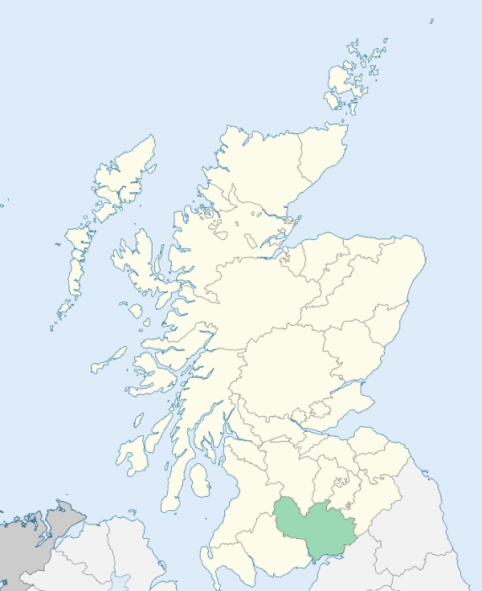
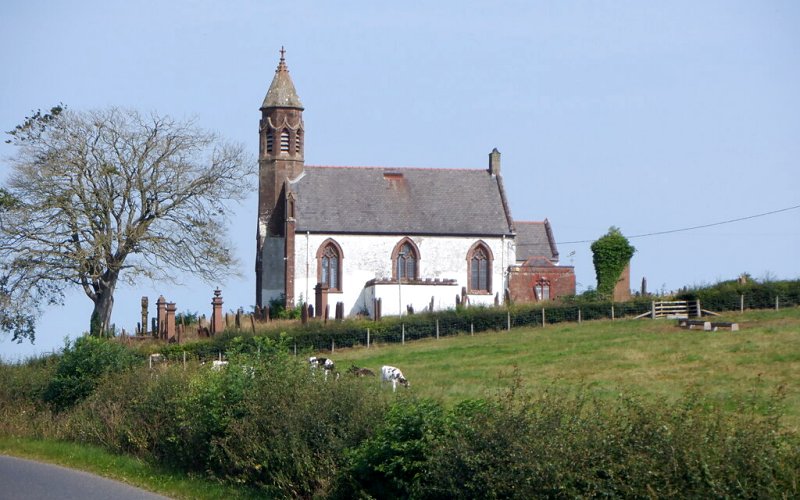
Mouswald is a parish midway between the rivers Nith and Annan, and from 2 to 7 miles north of the Solway Firth, Dumfriesshire. It is bounded by Lochmaben, Dalton, Ruthwell, and Torthorwald. (1867: The Imperial Gazetteer of Scotland, by John Marius Wilson).
Banks, Brocklehurst, Cleughbrae, Flexfield, Mouswald, Old Brocklehurt
Rockhall
PRE-REFORMATION GOVERNANCE:
POST-REFORMATION GOVERNANCE:
Mouswald. The church was dedicated to St Peter, and near it was St Peter's Well.
Little Dalton. Little Dalton was joined to Mouswald by letter of James VI to the Privy Council, 27 May 1615. It was again united to Meikle Dalton (Dalton), 28 June 1633.
Includes ministers, licentiates, assistants, readers, and clerks.
Mouswald (QO)
Little Dalton (QO)
(1928: Fasti Ecclesiæ Scoticanæ, by Hew Scott, D. D.)
Parish registers turned over to the Registrar-General, as a result of the Registration of Births, Deaths, and Marriages (Scotland) Act of 1854. The letters B. D. and M. indicate Births (or Baptisms), Deaths (or Burials), and Marriages (or Proclamations of Banns) respectively. Numbers indicate separate volumes or books. Note: These records are by no means complete or without damage; consult the Detailed List of the Old Parochial Registers of Scotland (1872) to learn more about the condition of the records.
| OPR and RD Numbers | |||
|---|---|---|---|
| Date Range | Name | Number | Type |
| 1751-1854 | Mouswald | 844 | OPR |
| 1855-1968 | Mouswald | 844 | RD |
| 2009 | Dumfries and Galloway, Dumfries | 834 | RD |
| 2026 | Dumfries & Galloway Council; Mouswald Community Council | ||
(2009: Parishes and Registration Districts of Scotland - Old and New, National Records of Scotland)
Local community councils (2026) are provided as a potential source of additional information for settlements within the original boundaries of the parish. (Source)
Statistics from informal and official censuses
Dickson, Dobie, Grierson, Irving, Johnstone, Kerr, Kirkpatrick, Mundell, Paterson, Tweedie
Note: Names appearing in research materials, other than censuses. Simple names (First name, surname only) have been omitted unless they appear associated with large properties. All women's names, and men's names with occupations, military ranks, or peerage titles are included.
By the Reverend Mr Jacob Dickson.
"From a pretty accurate survey taken in spring 1791, the numbers and professions of the inhabitants were found to be: 628 souls, of whom 242 were inhabitants in village, 386 in the country. There were 298 males, 330 females, and 157 persons under 10 years of age. There were 614 members of the Established Church, 2 Burgher Seceders, 10 Antiburghers, 2 of the Relief Chapel, 2 persons born in England, and 3 persons born in Ireland.
There were 60 farmers, 5 smiths, 1 mason, 8 carpenters, 15 weavers, 1 stocking-maker, 6 tailors, 2 millers, 10 day-labourers, 60 cottagers, 24 male farm servants, and 25 female farm servants.
The people are, in general, sober, industrious, and discreet, and seemingly content with their circumstances. None have emigrated, though a good many young men go from hence to England and the West India Islands, in different lines of life; and several men, and some few women, pass over to England, where they are employed as servants. None have stood a trial before the Court of Justiciary for any capital crime. None have been banished. None have enlisted into the army, nor entered into the navy, for a great many years past; and none have died for want in the memory of the oldest living person."
(This section contains excerpts, at times restructured or paraphrased, from an article appearing in Statistical Account of Scotland, Sir John Sinclair, 1791-1799)
Primary Sources:
Statistical Account of Scotland (1791-1799), Volume 7, p. 290
New Statistical Account of Scotland (1834-1845), Volume 4, Section I, p. 442
See Parish Page Sources for all source information and links.