Idvie
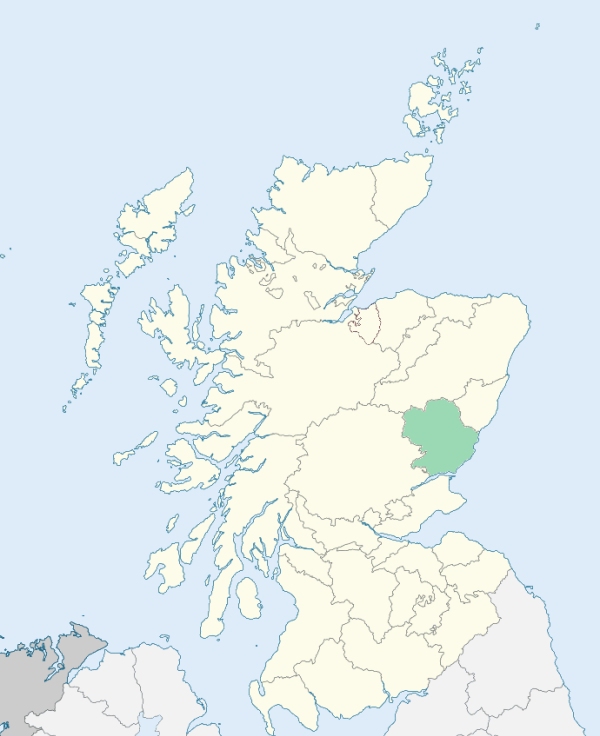
Kirkden is a parish in the maritime district of Forfarshire. It is bounded by Dunnichen, Rescobie, Guthrie, Kinnell, Inverkeillor, and Carmyllie. (1867: The Imperial Gazetteer of Scotland, by John Marius Wilson).
Friockheim, Kirkden, Letham
Pitmuies
The parish of Dunnichen had a detached part situated at Dumbarrow, and almost surrounded by the parish of Kirkden. The parish of Guthrie had a detached part situated at Kirkbuddo, and bounded by the parishes of Carmyllie, Dunnichen, Inverarity, and Monikie. The parish of Kirkden had a detached part situated at Middleton-moor, and bounded on the west and south by the parish of Guthrie, and elsewhere by the parish of Kinnell and a small detached part of the parish of Farnell. The detached part of Dunnichen was transferred to Kirkden, the detached part of Kirkden to Guthrie, and the detached part of Guthrie to Inverarity. See affected properties and landholders. (1892: Boundary of counties and parishes in Scotland as settled by the Boundary Commissioners under the Local Government Act, 1889, by Hay Shennan)
PRE-REFORMATION GOVERNANCE:
POST-REFORMATION GOVERNANCE:
The church of Idvie was dedicated to St Malrubh. It belonged to the Abbey of Arbroath. This parish was severed from the Presbytery of Forfar, and added to that of Arroath on 1 October 1616. There was within the bounds a Well of St Malrubh.
Disjoined Quoad Sacra Parishes:
Friockheim. Opened as an extension church in 1835. Disjoined from Kirkden and erected quoad sacra 28 February 1870.
Includes ministers, licentiates, assistants, readers, and clerks.
Kirkden (QO)
Friockheim (QS)
(1928: Fasti Ecclesiæ Scoticanæ, by Hew Scott, D. D.)
Parish registers turned over to the Registrar-General, as a result of the Registration of Births, Deaths, and Marriages (Scotland) Act of 1854. The letters B. D. and M. indicate Births (or Baptisms), Deaths (or Burials), and Marriages (or Proclamations of Banns) respectively. Numbers indicate separate volumes or books. Note: These records are by no means complete or without damage; consult the Detailed List of the Old Parochial Registers of Scotland (1872) to learn more about the condition of the records.
| OPR and RD Numbers | |||
|---|---|---|---|
| Date Range | Name | Number | Type |
| 1650-1854 | Kirkden | 298 | OPR |
| 1855-1945 | Kirkden | 298 | RD |
| 1946-1960 | Kirkden and Kinnell | 298 | RD |
| 1961-1968 | Kirkden, Kinnell and Guthrie | 298 | RD |
| 2009 | Angus, Arbroath | 369 | RD |
| 2026 | Angus Council, Friockheim and District Community Council | ||
(2009: Parishes and Registration Districts of Scotland - Old and New, National Records of Scotland)
Local community councils (2026) are provided as a potential source of additional information for settlements within the original boundaries of the parish. (Source)
Statistics from informal and official censuses
Craig, Donaldson, Esplin, Fyfe, Mitchell, Moir, Smith, Strachan, Whyte, Wood
Note: Names appearing in research materials, other than censuses. Simple names (First name, surname only) have been omitted unless they appear associated with large properties. All women's names, and men's names with occupations, military ranks, or peerage titles are included.
By the Reverend Mr William Milligan.
"On the last day of October 1790, the number of persons living in the parish of Kirkden, properly parishioners, were 727; of whom there were 359 males, and 368 females. In this parish there are 133 families; 17 of which, consist, but of two persons each, and 2 or 3 solitary individuals. Of the above there are 33 farmers (persons who have no other occupation), 26 weavers, 5 wrights, 4 tailors, 2 masons, 2 cadgers (fish carriers), 4 blacksmiths, 3 shoemakers, 6 millers, 2 creamers (persons who go through the parish, and neighbourhood, and buy butter, hens, eggs, &c. mostly for the Dundee market), and 19 labourers. The above are all heads of families. There are about 60 labouring servants, male and female, but almost all the females are chiefly employed in spinning. Many families have no occasion to hire servants, having a sufficient number of children to perform their work.
There is hardly a house in the parish, where one or more women are not employed in spinning yarn. The woman all spin with both hands. For this reason, many, instead of going to service, continue with their parents and friends, merely for the purpose of spinning, as being more profitable employment, and, in which they enjoy more liberty.
The inhabitants of this parish, with very few exceptions, are an industrious, civilized, and contented people. No person has been banished from it, nor been guilty of murder, suicide, or any atrocious crime, within the present century, if we except those, who, from a mistaken loyalty, followed the Pretender, in 1745."
(This section contains excerpts, at times restructured or paraphrased, from an article appearing in Statistical Account of Scotland, Sir John Sinclair, 1791-1799)
Primary Sources:
Statistical Account of Scotland (1791-1799), Volume 2, p. 505
New Statistical Account of Scotland (1834-1845), Volume 11, Section I, p. 383
See Parish Page Sources for all source information and links.