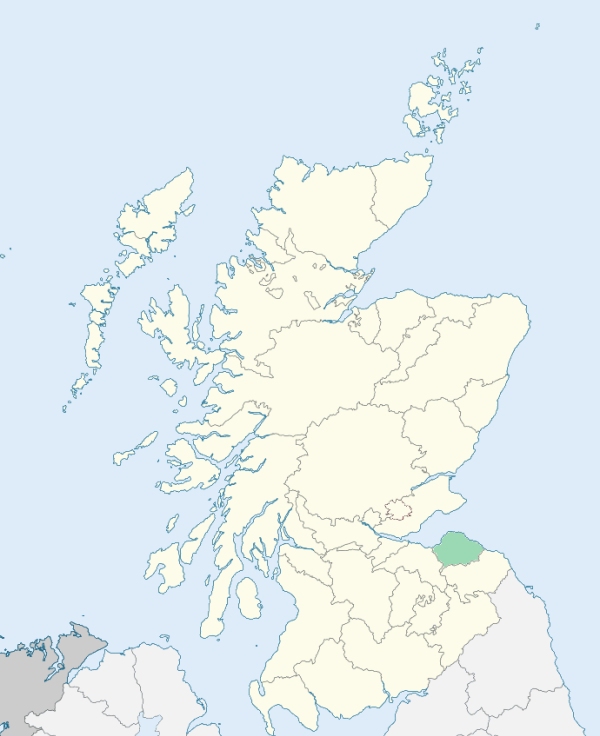
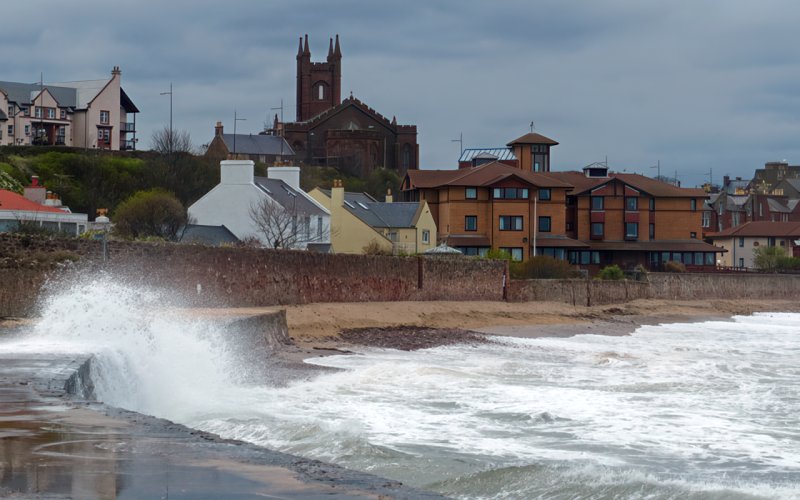
Dunbar is a parish in the east of Haddingtonshire. It comprises a main body and a detached district. The main body lies along the coast and is bounded on the north by the German Ocean (North Sea), and on other sides by the parishes of Whitekirk, Prestonkirk, Stenton, Spott, and Innerwick. (1867: The Imperial Gazetteer of Scotland, by John Marius Wilson).
Belhaven, Belton, Beltonford, Dunbar, East Barns, Hedderwick, Pinkerton, West Barns
Belton, Heatherwick
PRE-REFORMATION GOVERNANCE:
POST-REFORMATION GOVERNANCE:
Formerly a collegiate church dedicated to St Bey, a female saint of little fame, who is said to have led an anchoretical life on the Great Cumbrae (Cumbrae), in the Firth of Clyde. Founded by Patrick, ninth Earl of Dunbar, in 1342, it was the first Collegiate Kirk in Scotland. Its prebends were Pinkerton, Heatherwick or Belton, Whittingehame, Pensheil, Duns, Stenton, and Spott.
Disjoined Quoad Sacra Parishes:
Belhaven. Church built in 1838. Declared a charge quoad sacra, 29 May 1839. The parish was disjoined by the Court of Teinds, 28 January 1863.
Includes ministers, licentiates, assistants, readers, and clerks.
Dunbar (QO)
Belhaven (QS)
(1928: Fasti Ecclesiæ Scoticanæ, by Hew Scott, D. D.)
Parish registers turned over to the Registrar-General, as a result of the Registration of Births, Deaths, and Marriages (Scotland) Act of 1854. The letters B. D. and M. indicate Births (or Baptisms), Deaths (or Burials), and Marriages (or Proclamations of Banns) respectively. Numbers indicate separate volumes or books. Note: These records are by no means complete or without damage; consult the Detailed List of the Old Parochial Registers of Scotland (1872) to learn more about the condition of the records.
| OPR and RD Numbers | |||
|---|---|---|---|
| Date Range | Name | Number | Type |
| 1651-1854 | Dunbar | 706 | OPR |
| 1855-1856 | Dunbar Burgh | 706-1 | RD |
| 1855-1856 | Dunbar Landward | 706-2 | RD |
| 1857-1971 | Dunbar | 706 | RD |
| 1972-2003 | Dunbar | 724 | RD |
| 2004-2008 | Dunbar, East Lothian | 724 | RD |
| 2009 | East Lothian, Dunbar | 724 | RD |
| 2026 | East Lothian Council; Dunbar Community Council West Barns Community Council | ||
(2009: Parishes and Registration Districts of Scotland - Old and New, National Records of Scotland)
Local community councils (2026) are provided as a potential source of additional information for settlements within the original boundaries of the parish. (Source)
Statistics from informal and official censuses
Anderson, Brown, Henderson, Paxton, Purves, Robertson, Scott, Smith, Thomson, Young
Note: Names appearing in research materials, other than censuses. Simple names (First name, surname only) have been omitted unless they appear associated with large properties. All women's names, and men's names with occupations, military ranks, or peerage titles are included.
By the Reverend Mr George Bruce.
"By an accurate survey in the present year (1792), it appears, that there are 3700 inhabitants in the parish, of all ages.
There are five villages in the parish, viz. Belhaven, West Barns, Hedderwick, East Barns, and Pinkerton. On the river Biel, at the village of West Barns, a cotton and flax mill is just now begun to be erected, from which we have great expectations. At West Barns, there are flour mills of the best sort, where a considerable quantity of wheat and barley is manufactured. There are three other corn mills in the parish.
In the shipping trade at the harbour of Dunbar, there are 33 men in the coasting trade, 67 in foreign trade, and 30 in the whale-fishing trade. There are 12 fishing boats for white fish and lobsters, which employ about 40 men. There is a custom-house, in which there are a collector and comptroller, a land surveyor, a tide surveyor, 4 tide-waiters, and a custom-house boat, with 7 men belonging to it. There is a very fine ropery at Dunbar, where there are employed from 20 to 30 men; and another new one at West Barns. Kelp, in a small quantity, is made on the coast. Soap and starch are manufactured in the town and neighbourhood.
The expense in dress, in furniture of the house, and in the table, is greatly increased from what was the mode half a century ago. This is indeed the case in general throughout every part of Scotland, in proportion to the progress of refinement and wealth, in the present advanced period of society."
(This section contains excerpts, at times restructured or paraphrased, from an article appearing in Statistical Account of Scotland, Sir John Sinclair, 1791-1799)
Primary Sources:
Statistical Account of Scotland (1791-1799), Volume 5, p. 474
New Statistical Account of Scotland (1834-1845), Volume 2, Section II, p. 70
See Parish Page Sources for all source information and links.