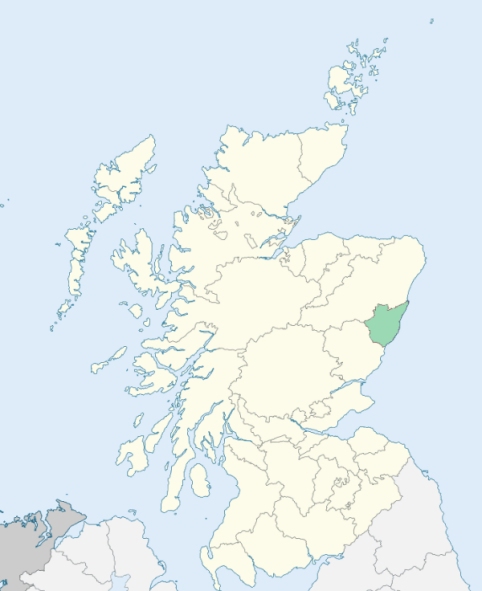
Arbuthnott is a parish in the south-east part of the county of Kincardine. It is nearly of a triangular form, with the exception of a small district on the south-west side, which forms a projection southward of the Water of Bervie, which, except at this point, divides it from the parishes of Bervie and Garvock. Upon the west it is bounded by the parishes of Fordoun and Glenbervie, or the great hollow of the Mearns, the Bervie and the Forth forming the dividing line on this side, and on the north-east and east it is bounded by the parishes of Dunottar and Kinneff. (1867: The Imperial Gazetteer of Scotland, by John Marius Wilson).
Arbuthnott
PRE-REFORMATION GOVERNANCE:
POST-REFORMATION GOVERNANCE:
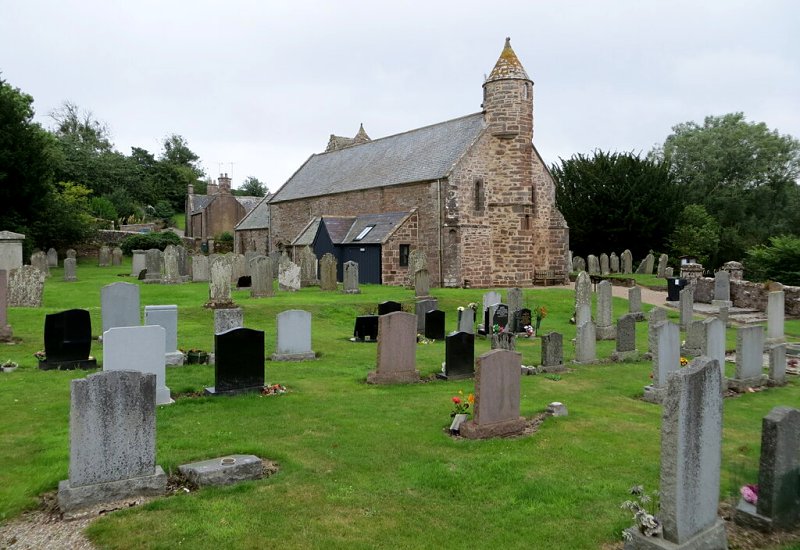
The church of Arbuthnott was dedicated to St Ternan and consecrated by Bishop David de Bernham on 3 August 1242. It belonged to the collegiate church of St Mary on the Kirk Heugh at St Andrews. There is a mission chapel within the bounds at Fiddes.
Includes ministers, licentiates, assistants, readers, and clerks.
(1928: Fasti Ecclesiæ Scoticanæ, by Hew Scott, D. D.)
Parish registers turned over to the Registrar-General, as a result of the Registration of Births, Deaths, and Marriages (Scotland) Act of 1854. The letters B. D. and M. indicate Births (or Baptisms), Deaths (or Burials), and Marriages (or Proclamations of Banns) respectively. Numbers indicate separate volumes or books. Note: These records are by no means complete or without damage; consult the Detailed List of the Old Parochial Registers of Scotland (1872) to learn more about the condition of the records.
| OPR and RD Numbers | |||
|---|---|---|---|
| Date Range | Name | Number | Type |
| 1631-1854 | Arbuthnott | 250 | OPR |
| 1855-1967 | Arbuthnott | 250 | RD |
| 2009 | Aberdeenshire, Stonehaven and East Kincardine | 342 | RD |
| 2026 | Aberdeenshire Council; Arbuthnott Community Council | ||
(2009: Parishes and Registration Districts of Scotland - Old and New, National Records of Scotland)
Local community councils (2026) are provided as a potential source of additional information for settlements within the original boundaries of the parish. (Source)
Statistics from informal and official censuses
Brown, Hadden, Low, Milne, Murray, Scott, Smith, Taylor, Thomson, Watt
Note: Names appearing in research materials, other than censuses. Simple names (First name, surname only) have been omitted unless they appear associated with large properties. All women's names, and men's names with occupations, military ranks, or peerage titles are included.
By a Friend to Statistical Inquiries.
"The total number of souls in the year 1774 was 1040; and three years ago it was precisely the same. At present there is only one more. The number of males is 494; the number of females, 547. Of these there are 104 males and 147 females under 10 years of age. There are 4 gardeners, 7 wrights and house carpenters, 2 masons, 5 tailors, 8 shoemakers, 20 weavers, 1 dyer, 4 millers, 7 smiths, 2 shopkeepers, 2 wheel-wrights, and 1 cooper. There are 230 inhabited houses, of which 27 are inhabited by a single person.
The general character of the people is industrious and sober, little disposed to change of place or employment. Hence the population has been so stationary."
(This section contains excerpts, at times restructured or paraphrased, from an article appearing in Statistical Account of Scotland, Sir John Sinclair, 1791-1799)
Primary Sources:
Statistical Account of Scotland (1791-1799), Volume 17, p. 385
New Statistical Account of Scotland (1834-1845), Volume 11, Section II, p. 153
See Parish Page Sources for all source information and links.