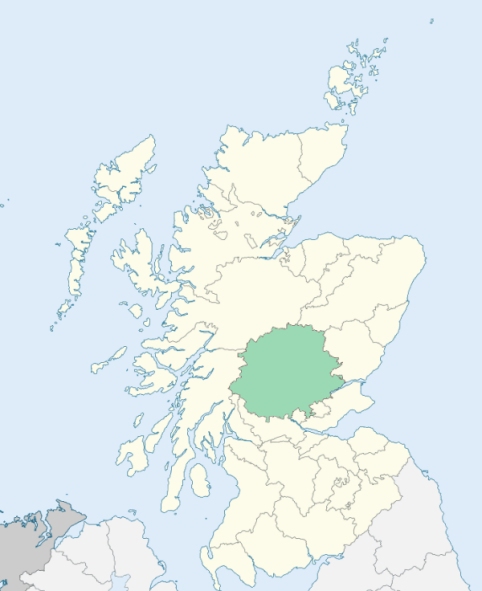
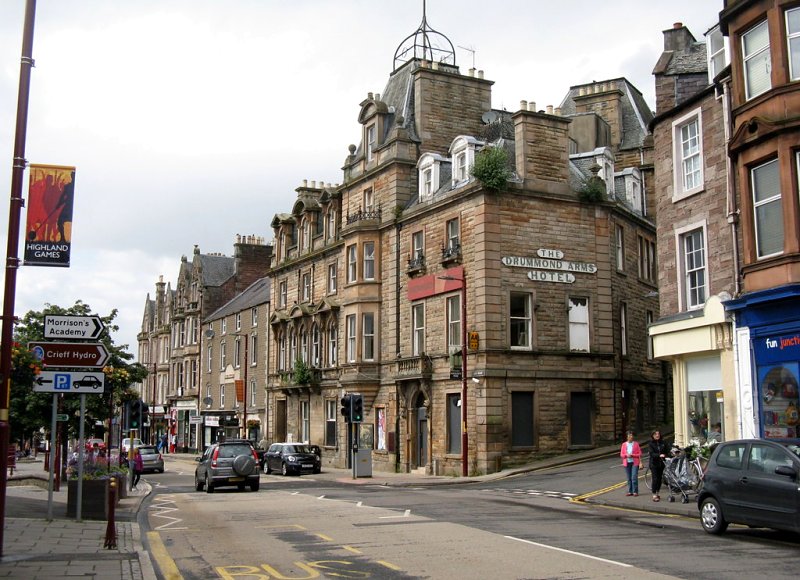
Crieff is a parish in the central part of Perthshire. A large division of it is separated from the rest by the intervention of the parish of Monzie. The main district lies in Strathearn, and is bounded by Fowlis Wester, Monzie, Monzievaird, Madderty, and Muthill. (1867: The Imperial Gazetteer of Scotland, by John Marius Wilson).
Crieff, Gilmerton, Milton of Cultoquhey, Powmill, Tomaknock
Abercairney, Broich, Collerie, Cultoquhey, Fern Tower, Glenalmond, Inchbrakie, Innerpeffray, Monzie, Ochtertyre
The parish of Crieff had two detached parts:
(a) Auchilanzie, surrounded by the parish of Fowlis Wester
(b) Glenshervie (included in Ordnance Survey maps in Monzie detached No. 2)
The detached part of Crieff, situated at Glenshervie was transferred to the parish of Monzievaird & Strowan. The part of the parish of Crieff which lay on the right bank of the Earn was transferred to the parish of Muthill. The detached part of Crieff situated at Auchilanzie was transferred to the parish of Fowlis Wester, and so also was the whole of that portion of Crieff which lay in the basin of the River Almond. The portion of the parish of Monzie which contained the village of Monzie, and also Monzie detached No. 1, were annexed to the parish of Crieff. See affected properties and landholders. (1892: Boundary of counties and parishes in Scotland as settled by the Boundary Commissioners under the Local Government Act, 1889, by Hay Shennan)
PRE-REFORMATION GOVERNANCE:
POST-REFORMATION GOVERNANCE:
The church of Crieff was dedicated to St Michael. It was a prebend of Dunblane. A Michaelmas fair was held at Crieff. There was in this parish a hospital, or other such small church foundation, dedicated to St Thomas the Martyr. It stood at Mylnab (Muilin an Aib = the Abbot's Mill). Adjoining it was St Thomas's Well, and there St Thomas's Fair was held.
Disjoined Quoad Sacra Parishes:
Amulree. The name of this parish, Ath Mhalruibh (the ford of Malrubh), commemorates an ancient chapel of St Malrubh, which stood here beside the ford of the River Braan. Amulree was disjoined from Dull, Fowlis Wester, Kenmore, Little Dunkeld, Monzie, Weem, and Crieff on 15 July 1871. The church was begun in 1743, but owing to the (Jacobite) Rebellion in 1745, was not completed until 1752.
Crieff West. A chapel here had a constitution from the General Assembly, 28 May 1838. The parish was disjoined from Crieff, 20 July 1864.
Includes ministers, licentiates, assistants, readers, and clerks.
Crieff (QO)
Amulree (QS)
Crieff West (QS)
(1928: Fasti Ecclesiæ Scoticanæ, by Hew Scott, D. D.)
Parish registers turned over to the Registrar-General, as a result of the Registration of Births, Deaths, and Marriages (Scotland) Act of 1854. The letters B. D. and M. indicate Births (or Baptisms), Deaths (or Burials), and Marriages (or Proclamations of Banns) respectively. Numbers indicate separate volumes or books. Note: These records are by no means complete or without damage; consult the Detailed List of the Old Parochial Registers of Scotland (1872) to learn more about the condition of the records.
| OPR and RD Numbers | |||
|---|---|---|---|
| Date Range | Name | Number | Type |
| 1692-1854 | Crieff | 342 | OPR |
| 1855-1971 | Crieff | 342 | RD |
| 1972-2003 | Crieff | 394 | RD |
| 2009 | Perth and Kinross, Crieff | 394 | RD |
| 2026 | Perth and Kinross Council; Crieff Community Council East Strathearn Community Council | ||
(2009: Parishes and Registration Districts of Scotland - Old and New, National Records of Scotland)
Local community councils (2026) are provided as a potential source of additional information for settlements within the original boundaries of the parish. (Source)
Statistics from informal and official censuses
Cameron, Campbell, Drummond, Graham, Marshall, Miller, Roy, Stewart, Taylor, Wilson
Note: Names appearing in research materials, other than censuses. Simple names (First name, surname only) have been omitted unless they appear associated with large properties. All women's names, and men's names with occupations, military ranks, or peerage titles are included.
By the Reverend Mr Robert Stirling.
"There are 102 families in the country, of whom 253 are males and 316 females, total 569. There are 609 families in the town, of whom 955 are males, and 1116 females, total 2071. The village of Bridgend is comprehended in the town, as they are nearly joined by their mutual extension. Total in the parish 2640 souls. There are 25 Papists, 39 Episcopals, 50 Bereans, 96 Relief, and 2225 of the Established Church.
Among the heads of families in 1792, were 124 widows, 55 maids old and young; and 69 bachelors, of whom 15 were above 50 years. The whole 711 heads of families consisted of the following classes or offices: 4 apothecaries, physicians and surgeons, 4 bakers, 2 barbers, 8 butchers, 9 carriers, 29 carters, 3 clergymen, 4 clockmakers, 4 coopers, 4 dyers, 3 distillers and brewers, 3 excise officers, 40 farmers, 2 fiddlers, 2 gardeners, 11 gentry, 7 hecklers, 17 innkeepers, 111 labourers, 6 manufacturers, 16 masons and a slater, 49 merchants or shopkeepers, of whom 19 retail tea, 2 messengers, 4 midwives, 3 millers, 2 saddlers, 6 schoolmasters and school-mistresses, 29 shoemakers, 8 smiths, 159 spinsters, 6 stocking-makers, 30 tailers, 92 weavers, 20 wrights, and 1 writer and notary public.
The people speak the English language in the best Scotch dialect: although the Gaelic be commonly spoken at the distance of three miles north, or four west from Crieff, yet no adult natives of the lowland part of the parish can either speak or understand it."
(This section contains excerpts, at times restructured or paraphrased, from an article appearing in Statistical Account of Scotland, Sir John Sinclair, 1791-1799)
Primary Sources:
Statistical Account of Scotland (1791-1799), Volume 9, p. 583
New Statistical Account of Scotland (1834-1845), Volume 10, p. 487
See Parish Page Sources for all source information and links.