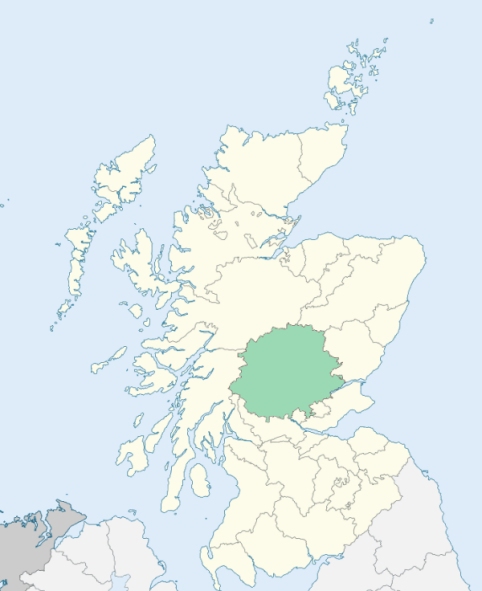
Dull is an extensive parish in Perthshire. It is bounded by Blair-Atholl, Moulin, Logierait, Little Dunkeld, Fowlis Wester, Crieff, Monzie, Kenmore, Weem, and Fortingall. It comprises five distinct districts - the district of Appin, the district of Grandtully, a peninsulated portion in the south-east, the district of Amulree, which is situated south from the rest of the parish, and is completely isolated from it, the district of Foss in the north-west, and the district of Fincastle in the north-east. (1867: The Imperial Gazetteer of Scotland, by John Marius Wilson).
Aberfeldy, Amulree, Dull, Foss, Shian
Blair, Bohally, Bonskeid, Breadalbane, Derculich, Easter Shian, Fincastle, Grantully, Menzies, Shierglass
(1) All those parts of Dull which lay north of the River Tummell and of Loch Tummel were transferred to Blair Atholl. See affected properties and landholders. (1892: Boundary of counties and parishes in Scotland as settled by the Boundary Commissioners under the Local Government Act, 1889, by Hay Shennan)
(2) The parish of Fortingall had two detached parts:
1. Bolfacks, on the south of the River Tay, west of Aberfeldy
2. Loch Lyon, at the head of Glen Lyon
Fortingall detached No. 1 was transferred to the parish of Dull. See affected properties and landholders. (1892: Boundary of counties and parishes in Scotland as settled by the Boundary Commissioners under the Local Government Act, 1889, by Hay Shennan)
(3) The parish of Kenmore had five detached parts:
No. 1. Daldravaig, a little to the west of Killin village, and almost wholly surrounded by the parish of Killin
No. 2. Corrycharmaig, in Glenlochay, west of Killin village
No. 3 Morenish and Carie, lying on both sides of Loch Tay towards its west end
No. 4. Shian, in Glenquaich
No. 5 Kenknock, at the head of Glenlochay, and extending northwards into Glenlyon
Kenmore detached No. 4 was transferred to the parish of Dull. See affected properties and landholders. (1892: Boundary of counties and parishes in Scotland as settled by the Boundary Commissioners under the Local Government Act, 1889, by Hay Shennan)
PRE-REFORMATION GOVERNANCE:
POST-REFORMATION GOVERNANCE:
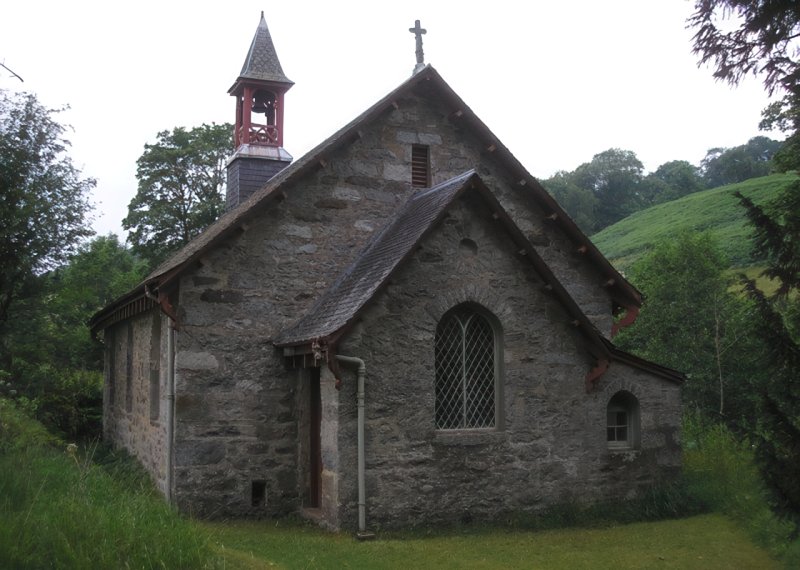
The parish church was dedicated to St Ninian, and prior to the Reformation belonged to the Priory of St Andrews. From a very early time there was at Dull a great Celtic monastery. Like other foundations of that kind, it fell under the sway of a powerful landed family, and its government was more or less hereditary. In the twelfth century this ancient abbey was converted by the Crown into a Tironensian Priory. Its patron was always St Adamnan. An important yearly market held at Dull was called Feill Eonain (Adamnan's Fair).
Disjoined Quoad Sacra Parishes:
Amulree. The name of this parish, Ath Mhalruibh (the ford of Malrubh), commemorates an ancient chapel of St Malrubh, which stood here beside the ford of the River Braan. Amulree was disjoined from Dull, Fowlis Wester, Kenmore, Little Dunkeld, Monzie, Weem, and Crieff on 15 July 1871. The church was begun in 1743, but owing to the (Jacobite) Rebellion in 1745, was not completed until 1752.
Grantully. The parish of Grantully was disjoined from Little Dunkeld and Dull on 12 March 1883. At Pitcairn, within the bounds, stands a chapel built in 1533 by Alexander Stewart of Grantully, part of which is now used as a burial vault by that family. It was dedicated to St Mary, St Andrew, St Adamnan, and St Bean.
Tenandry, previously Fincastle. The parish of Fincastle, consisting mainly of Glen Fincastle and adjoining portions of Strathtummel, was united to Dull early in the seventeenth century. In 1836 a parliamentary chapel was built at Tenandry in the parish of Blair-Atholl. On 19 November 1851 the ancient parish of Fincastle was again disjoined from Dull, along with the church of Tenandry, and neighbouring parts of Blair-Atholl and Moulin, thus forming an enlarged parish of Fincastle or Tenandry.
Includes ministers, licentiates, assistants, readers, and clerks.
Dull (QO)
Amulree (QS)
Grantully (QS)
Tenandry, or Fincastle (QS)
(1928: Fasti Ecclesiæ Scoticanæ, by Hew Scott, D. D.)
Parish registers turned over to the Registrar-General, as a result of the Registration of Births, Deaths, and Marriages (Scotland) Act of 1854. The letters B. D. and M. indicate Births (or Baptisms), Deaths (or Burials), and Marriages (or Proclamations of Banns) respectively. Numbers indicate separate volumes or books. Note: These records are by no means complete or without damage; consult the Detailed List of the Old Parochial Registers of Scotland (1872) to learn more about the condition of the records.
| OPR and RD Numbers | |||
|---|---|---|---|
| Date Range | Name | Number | Type |
| 1703-1854 | Dull | 346 | OPR |
| 1855-1955 | Dull | 346 | RD |
| 1956-1961 | Aberfeldy and Dull | 324 | RD |
| 1962-1971 | Aberfeldy, Dull and Weem | 324 | RD |
| 1972-2003 | Aberfeldy, Dull and Weem | 385 | RD |
| 2009 | Perth and Kinross, Aberfeldy | 385 | RD |
| 2026 | Perth and Kinross Council; Dull and Weem Community Council | ||
(2009: Parishes and Registration Districts of Scotland - Old and New, National Records of Scotland)
Local community councils (2026) are provided as a potential source of additional information for settlements within the original boundaries of the parish. (Source)
Statistics from informal and official censuses
Cameron, Campbell, Dewar, Forbes, Fraser, Menzies, Munro, Robertson, Stewart, Thomson
Note: Names appearing in research materials, other than censuses. Simple names (First name, surname only) have been omitted unless they appear associated with large properties. All women's names, and men's names with occupations, military ranks, or peerage titles are included.
By the Reverend Mr Archibald Menzies.
"The number of inhabitants, as appear from an exact list of them, recently taken, amount to 4676. There is 1 surgeon and 1 family of Roman Catholics in the parish. The people are sober, regular, and industrious: they are lively, cheerful, and given to hospitality. Crimes are daily becoming more rare. Gross offenders are held in great disgrace. A notorious drunkard is despised in the highest degree. The people enjoy, in a reasonable degree, the comforts and conveniences of life; and, in general, appear happy and contented with their condition."
(This section contains excerpts, at times restructured or paraphrased, from an article appearing in Statistical Account of Scotland, Sir John Sinclair, 1791-1799)
Primary Sources:
Statistical Account of Scotland (1791-1799), Volume 6, p. 149
New Statistical Account of Scotland (1834-1845), Volume 10, p. 752
See Parish Page Sources for all source information and links.