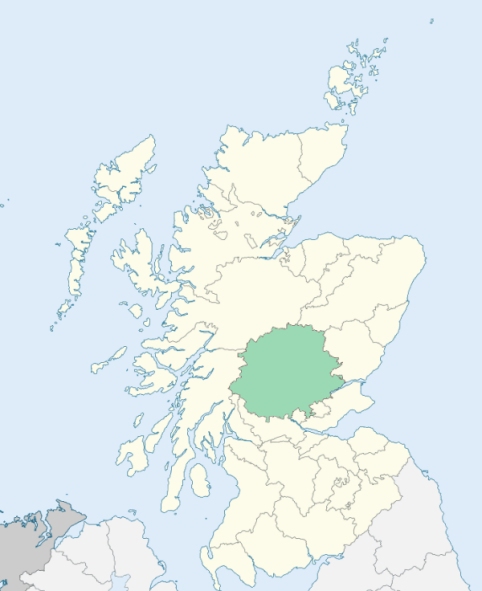
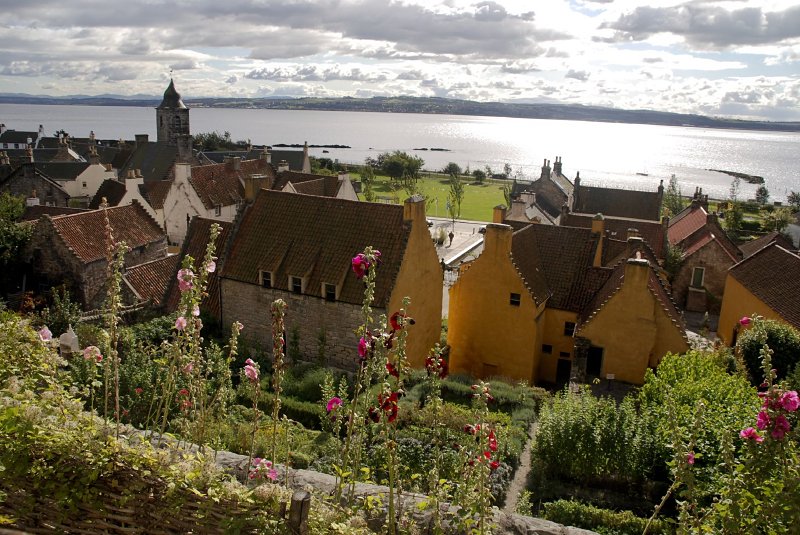
Culross is a parish in the detached district of Perthshire. It is bounded on the south by the Firth of Forth, and on other sides by the parishes of Tulliallan, Clackmannan, Saline, and Torryburn. (1867: The Imperial Gazetteer of Scotland, by John Marius Wilson).
Blairburn, Comrie, Culross, Low Valleyfield, Oakley
Dunimarle, Valleyfield
The parishes of Culross and Tulliallan formed a detached part of Perthshire, lying on the Forth between the counties of Clackmannan and Fife. They have now been transferred to the county of Fife. See affected properties and landholders. (1892: Boundary of counties and parishes in Scotland as settled by the Boundary Commissioners under the Local Government Act, 1889, by Hay Shennan)
PRE-REFORMATION GOVERNANCE:
POST-REFORMATION GOVERNANCE:
The original parish church of Culross, dating from a very early period, is situated in a field about three-quarters of a mile to the west of the burgh, and is surrounded by a graveyard. An Act of Parliament of 1633 decreed that the abbey church be that of the parish. Dedicated to the Virgin Mary and St Serf, the Cistercian Abbey of Culross was founded in 1217 by Malcolm, Earl of Fife. It was much resorted to by pilgrims of all classes. In 1905 the eastern portion underwent restoration. At the south-eastern boundary of the abbey grounds stood the chapel of St Mungo. In 1672 the barony of Kincardine-on-Forth and the lands of Lurg, Sands, and Kellywood were disjoined from Culross, and added to the parish of Tulliallan. Fairs of St Serf and St Matthew were held at Culross.
Includes ministers, licentiates, assistants, readers, and clerks.
(1928: Fasti Ecclesiæ Scoticanæ, by Hew Scott, D. D.)
Parish registers turned over to the Registrar-General, as a result of the Registration of Births, Deaths, and Marriages (Scotland) Act of 1854. The letters B. D. and M. indicate Births (or Baptisms), Deaths (or Burials), and Marriages (or Proclamations of Banns) respectively. Numbers indicate separate volumes or books. Note: These records are by no means complete or without damage; consult the Detailed List of the Old Parochial Registers of Scotland (1872) to learn more about the condition of the records.
| OPR and RD Numbers | |||
|---|---|---|---|
| Date Range | Name | Number | Type |
| 1640-1854 | Culross | 343 | OPR |
| 1855-1856 | Culross Burgh | 343-1 | RD |
| 1855-1856 | Culross Landward | 343-2 | RD |
| 1857-1892 | Culross, Perth | 343 | RD |
| 1893-1967 | Culross | 418b | RD |
| 1968-1971 | Culross, Fife | 418 | RD |
| 1972-1993 | Culross | 435 | RD |
| 2009 | Fife, Culross | 435 | RD |
| 2026 | Fife Council; Culross Community Council | ||
(2009: Parishes and Registration Districts of Scotland - Old and New, National Records of Scotland)
Local community councils (2026) are provided as a potential source of additional information for settlements within the original boundaries of the parish. (Source)
Statistics from informal and official censuses
Buchanan, Harrower, Hunter, Hutton, Kirk, Lawson, Scotland, Smith, Thomson, Wilson
Note: Names appearing in research materials, other than censuses. Simple names (First name, surname only) have been omitted unless they appear associated with large properties. All women's names, and men's names with occupations, military ranks, or peerage titles are included.
By the Reverend Messrs Robert Rolland and Walter M'Alpine.
"The population in 1791 was 1442, of whom 655 were males, and 787 females; in the country 373, in the town and in the villages of Blairburn and Laigh Valleyfield, 1069. There were 72 houses in the country, and 203 houses in the town and suburbs. There were 21 shoemakers, 1 tanner, 72 weavers, 9 tailors, 17 carpenters and wrights, 16 masons, 7 bakers, 6 smiths, 3 butchers, 1 brewer, and 11 licensed alehouses.
There is no manufacture of any note at present established in the parish, many of the weavers who reside in it being employed in working diapers for dealers in Dunfermline, or cotton cloths for those in Glasgow; but there was formerly a species of manufacture in some measure peculiar, if not altogether confined, to the place, from 30 to 40 hands having been usually engaged in it. This branch was that of making of girdles (griddles), a kitchen utensil well known in Scotland for toasting unleavened breads.
From June 1791, when a particular investigation was gone into, with a view to this report, a considerable addition has been made to the number of looms in the parish; and two new branches of manufacture have been established in the town, viz. those of tambouring and flowering muslins. In the first, 38 young girls are already engaged, from 9 years old and upwards; and in the other 34. Those below 12 years old are bound for three years. So that now, in proportion to the numbers in a family, provided they are soberly and industriously brought up, their affluence and comfort increase; and, indeed, a spirit of contentment and cheerfulness is universally diffused among the people, and hardly a murmur to be heard.
The people, in general, are tall, well proportioned, with good eyes, vivid complexions, and upon the whole, very expressive countenances. They are not only decently clothed, but many of them, such as the young trades people, genteelly dressed, even more so than is usual with persons of the same station elsewhere. Few are known to complain of wanting the necessaries of life; none, indeed, who are able and willing to work, or who are not notorious spendthrifts. A general spirit of discontent has never been known to prevail among them, nor are any combinations formed, on account of oppression, bad usage, or want of subsistence, for leaving the country.
In the country part of the parish, their manners are, in general, simple and virtuous, living in the habits of sobriety and industry; and, though not many of them are rich, yet they are contented with their situation, enjoying the necessaries, and many of the comforts, of life.
We are sorry we cannot give the same favourable report, at least without many exceptions, of those in the town. This is chiefly owing to the unhappy influence of borough politics, which, in a place like this, where the numbers are small, draw almost every individual tradesman to act a part in them, when a competition happens, which is often the case; thus communicating the baneful habits of idleness, and a taste for luxury and dissipation. We have, however, the comfort to add, that there are but few instances of any atrocious crimes. For 20 years and upwards, there have been no murders committed, one or two child-murders excepted. None have suffered by the hand of the executioner, and only two by their own."
(This section contains excerpts, at times restructured or paraphrased, from an article appearing in Statistical Account of Scotland, Sir John Sinclair, 1791-1799)
Primary Sources:
Statistical Account of Scotland (1791-1799), Volume 10, p. 131
New Statistical Account of Scotland (1834-1845), Volume 10, p. 597
See Parish Page Sources for all source information and links.