Pollock, Pollok
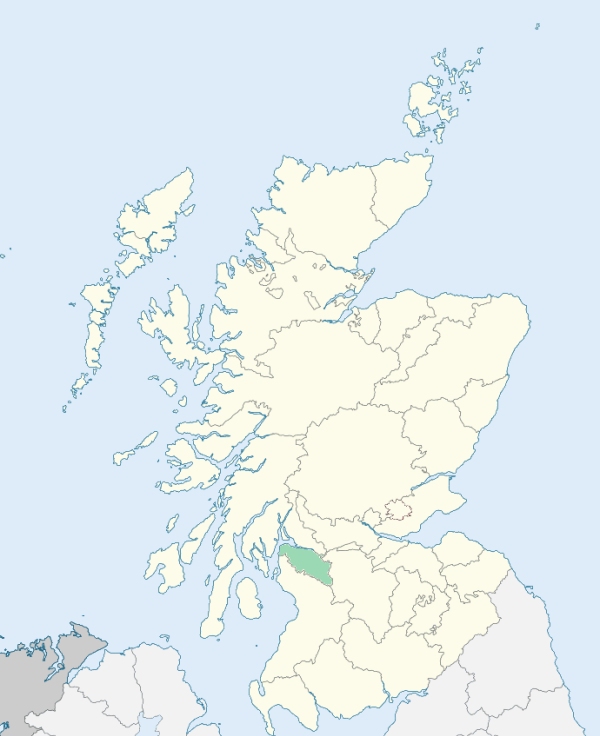
Eastwood is a parish in the east side of Renfrewshire. It is bounded by the parishes of Cathcart, Mearns, Neilston, Paisley, and Govan. (1867: The Imperial Gazetteer of Scotland, by John Marius Wilson).
Cowglen, Giffnock, Pollockshaws, Thornliebank
Pollok House
The city of Glasgow, as defined by the City of Glasgow Act, 1891, is partly in Lanarkshire and partly in Renfrewshire. Clause III proposes to put the whole of the extended city in the county of Lanark. The subjects so to be transferred are far too numerous to detail. They are situated partly in the:
Parish of Govan - Polmadei, Strathbungo, Pollokshields, Pollokshields East
Parish of Cathcart - Crosshill, Crossmyloof, Langside, Mount Florida
Parish of Eastwood - Shawlands
The effect of the change just described would be to place the parish of Govan wholly in Lanarkshire, with the exception of the police burgh of Kinning Park, which would remain in Renfrewshire. See affected properties and landholders. (1892: Boundary of counties and parishes in Scotland as settled by the Boundary Commissioners under the Local Government Act, 1889, by Hay Shennan)
PRE-REFORMATION GOVERNANCE:
POST-REFORMATION GOVERNANCE:
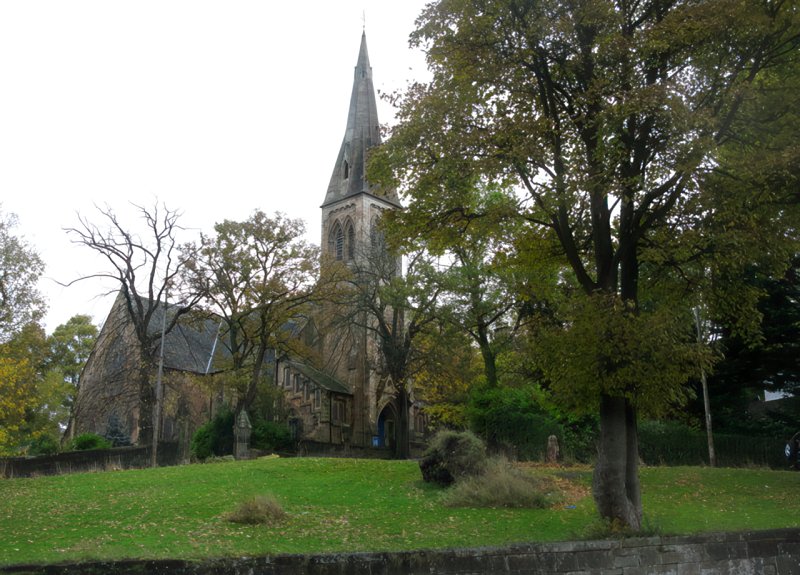
The vicarage of Pollok belonged to the Abbey of Paisley. Its church was dedicated to St Conal, and in the Old Glebe at Pollock is St Conal's Well. The parish church was removed from Pollok to Eastwood in the seventeenth century. In 1781 Eastwood Church was rebuilt on a new site. A new church, the gift of Sir John Maxwell of Pollok, Bart., was built in 1863.
Disjoined Quoad Sacra Parishes:
Giffnock. Disjoined from Eastwood, Mearns, and Thornliebank, 10 January 1919.
Greenbank. A church was built here in 1885. The parish was disjoined from Cathcart, Eastwood, and Mearns by the Court of Teinds, 25 Feb 1889.
Levern. A church was opened here on 23 March 1835. On 30 May 1836 a chapel constitution was granted to it, and a definite district given it. The parish of Levern was disjoined from the parishes of the Abbey of Paisley and Eastwood, 17 January 1866.
Pollokshaws. The earliest church building here was called Auldfield Chapel. The General Assembly granted a chapel constitution with a definite district, 29 May 1837. The parish was disjoined from Eastwood, 6 June 1862. At Pollokshaws St Conal's Fair was held annually in September.
Shawlands. The church was built in 1889. The parish was disjoined from Eastwood by the Court of Teinds, 18 March 1901.
Thornliebank. The parish was disjoined from Eastwood by the Court of Teinds, 7 March 1892.
Includes ministers, licentiates, assistants, readers, and clerks.
Eastwood (QO)
Giffnock (QS)
Greenbank (QS)
Levern (QS)
Pollokshaws (QS)
Shawlands (QS)
Thornliebank (QS)
(1928: Fasti Ecclesiæ Scoticanæ, by Hew Scott, D. D.)
Parish registers turned over to the Registrar-General, as a result of the Registration of Births, Deaths, and Marriages (Scotland) Act of 1854. The letters B. D. and M. indicate Births (or Baptisms), Deaths (or Burials), and Marriages (or Proclamations of Banns) respectively. Numbers indicate separate volumes or books. Note: These records are by no means complete or without damage; consult the Detailed List of the Old Parochial Registers of Scotland (1872) to learn more about the condition of the records.
| OPR and RD Numbers | |||
|---|---|---|---|
| Date Range | Name | Number | Type |
| 1674-1854 | Eastwood | 562 | OPR |
| 1855-1926 | Eastwood | 562 | RD |
| 1927-1934 | Eastwood | 644-25 | RD |
| 1965-1971 | Eastwood and Mearns | 562 | RD |
| 1972-2003 | Eastwood and Mearns | 650 | RD |
| 2004-2008 | Eastwood and Mearns, East Renfrewshire | 650 | RD |
| 2009 | East Renfrewshire, Eastwood and Mearns | 650 | RD |
| 2026 | East Renfrewshire Community Council; Clarkston Community Council Giffnock Community Council Netherlee and Stamperland Community Council Thornliebank Community Council | ||
(2009: Parishes and Registration Districts of Scotland - Old and New, National Records of Scotland)
Local community councils (2026) are provided as a potential source of additional information for settlements within the original boundaries of the parish. (Source)
Statistics from informal and official censuses
Anderson, Cameron, Campbell, Craig, Hamilton, Reid, Robertson, Smith, Watson, Wilson
Note: Names appearing in research materials, other than censuses. Simple names (First name, surname only) have been omitted unless they appear associated with large properties. All women's names, and men's names with occupations, military ranks, or peerage titles are included.
By the Reverend Mr Stevenson M'Gill.
"The population of this parish, in 1793, amounted to 2642 young and old persons, divided into 558 families. Of this number 1349 are males, 1293 females. Below 10 years of age, 361 are males, 351 females.
The manufactures carried on, are chiefly the weaving of muslins, bleaching, printing of calico, and cotton spinning. In the weaving, there were employed, in 1793, about 470 looms: In printing, bleaching and the occupations connected with them, about 226 men and boys, and 174 women. There are also two cotton mills in the parish, which at the same period, employed above 600 persons of different ages."
(This section contains excerpts, at times restructured or paraphrased, from an article appearing in Statistical Account of Scotland, Sir John Sinclair, 1791-1799)
Primary Sources:
Statistical Account of Scotland (1791-1799), Volume 18, p. 199
New Statistical Account of Scotland (1834-1845), Volume 7, Section I, p. 33
See Parish Page Sources for all source information and links.